FREE 5-Ingredient Recipe EBook
- Why You Need My Harissa Chicken Recipe
- Ingredients & Substitutions
- How To Make Harissa Chicken
- My Cooking Tips
- Recipe Variations
- Storage & Meal Prep
- Serving Ideas
- More Spicy Chicken Recipes
- Harissa Chicken Recipe card
- Recipe Reviews
Out of all the Mediterranean-inspired recipes I’ve made, this harissa chicken might be the boldest! My fiery harissa marinade makes these chicken thighs spicy, flavorful, and extra juicy. I’ll be honest, my kids can’t handle the heat, but I love making this for my husband and me. Don’t let the word “fiery” scare you, though — just like my peri peri chicken and tandoori chicken , I’ve got ways you can adjust the heat. Make it with me for a flavorful chicken dinner!
Why You Need My Harissa Chicken Recipe

- Bright, fiery, and juicy – If you’re bored with plain chicken recipes, my harissa chicken hits totally different. It tastes like a flavor explosion of chilies and spices! Plus, marinated chicken is always more juicy.
- Simple ingredients – With the exception of the chicken and harissa paste that you might need to pick up, the ingredients you’ll need for my recipe are pantry staples.
- Impressive, yet super easy – It’s the perfect dinner recipe when you’re in the mood for a restaurant-quality meal, but don’t want to eat out. And since you can marinate the chicken the day before (which I highly recommend doing!), it’s super fast at dinnertime.


Ingredients & Substitutions
Here I explain the best ingredients for my harissa chicken recipe, what each one does, and substitution options. For measurements, see the recipe card .
- Chicken – I used boneless skinless chicken thighs, because they’re easy to work with and turn out so juicy. You can use chicken breasts or bone-in chicken thighs if you prefer (see my tips below).
- Harissa Paste – This is a North African chili paste, and gives this dish its main flavor! I like this brand , made with olive oil, lemon juice, chili peppers, oil, and spices. It’s spicy -spicy, so if you want less heat, reduce the amount or balance it out with a dollop of plain yogurt in the marinade.
- Olive Oil – You’ll need it for searing the chicken and for the harissa marinade. Avocado oil also works.
- Lemon Juice – This tenderizes the chicken and balances the heat. I used fresh for the brightest flavor, but you can take a shortcut with bottled .
- Garlic – Even though most brands of harissa paste contain garlic (mine does), I still add more fresh garlic cloves. It’s hard to have too much garlic!
- Spices – Coriander , cumin , paprika (or feel free to use smoked paprika), sea salt, and black pepper.
- Optional Garnishes – I like to garnish my harissa chicken with lemon wedges and fresh cilantro, but it’s up to you. Other fresh herbs, like parsley or mint, would also work well.

How To Make Harissa Chicken
I have step-by-step photos here to help you visualize the recipe. For full instructions with amounts and temperatures, see the recipe card .
- Mix up the marinade. In a small bowl, stir together the harissa paste, olive oil, lemon juice, minced garlic, coriander, cumin, paprika, sea salt, and black pepper.
- Marinate. Pat your chicken thighs dry with a paper towel, then place them in a large zip lock bag and pour the marinade over them. Seal and marinate in the fridge. (You can also marinate in a large bowl covered with plastic wrap instead.)


- Cook until golden and juicy. Heat more olive oil in a large cast iron skillet (I like this one ). Arrange the harissa chicken thighs in a single layer, and cook on each side until golden and cooked through.
- Enjoy! Let the chicken rest for 5 minutes. Serve with lemon wedges and fresh cilantro for the perfect finishing touch.


My Cooking Tips
- Marinate for as long as you can, but no more than 24 hours. I find that an hour is the minimum, but it works even better overnight. Your harissa chicken will turn out mushy if you go past 24 hours, though.
- Preheat the skillet well. Make sure the oil is very hot before you add the chicken. I test by adding a drop of water — it should sizzle. This will help your chicken sear nicely and prevents sticking.
- Use a meat thermometer, and aim for 170 degrees F. We all know chicken has to be cooked through, but did you know there’s a sweet spot for dark meat? That’s why I always use my meat thermometer . For dark meat like chicken thighs, aim for an internal temperature of 170 degrees F — that’s when the collagen starts to break down and it gets juicy. On the flip side, chicken breast is best at 165 degrees F.
- Adjust the cooking time and method depending on your cut of chicken. Dark meat and white meat do not cook the same, and bone-in vs. boneless also makes a difference. I find that chicken breasts take a little longer, despite their lower target temp, because they are larger. If you’re cooking bone-in chicken thighs, you’ll need to either cover them to finish like my pan fried chicken thighs (the skin will be softer this way) or finish them in the oven (like my cast iron chicken thighs , my preferred method).
- What if your chicken isn’t cooked inside when the outside is golden? This can happen depending on your stove and your pan, but it’s not a problem. Just reduce the heat and continue cooking until it reaches the right internal temp.
Recipe Variations
- Adjust the heat: Taste the marinade before pouring it over the chicken — if it’s too spicy, add a dollop of Greek yogurt. (I do this for my butter chicken , and it works here, too.) Just keep in mind that it will taste more intense by itself, so I aim for a bit more spicy than I actually want.
- Hint of sweetness: Add 2 tablespoons of honey (I use my natural sugar-free honey for this version) to balance out the heat.
- Extra sauce: This marinade can double as a yummy harissa sauce for spooning over your chicken! Just double the amounts, and only use half for marinating the chicken. Keep the other half for serving. Don’t use marinade that touched the chicken for serving, though.
- Use your grill: You can easily cook my harissa chicken on the grill instead of a skillet. After marinating, just preheat to medium-high and then grill for 4-5 minutes per side over direct heat.
Storage & Meal Prep
- Store: Place leftovers in an airtight container and store in the fridge for 3-4 days. I like to chop it over my Mediterranean salad or use it to make chicken lettuce wraps .
- Meal prep: Since you need to marinate harissa chicken anyway, it’s perfect to meal prep a day ahead! And since it stores well after cooking, I love it as a new and different chicken meal prep idea ! Portion it into individual containers with a side of your choice, then warm it up for a quick and easy lunch throughout the week.
- Reheat: Toss it in a skillet over medium heat, pop in the oven at 350 degrees F, or simply warm in the microwave.
- Freeze: You can keep harissa chicken in the freezer for up to 3 months. Thaw in the fridge overnight before heating.

Serving Ideas
I like to pair this harissa chicken with other dishes that have Mediterranean or Middle Eastern flavors. Here are some ideas:
- Starches – Harissa chicken is commonly served over fluffy white rice. I served it over quick and easy frozen cauliflower rice (pictured above) for a lighter option, but also enjoy it over lemon potatoes . You can also make fresh cauli rice .
- Vegetables – Roasted eggplant , fried eggplant , or grilled zucchini work well with this dish.
- Salads – I serve a Mediterranean salad or Greek salad on the side most often. You can also whip up my Mediterranean quinoa salad to make a more hearty bowl meal.
- Sauce – My tzatziki sauce does a great job of balancing out the spicy harissa chicken.
More Spicy Chicken Recipes
Love the fiery kick of this dish? Try some of my other spicy chicken recipes next:
Ingredients
Tap underlined ingredients to see the ones I use.
- 8 medium Boneless skinless chicken thighs (mine were 3.5 oz each, a little over 1.5 pounds total) ▢
- 1/4 cup Harissa paste ▢
- 5 tbsp Olive oil (divided into 1/4 cup and 1 tbsp) ▢
- 2 tbsp Lemon juice (from 1 lemon; plus extra wedges for garnish) ▢
- 4 cloves Garlic (minced) ▢
- 1 tsp Coriander ▢
- 1 tsp Cumin ▢
- 1 tsp Paprika ▢
- 1 tsp Sea salt ▢
- ½ tsp Black pepper ▢
- Fresh cilantro (optional, for garnish) ▢
Instructions
Tap on the times in the instructions to start a kitchen timer.
- Pat the chicken thighs dry with a paper towel.
- In a small bowl, stir together the harissa paste, 1/4 cup of the olive oil, lemon juice, minced garlic, coriander, cumin, paprika, sea salt, and black pepper.
- Add the chicken thighs to a large zip lock bag and pour the marinade over them. Marinate in the fridge for at least 1 hour , or up to 24 hours for juicier results.
- Heat the remaining 1 tablespoon of olive oil in a large cast iron skillet over medium-high heat. Add the chicken thighs in a single layer (you may have to cook in 2 batches if they don’t fit in your pan). Cook for 5-7 minutes per side, or until the chicken reaches an internal temperature of 170 degrees F (77 degrees C). Reduce heat if the chicken is browned but not yet cooked through, and continue cooking until it reaches the right temperature.
- Remove the harissa chicken from the pan to prevent overcooking, and let it rest for 5 minutes to let the juices settle. Serve with lemon wedges and fresh cilantro if you like.
LAST STEP: Leave a rating to help other readers, or tag me @wholesomeyum on Instagram. I’d love to hear from you!
Maya’s Recipe Notes
Serving size: 2 chicken thighs
- Tips & variations: See the details in the post above! I’ve got tips to help you make your harissa chicken super juicy, how to adjust the spice level, and variations for a hint of sweetness, extra harissa sauce on the side, or cooking on the grill.
- Store: 3-4 days in the fridge.
- Meal prep: Marinate the chicken the day before, or cook the chicken and portion in meal prep containers.
- Freeze: Up to 3 months in the freezer.
Nutrition info uses half the marinade, as about half is discarded. The optional cilantro is not included, but doesn’t change it very much.
I provide nutrition facts as a courtesy. Have questions about calculations or why you got a different result? Please see my nutrition policy .
Add Your NotesYour Notes
© Copyright Maya Krampf for Wholesome Yum. Please DO NOT SCREENSHOT OR COPY/PASTE recipes to social media or websites. We’d LOVE for you to share a link with photo instead.
Harissa Chicken

Free Printable: Low Carb & Keto Food List
- Want The Keto Cheat Sheet Printable PDF System?
- The Basic Keto Meal Formula
- Understanding Macros
- Keto Food Swaps
- Keto Food List
- Electrolyte Basics
- Keto Diet Types
- Want The Keto Cheat Sheet Printable PDF System?
- Recipe Reviews
Even though I have a great guide to starting a keto diet , people often ask me for a quick keto cheat sheet they can use. That’s why I created this simple keto diet cheat sheet , so that you can have all the info you need handy. We’ll cover the basic keto formula for building meals, foods to eat and to avoid, delicious keto swaps for high-carb foods, electrolyte basics, and 4 ways to follow the keto lifestyle.
You can keep reading to view this info, or download my keto cheat sheet printable pdf to print out or save ad-free on any device (plus the pdf has more details!).
Want The Keto Cheat Sheet Printable PDF System?
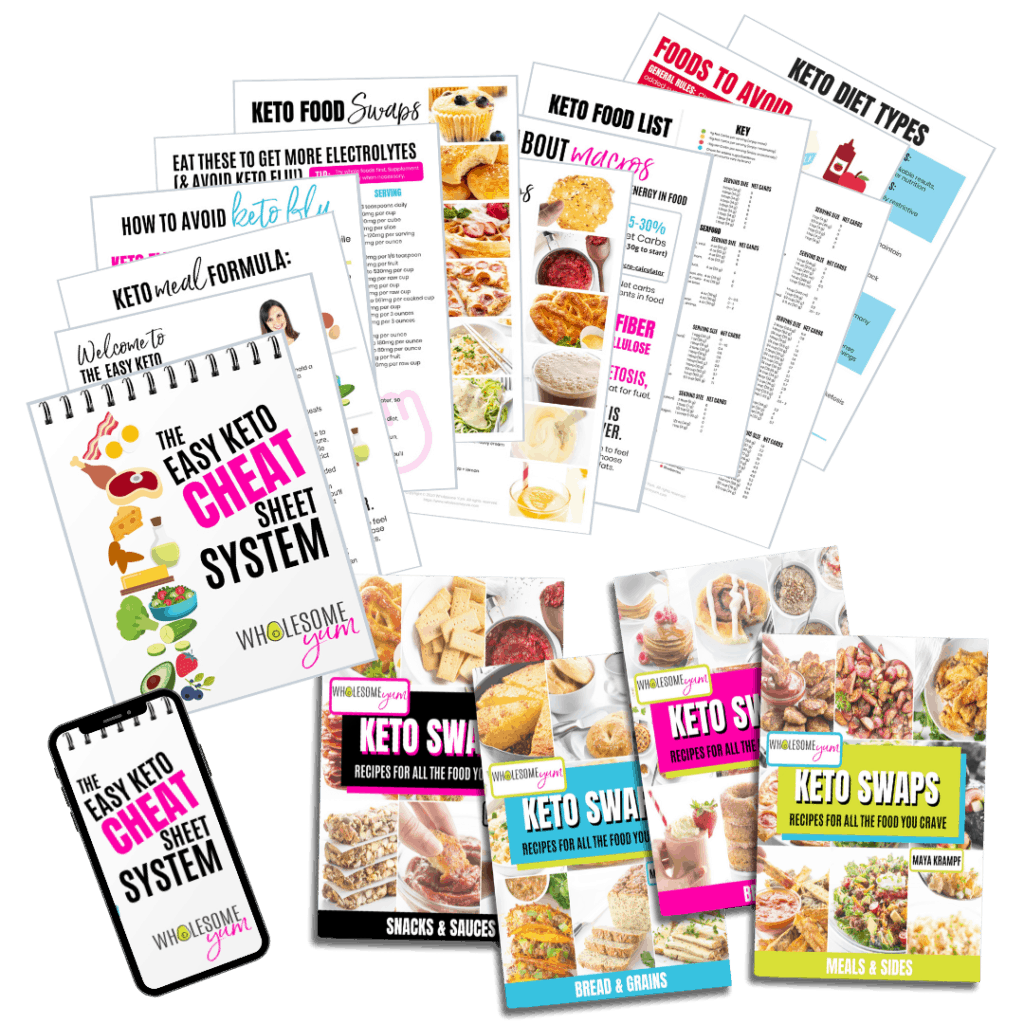
Get all this information and MORE in convenient printer-friendly format – 13 cheat sheet pages you can take with you anywhere or keep in your kitchen, plus 4 recipe cookbooks! Includes:
- Keto food list (230+ foods) – Super detailed & color-coded, with net carb counts, so you’ll know exactly what to eat.
- Foods to avoid on keto – Detailed and specific list so that you know exactly what to watch out for.
- Macros cheat sheet – Explains everything you need to know about macros to succeed on keto.
- Keto food swaps (60+ foods) – Covers virtually every food you love, so you don’t have to miss out!
- Keto meal formula – With specific food ideas, so it’s easy to mix-and-match.
- Keto flu guide – Understand what it is and exactly how to avoid it.
- Electrolyte cheat sheet – With whole food ideas + bonus keto tips.
- Keto Diet Types – Summary of 4 ways to do keto, so you can choose what fits you best.
- FOUR (4!) Keto Swaps Recipe EBooks – Dozens of recipes to replace bread, rice, potatoes, pasta, desserts, and other carbs you’d otherwise miss.
Get The Printable Keto Cheat Sheet System + EBooks (Only $37)
The Basic Keto Meal Formula
Eating keto doesn’t have to be complicated! While there are plenty of delicious easy keto recipes to choose from, you don’t even have to cook from a recipe to get started.
Simply follow the keto cheat sheet formula of protein + veggie + fat for your meals.
Be sure to choose a moderate amount of protein, only low carb vegetables (mostly ones that grow above ground), and generous fat to attain an optimal macro ratio. That’s approximately 60-75% of calories from fat, 20-25% protein, and 5-10% from carbohydrates. The table below will give you ideas for what to choose.
| Pick A Protein | Pick A Veggie | Add Fat |
|---|---|---|
| Beef Chicken Pork Eggs Lamb Turkey Fish Shellfish Protein powder Venison | Cauliflower Broccoli Zucchini Leafy Greens Cucumbers Brussels Sprouts Cabbage Asparagus Radishes Bell Peppers Jicama Celery | Butter Avocado Oil Cheese Bacon Avocado Lard Ghee Mayo Nuts MCT Oil |
Understanding Macros
Macros are macronutrients for short. They include fat, protein, and carbohydrates.
You can calculate your own macros using the macro calculator , but the macro keto cheat sheet below will explain how to look at macros when following a keto lifestyle.
Carbs Are A Limit.
Keeping carbs low is what gets you into ketosis and keeps you there. Ketosis means that you’re using fat as your primary energy source instead of sugar, and requires keeping carbs very low.
A good starting point is 20-25 grams net carbs per day, but you can experiment after a few weeks to see if your body stays in ketosis at higher levels. People who are very active may be able to do more and stay in ketosis, up to around 50 grams per day.
“Carbs are a limit” means that you set a limit for how many carbs to eat per day and don’t exceed it. You don’t have to hit that limit, so if you’re under that’s okay, just don’t go over. Ideally most of your carbs would come from low carb vegetables, and if you’re eating enough veggies, you’ll usually get close to the limit naturally.
A common misconception is that reaching ketosis requires a certain macro ratio, but it’s really only restricting your carb intake that gets you there [ * ]. In the absence of sufficient carbs to use as energy, the body will switch to using fat as fuel. This is called the metabolic state of ketosis.
Protein Is A Goal.
Protein is made up of amino acids, the building blocks of all our cells. It’s a crucial for keeping our muscles strong and for many cellular functions [ * ].
“Protein is a goal” means that you always want to eat enough protein to reach the goal each day, but not exceed it too much. You want enough for your needs, but excess protein can trigger gluconeogenesis, which is protein being converted to sugar [ * ] and can kick you out of ketosis.
Fat Is A Lever.
Fat is the primary macronutrient in a keto lifestyle, because being in ketosis means that fat is your primary fuel source. Fat as a fuel source will come from your food, and if you are losing weight, from your body.
A big advantage of a keto lifestyle is the high fat intake. It keeps you full and satisfied, making it easier to stick to, and using it as the primary fuel source makes it easier on your body to burn body fat, with a lower chance of breaking down your muscle (provided you get enough protein).
Aside from reaching your protein goal and limiting your carbs, the remainder of your calories on a keto diet comes from fat.
Don’t fear fat – it’s your main energy source on keto, and getting enough of it trains your body to use fat for fuel instead of sugar. That means that as long as you are not overdoing your overall calorie intake, you’ll efficiently burn your body fat for fuel as well.
“Fat is a lever” means that you can increase or decrease your fat intake depending on your goals and hunger levels. Increase it (along with exercise) to gain muscle, or decrease it to lose weight.
Keto Food Swaps
One of my favorite challenges is creating recipes, or just discovering, keto food swaps. These are delicious keto replacements for traditionally high-carb or high-sugar foods.
So, I created this keto diet cheat sheet with all the swaps in one place! I also have more keto food swaps in my Easy Keto Cookbook .
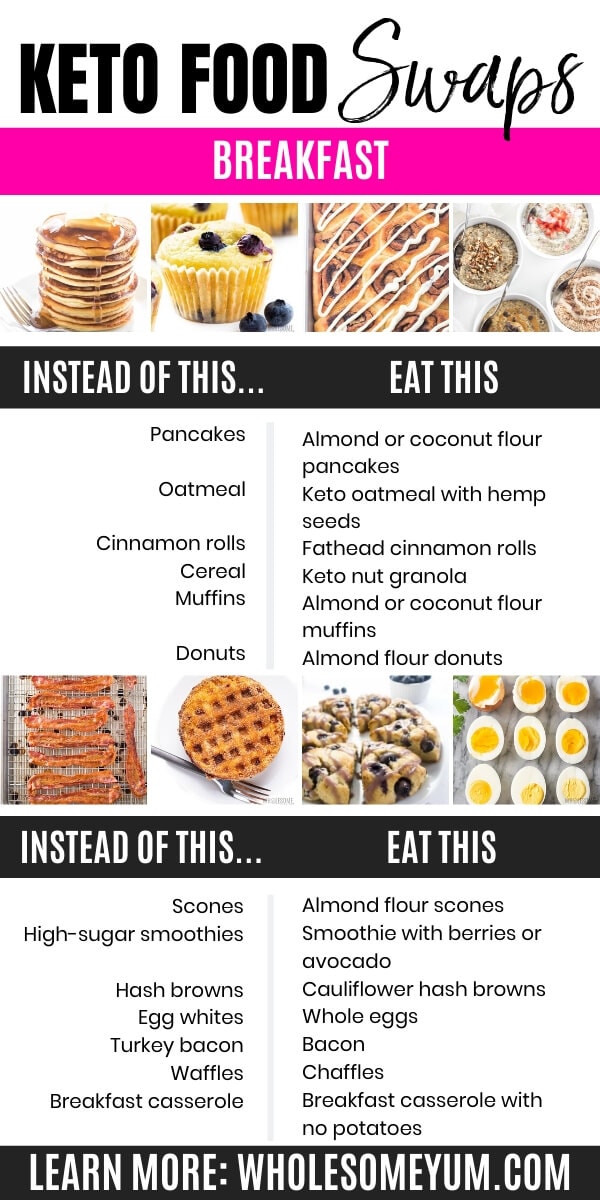
Keto Swaps For Breakfast
| Instead Of This… | Eat This |
|---|---|
| Pancakes | Almond flour pancakes or coconut flour pancakes |
| Oatmeal | Keto oatmeal with hemp seeds |
| Cinnamon rolls | Fathead cinnamon rolls |
| Cereal | Keto nut granola |
| Muffins | Almond flour muffins or coconut flour muffins |
| Donuts | Almond flour donuts |
| Scones | Almond flour scones |
| High-sugar smoothies | Smoothie with berries or avocado |
| Hash browns | Cauliflower hash browns |
| Breakfast casserole | Breakfast casserole with no potatoes |
| Egg whites | Whole eggs |
| Turkey bacon | Bacon |
| Waffles | Chaffles |
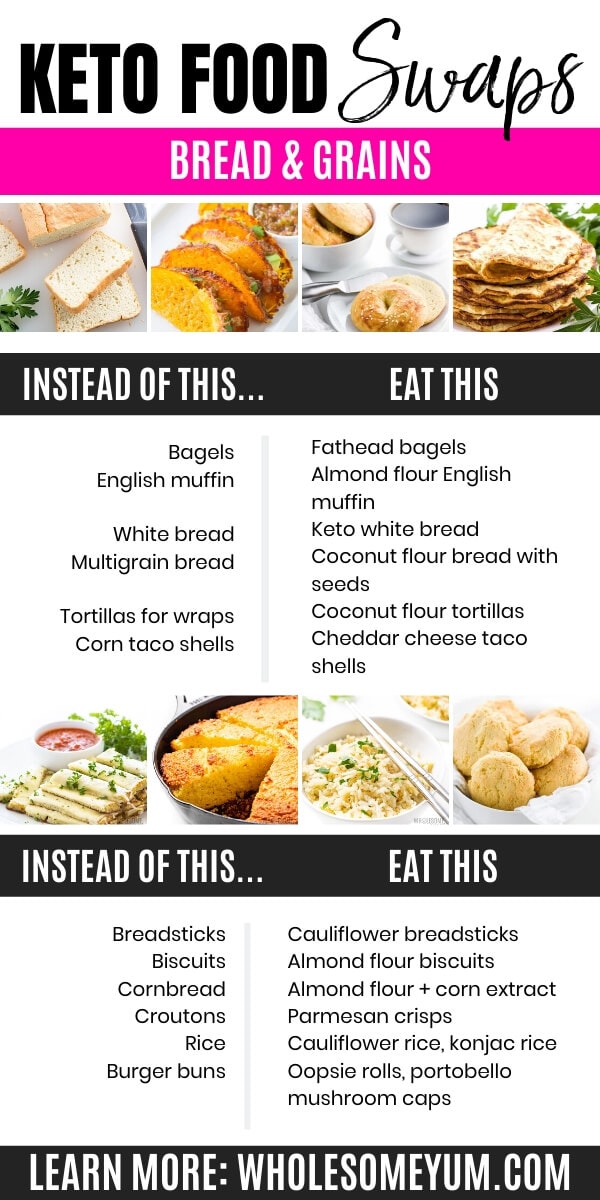
Keto Swaps For Bread
| Instead Of This… | Eat This |
|---|---|
| Bagels | Fathead bagels |
| English muffin | Almond flour English muffin |
| White bread | Keto white bread |
| Multigrain bread | Coconut flour bread with seeds |
| Tortillas for wraps | Coconut flour tortillas |
| Corn taco shells | Cheddar cheese taco shells |
| Burger buns | Oopsie rolls , portobello mushroom caps |
| Breadsticks | Cauliflower breadsticks |
| Biscuits | Almond flour biscuits |
| Cornbread | Almond flour cornbread |
| Croutons | Parmesan crisps |
| Rice | Cauliflower rice , konjac rice |
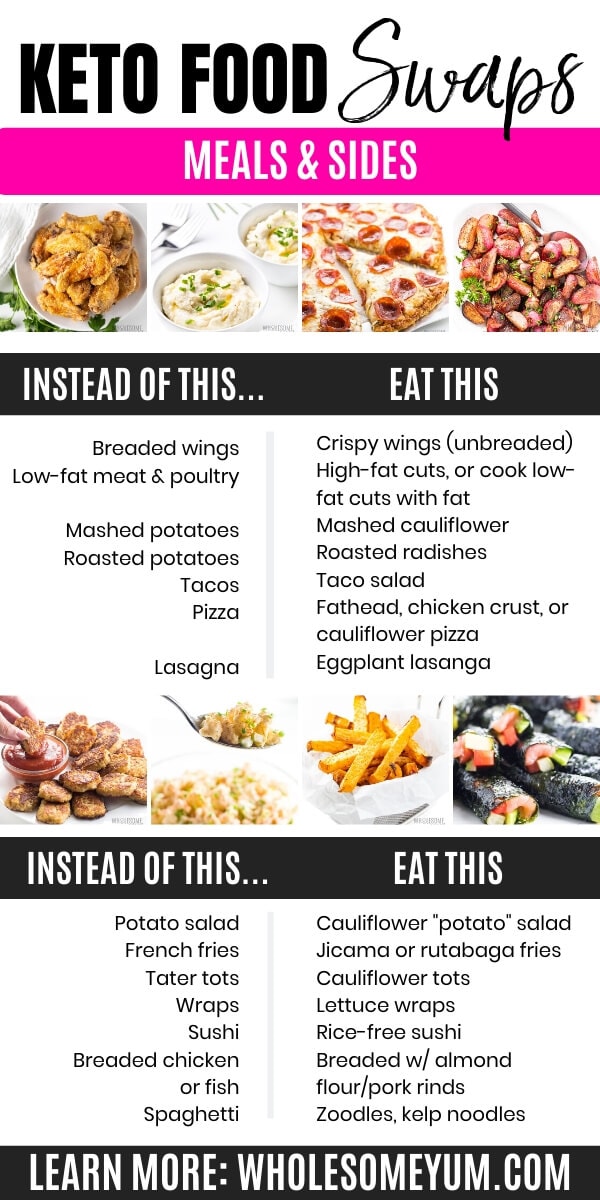
Keto Swaps For Meals & Side Dishes
| Instead Of This… | Eat This |
|---|---|
| Breaded wings | Crispy air fryer wings (unbreaded) |
| Low-fat meat & poultry | High-fat cuts, or cook low-fat cuts with fat |
| Mashed potatoes | Mashed cauliflower |
| Roasted potatoes | Roasted or fried radishes |
| Tacos | Taco salad |
| Pizza | Fathead crust , chicken crust , or cauliflower crust pizza |
| Lasagna | Eggplant lasagna |
| Potato salad | Cauliflower “potato” salad |
| French fries | Jicama , rutabaga , or zucchini fries |
| Tater tots | Cauliflower tots |
| Wraps | Lettuce wraps , almond flour tortillas |
| Sushi | Naruto-style or homemade rice-free sushi |
| Breaded chicken or fish | Breaded cuts with almond flour or pork rinds |
| Spaghetti | Zoodles , spaghetti squash , shirataki noodles, kelp noodles |
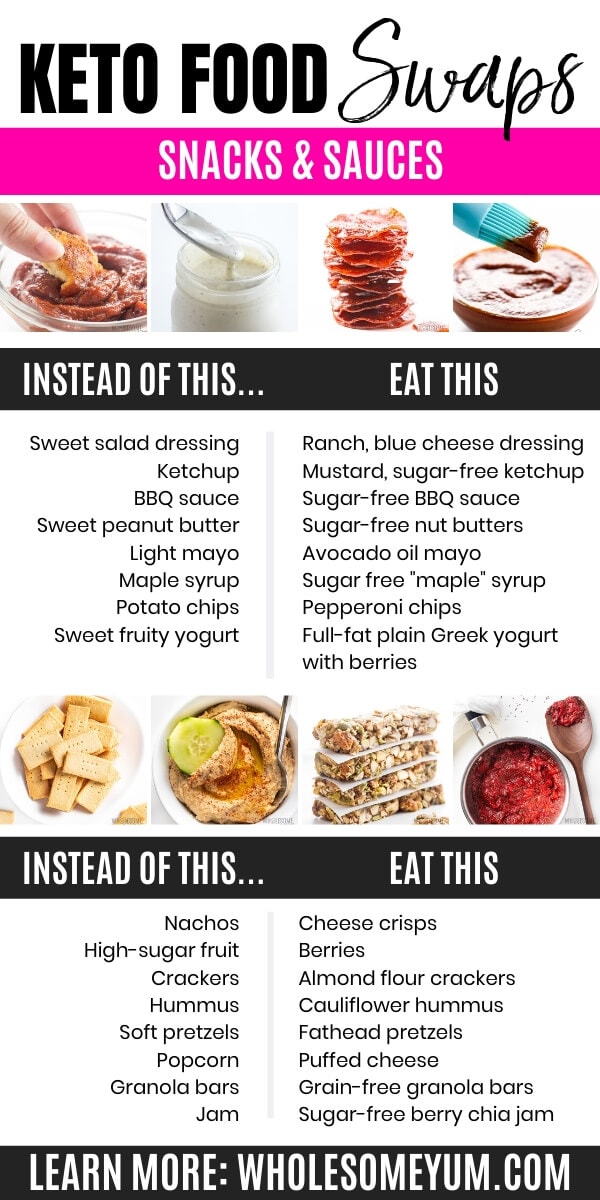
Keto Swaps For Snacks & Sauces
| Instead Of This… | Eat This |
|---|---|
| Nachos | Cheese crisps |
| High-sugar fruit | Berries & other keto fruits |
| Crackers | Almond flour crackers |
| Hummus | Cauliflower hummus |
| Soft pretzels | Fathead pretzels |
| Popcorn | Puffed cheese |
| Granola bars | Grain-free granola bars |
| Jam | Sugar-free berry chia jam |
| Sweet fruity yogurt | Full-fat plain Greek yogurt with berries |
| Sweet salad dressing | Ranch , blue cheese , or plain vinaigrette |
| Ketchup | Mustard and/or sugar-free ketchup |
| BBQ sauce | Sugar-free BBQ sauce |
| Sweetened peanut butter | Natural, sugar-free nut butters |
| Light mayo | Avocado oil mayo |
| Maple syrup | Sugar-free, maple flavored syrup |
| Potato chips | Zucchini chips , pepperoni chips , pork rinds |
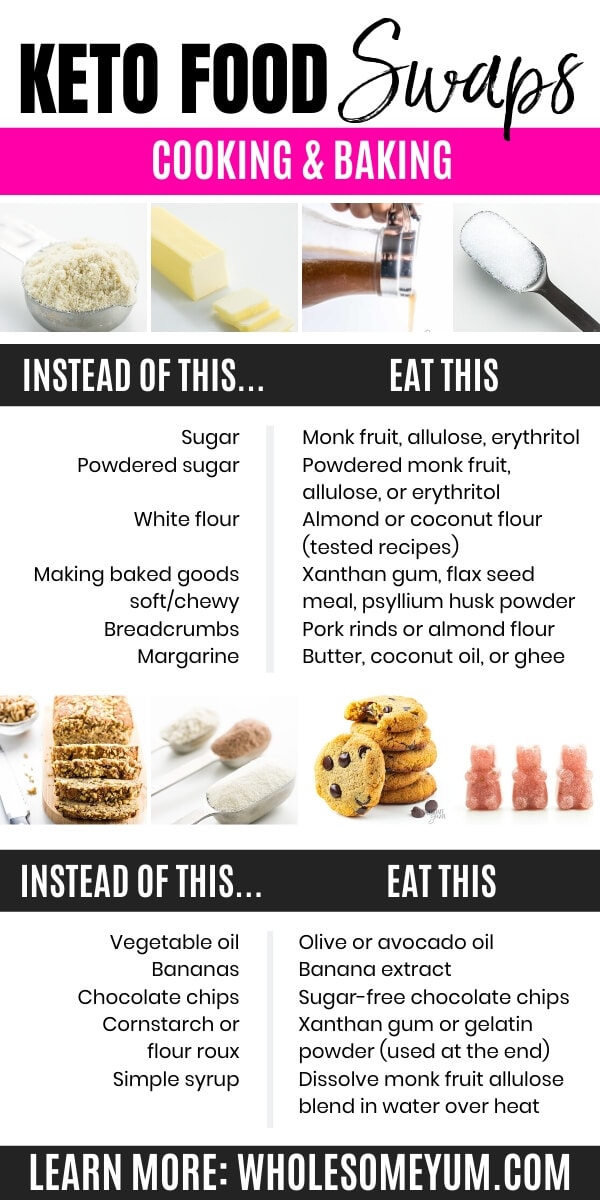
Keto Swaps For Cooking & Baking
| Instead Of This… | Eat This |
|---|---|
| Sugar | Monk fruit or allulose |
| Powdered sugar | Powdered monk fruit or allulose |
| White flour | Almond or Coconut flour (use in tested recipes) |
| Making baked goods soft/chewy | Xanthan gum, flax seed meal, psyllium husk powder |
| Breadcrumbs | Pork rinds or almond flour |
| Margarine | Butter, coconut oil, or ghee |
| Vegetable oil | Olive or avocado oil |
| Bananas | Banana extract |
| Chocolate chips | Sugar-free chocolate chips |
| Cornstarch or flour roux | Xanthan gum or gelatin powder (used at the end) |
| Simple syrup | Dissolve monk fruit allulose blend in water over heat |
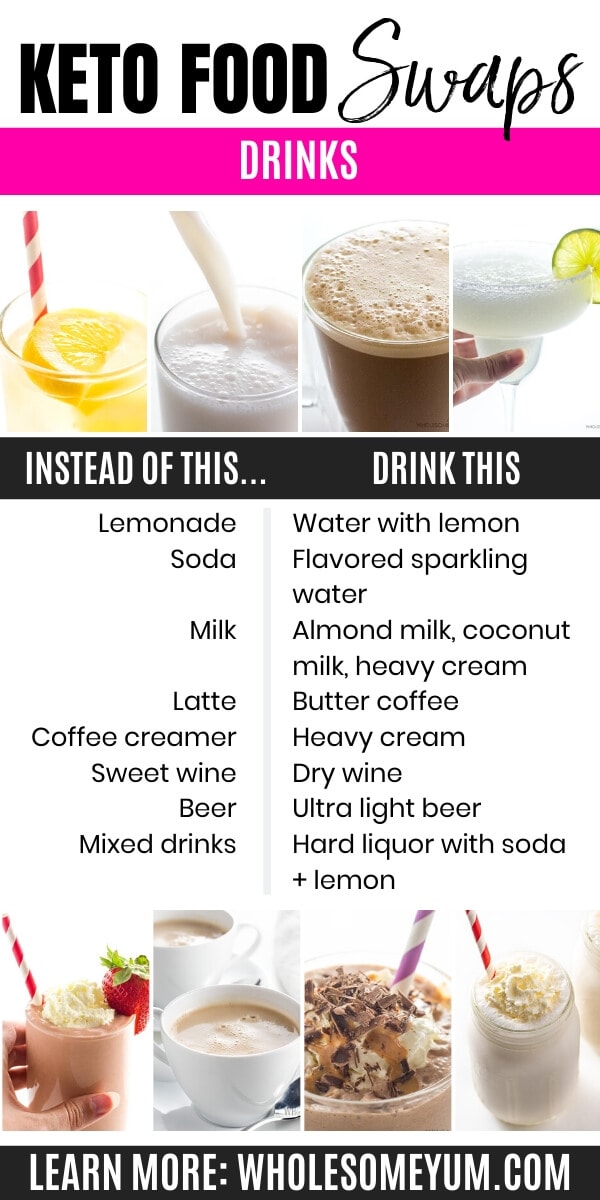
Keto Swaps For Drinks
| Instead Of This… | Eat This |
|---|---|
| Lemonade | Water with lemon |
| Soda | Flavored sparkling water |
| Milk | Almond milk, coconut milk, heavy cream |
| Latte | Butter coffee |
| Coffee creamer | Heavy cream |
| Sweet wine | Dry wine |
| Beer | Ultra light beer |
| Mixed drinks | Hard liquor with soda + lemon |
If you’re looking specifically for keto alcohol options, browse the full keto alcohol guide .
Keto Food List
When looking for a keto cheat sheet printable, the most-requested information is a keto food list.
The great thing is that keto doesn’t have to feel restrictive. It’s incredibly satisfying and there’s such a wide variety of foods you can eat!
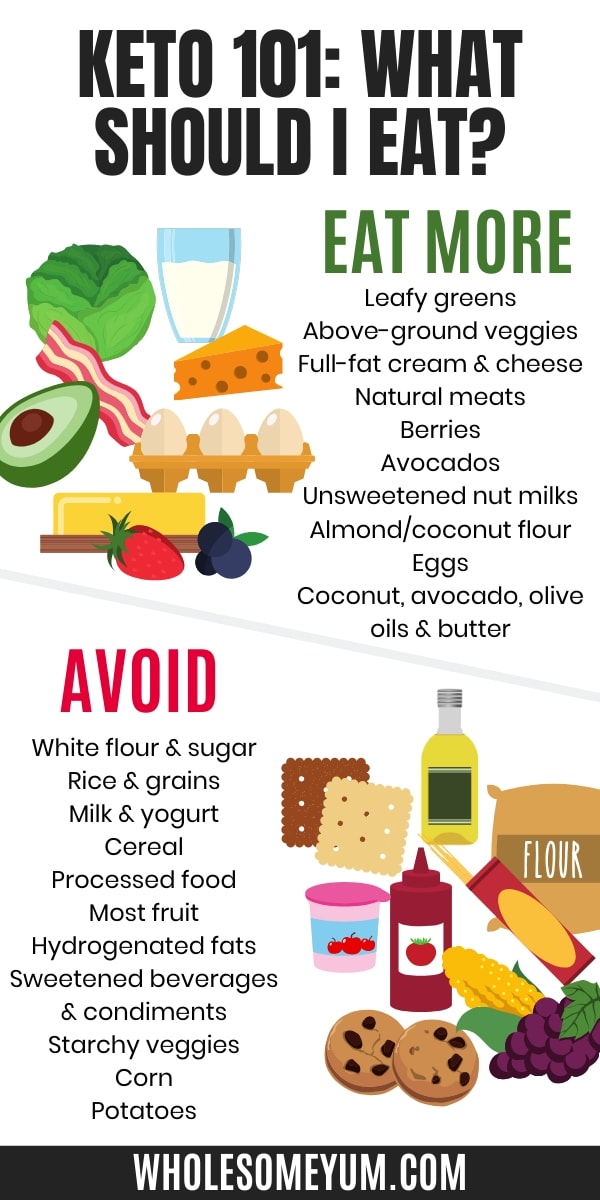
Foods To Eat On Keto
- Leafy greens – Such as spinach, chard, and lettuce.
- Above-ground veggies – Such as peppers, zucchini, and cauliflower.
- Full-fat cream & cheese – Such as heavy cream, sour cream, and full-fat hard cheeses.
- Natural meats – Such as beef, lamb, and pork.
- Berries – Such as raspberries, blackberries, and strawberries.
- Avocados
- Unsweetened nut milks – Such as almond milk and coconut milk.
- Almond flour and coconut flour
- Eggs
- Healthy fats – Such as coconut oil, avocado oil, olive oil and butter.
Foods To Avoid On Keto
- White flour & sugar
- Rice & grains – Such as barley, wheat, and corn.
- Milk & yogurt – Such as fruit on the bottom yogurt, sweetened Greek yogurt, and all milk.
- Cereal
- Processed food – Such as granola bars, candy
- Most fruit – Such as apples, bananas, and grapes
- Hydrogenated fats – Such as vegetable oil, soybean oil, and margarine
- Sweetened beverages & condiments – Such as soda, ketchup, and sweet dressings
- Starchy veggies – Such as peas, carrots, and beets.
- Potatoes – Such as sweet potatoes and white potatoes.
That’s the short keto diet cheat sheet version of all the keto food categories, but I recommend downloading the full Keto Cheat Sheet System. It includes a super detailed printable keto food list with over 100 items, including 2 color-coded pages with net carb counts, along with 6 more pages of keto cheat sheets:
Get The Keto Cheat Sheet System PDF (Only $37)
Electrolyte Basics
Getting enough electrolytes is crucial for anyone, but especially so on a keto diet. The reason is that ketosis has a diuretic effect, which increases excretion of water and electrolytes, especially sodium [ * ]. This is often the cause of the keto flu.
For more details on electrolytes and avoiding keto flu, check out the full keto flu guide here .
The important thing to know about electrolytes is that replenishing them will keep keto flu away and keep your body functioning well. I always recommend an electrolyte drink and whole food sources of anything your body needs before resorting to supplements, so I made a list of what to eat to get each of the 3 major electrolytes – sodium, magnesium and potassium.
Here’s your keto diet cheat sheet for getting electrolytes from food:
| Sodium | Magnesium | Potassium |
|---|---|---|
| Bone broth Boullion cubes Bacon Salted nuts Pickles | Seaweed Seeds Nuts Avocado Leafy greens | Potassium chloride Avocado Bone broth Spinach Broccoli Mushrooms Beef Pork |
Keto Diet Types
People follow a keto lifestyle for different reasons. Some do it just to lose weight, others are after better overall health, increased energy, and reduced inflammation.
Strictly speaking, the defining factor of a keto diet is the metabolic state of ketosis, which is achieved by restricting carbs. However, many people (myself included) also reduce or eliminate processed, inflammatory, or low-nutrient foods.
Below is your keto cheat sheet summary of the different ways that people follow keto. You choose what works best for your goals and lifestyle!
- Strict Keto – Up to 20-30g net carbs daily, count all calories and macros, and eat clean, unprocessed foods.
- Lazy Keto – Up to 20-30g net carbs daily, and track only net carbs OR eat keto foods without tracking.
- Dirty Keto – Up to 20-30g net carbs daily, with “if it fits your macros” approach including processed foods.
- Low Carb – Up to 50-100g net carbs daily, less strict.
For a more detailed listing of these different types of keto with pros and cons, grab the Easy Keto Cheat Sheet Printable PDF below!
Want The Keto Cheat Sheet Printable PDF System?
Get all this information and MORE in convenient printer-friendly format – 13 cheat sheet pages you can take with you anywhere or keep in your kitchen, plus 4 recipe cookbooks! Includes:
- Keto food list (230+ foods) – Super detailed & color-coded, with net carb counts, so you’ll know exactly what to eat.
- Foods to avoid on keto – Detailed and specific list so that you know exactly what to watch out for.
- Macros cheat sheet – Explains everything you need to know about macros to succeed on keto.
- Keto food swaps (60+ swaps) – Covers virtually every food you love, so you don’t have to miss out!
- Keto meal formula – With specific food ideas, so it’s easy to mix-and-match.
- Keto flu guide – Understand what it is and exactly how to avoid it.
- Electrolyte cheat sheet – With whole food ideas + bonus keto tips.
- Keto Diet Types – Summary of 4 ways to do keto, so you can choose what fits you best.
- FOUR (4!) Keto Swaps Recipe EBooks – Dozens of recipes to replace bread, rice, potatoes, pasta, desserts, and other carbs you’d otherwise miss.
Get The Printable Keto Cheat Sheet System (75 pages, Only $37!)
Harissa Chicken

Spice up your dinner with my easy harissa chicken! Just drench it in a bold, fiery marinade, then sear to golden, juicy perfection.
Scan this QR code with your phone’s camera for the full recipe, including tips, step-by-step photos, and storage, or to save it to your account. You can also find it at: https://www.wholesomeyum.com/harissa-chicken/


Ingredients
- 8 medium Boneless skinless chicken thighs (mine were 3.5 oz each, a little over 1.5 pounds total)
- 1/4 cup Harissa paste
- 5 tbsp Olive oil (divided into 1/4 cup and 1 tbsp)
- 2 tbsp Lemon juice (from 1 lemon; plus extra wedges for garnish)
- 4 cloves Garlic (minced)
- 1 tsp Coriander
- 1 tsp Cumin
- 1 tsp Paprika
- 1 tsp Sea salt
- ½ tsp Black pepper
- Fresh cilantro (optional, for garnish)
Instructions
- Pat the chicken thighs dry with a paper towel.
- In a small bowl, stir together the harissa paste, 1/4 cup of the olive oil, lemon juice, minced garlic, coriander, cumin, paprika, sea salt, and black pepper.
- Add the chicken thighs to a large zip lock bag and pour the marinade over them. Marinate in the fridge for at least 1 hour , or up to 24 hours for juicier results.
- Heat the remaining 1 tablespoon of olive oil in a large cast iron skillet over medium-high heat. Add the chicken thighs in a single layer (you may have to cook in 2 batches if they don’t fit in your pan). Cook for 5-7 minutes per side, or until the chicken reaches an internal temperature of 170 degrees F (77 degrees C). Reduce heat if the chicken is browned but not yet cooked through, and continue cooking until it reaches the right temperature.
- Remove the harissa chicken from the pan to prevent overcooking, and let it rest for 5 minutes to let the juices settle. Serve with lemon wedges and fresh cilantro if you like.
Maya’s Recipe Notes
Serving size: 2 chicken thighs
- Tips & variations: See the details in the post above! I’ve got tips to help you make your harissa chicken super juicy, how to adjust the spice level, and variations for a hint of sweetness, extra harissa sauce on the side, or cooking on the grill.
- Store: 3-4 days in the fridge.
- Meal prep: Marinate the chicken the day before, or cook the chicken and portion in meal prep containers.
- Freeze: Up to 3 months in the freezer.
Nutrition info uses half the marinade, as about half is discarded. The optional cilantro is not included, but doesn’t change it very much.
I provide nutrition facts as a courtesy. Have questions about calculations or why you got a different result? Please see my nutrition policy .
© Copyright Maya Krampf for Wholesome Yum. Please DO NOT SCREENSHOT OR COPY/PASTE recipes to social media or websites. We’d LOVE for you to share a link with photo instead. :)
