Free Printable: Low Carb & Keto Food List
- What Is A Low Carb Diet Plan?
- What Is The Keto Diet?
- Keto Diet Rules: How To Start Keto
- Get The Printable Keto Cheat Sheet System
- Understanding & Counting Macros
- What To Eat On A Keto Diet
- Low Carb & Keto Recipes
- Keto Meal Plans
- Keto Diet Benefits
- Keto Diet Side Effects
- Common Questions
- Conclusion: Is The Keto Diet For You?
- Recipe Reviews
Welcome to the ultimate guide to the keto diet plan, a form of low carb diet. If you are new to Wholesome Yum, or just starting out with this lifestyle, you’ve come to the right place. This guide will show you everything you need to know about how to start a keto diet , including keto diet basics, how to understand and calculate macros, what foods to eat, recipes to make, how to avoid side effects, and more. Be sure to check out all the keto diet recipes and the keto diet app , too!
JOIN THE EASY KETO CHALLENGE!
Join 300,000+ others to get this free guide to kickstart keto (everything you need to know, broken up into 10 doable days!) and get support.
What Is A Low Carb Diet Plan?
A low carb diet plan is a way of eating that is high in fat, moderate in protein and low in carbohydrates. It ends the rollercoaster of blood sugar spikes and crashes, allowing the body to burn fat.
There are different variations of low carbohydrate diets. The keto diet plan is a special type of low carb diet, with added characteristics. Optimal carb intake will vary depending on your insulin tolerance and activity level, but on average, these are the common numbers of carbs:
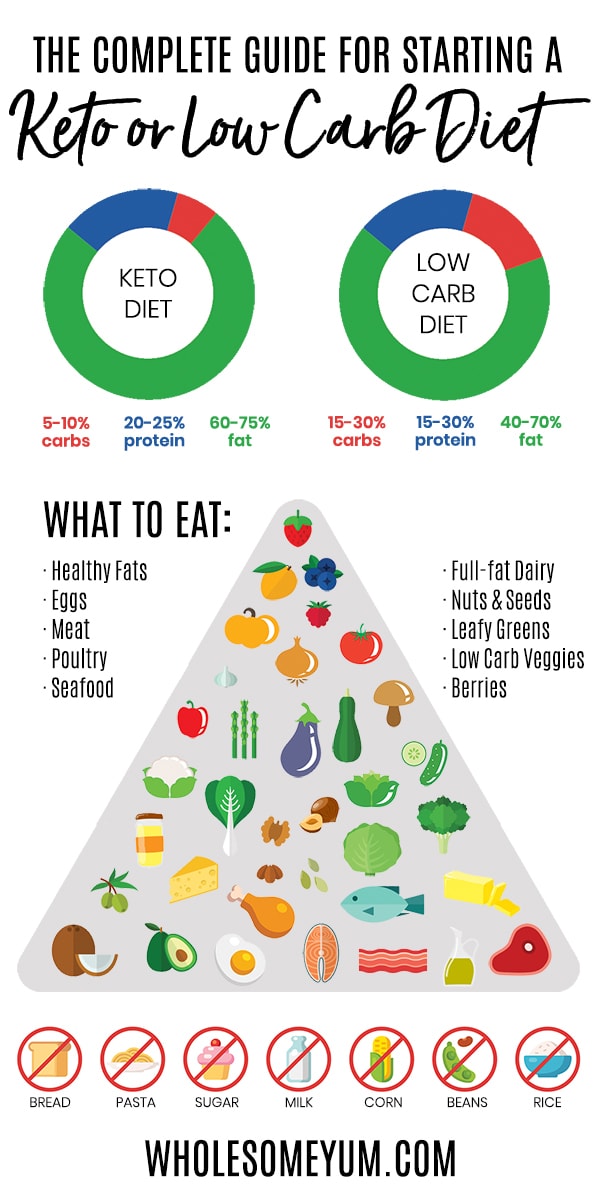
- Keto diet – Under 20g net carbs per day (sometimes under 25g or 30g works)
- Low carb diet – Under 50g net carbs per day
- Moderate low carb diet – Under 100g net carbs per day
Some people opt to count carbs diligently and some choose to simply focus on eat low carb or keto foods. For comparison, according to the Dietary Guidelines For Americans , a Standard American diet contains between 225 and 325 grams of carbohydrates per day.
What Is The Keto Diet?
The ketogenic diet, or keto diet plan, is a specific type of low carb diet that is focused on a specific ratio of macronutrients (or macros for short — these include fat, protein, and carbohydrates), with a goal of reaching a state called ketosis .
There are different ways to follow this diet, including clean keto (focusing on whole foods and nutrients), dirty keto, and lazy keto , among others, but ketosis is the goal with all of them. The keto diet basics below apply to all of them, as well.
What Is Ketosis?
Ketosis is a metabolic state in which the body burns fat for fuel instead of carbs. It’s very effective for weight loss, energy, and mental clarity [ * , * , * , * ]. The body enters a ketogenic state when carbs are restricted for extended periods, through a low carb diet, fasting [ * ], or starvation [ * ].
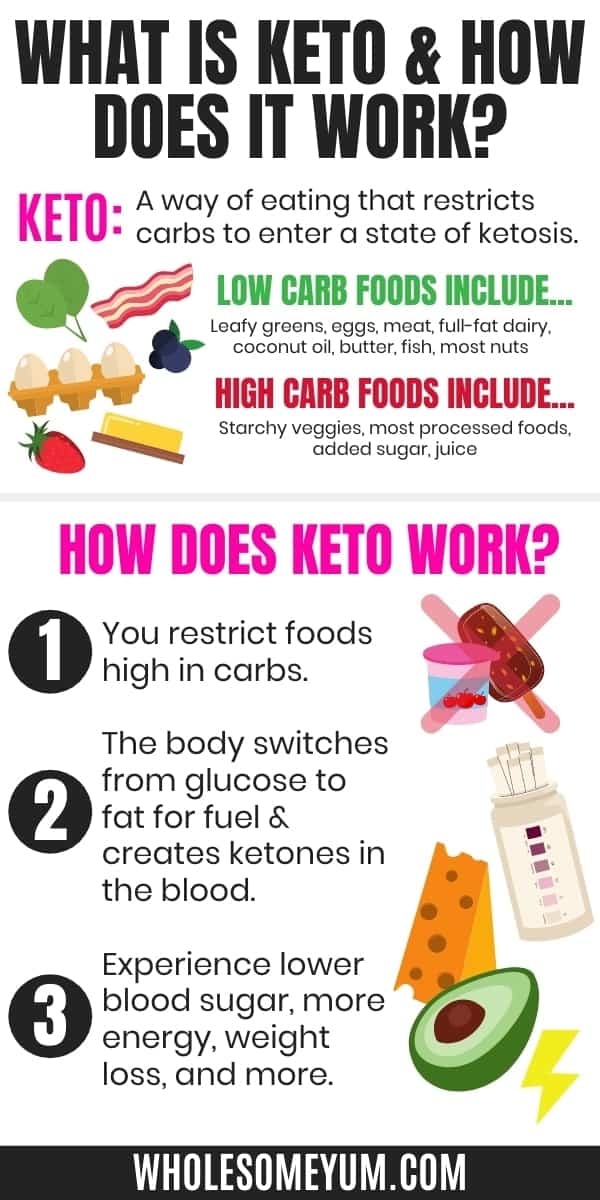
How Does The Keto Diet Work?
Unlike a low carb diet, ketosis is the primary goal of the keto diet plan. We achieve it by severely limiting carbohydrate intake, not necessarily calories, though calories are often restricted as a byproduct.
The core of how the keto diet works boils down to two things:
- In the absence of carbohydrates, the body switches to burning fat for fuel instead of glucose. When carbs are restricted and your body runs out of glucose, your body turns to fat in food and fat stores for fuel instead. Your livers breaks down the fat into ketones, small energy molecules that your body can use for energy [ * ].
- A ketogenic diet keeps insulin levels low. Insulin is a signal for your body to hold onto its fat stores, so low levels help your body access its fat stores for energy [ * ]. This regulates your blood sugar levels as well.
Signs of ketosis include increased energy and focus, decreased appetite, and changes in smell of breath or urine. You can test yourself for ketosis using ketone test strips (use code WY20 for 20% off!). A blood monitor is the most accurate, but not usually necessary if you follow the keto diet rules.
Keto Diet Rules: How To Start Keto
If you want to start a keto diet or low carb diet plan, it can be intimidating. I get it! I’ve been doing this for almost a decade (and it goes to show this is a sustainable lifestyle!), but it wasn’t always easy. We all have to start somewhere. Just start — you got this!
Whether you’re looking for how to start a keto diet or a low carb diet, there are lots of similarities. Let’s make it as easy as possible…
Easy Steps For Starting A Keto Diet
The main point to remember when starting a keto diet is this:
RULE #1: Restrict Carbohydrates. This is the most crucial part! Restrict to less than 20g or 25g net carbs per day for a keto diet plan (some people can get away with under 30g). For a low carb diet, aim for under 50g net carbs per day. Some variations limit to somewhere between 50-100g per day, particularly if you are more active.
Stay below your carb limit and you’re most of the way there! But to ensure your success, here are some additional tips for getting started on a keto diet — and the same applies for a low carb diet as well:
- Limit protein intake. Contrary to popular belief, keto diets and low carb diets are not high protein diets! Low carb is generally higher in protein than keto, but be careful with both. High protein diets can stress the kidneys, and besides, excess protein converts to glucose. Make your protein intake a goal to meet each day, but more than that is not better.
- Use fat as a lever. We’ve been taught to fear fat, but don’t! Both keto and low carb are forms of a high-fat diet. Fat is our source of energy as well as satiety. The key to understand, though, is that fat is a lever on a low carb or keto diet. Carbs and protein stay constant, and fat is the one you increase or decrease (push the lever up or down) to gain or lose weight, respectively. So if your goal is weight loss, eat enough fat to be satisfied, but there’s no need to “get your fats in” once you’re satisfied.
- Drink lots of water. This is especially crucial on a low carb or keto diet. Why? When you eat carbs, your body stores the extra as glycogen in the liver, where they are bound to water molecules. Eating low carb depletes this glycogen, which allows you to burn fat. But it also means you are storing less water, making it easier to get dehydrated. Instead of the traditional recommendation of 8 cups of water per day, aim for 16 cups when following a low carb lifestyle.
- Keep up electrolytes. The major electrolytes in our bodies are sodium, potassium and magnesium. It’s crucial to get enough of these so that you don’t experience these side effects — they are temporary, but avoidable. Read more about side effects and their remedies below.
- Eat only when you are hungry. Get out of the mindset that you need to eat 4-6 meals per day or constantly snack. Eating too frequently on a keto or low carb diet is not necessary, and can affect weight loss. Eat when you’re hungry, but if you aren’t, don’t. Eating fewer carbs will make this much easier, as this naturally suppresses appetite.
- Focus on whole foods. Although eating natural or whole foods is technically not 100% required to restrict carbohydrates, eating processed foods will not help you get rid of cravings or be good for your body. Check the section below for more on what low carb foods are best.
- Exercise. This is not required for a low carb diet, but recommended. You’ll feel better, improve your health, and if your goal is weight loss, it will happen faster!
Keto Diet Tips For Beginners
The steps above are the most important, but to set yourself up for success, read over these keto diet tips for beginners , too.
Get The Printable Keto Cheat Sheet System
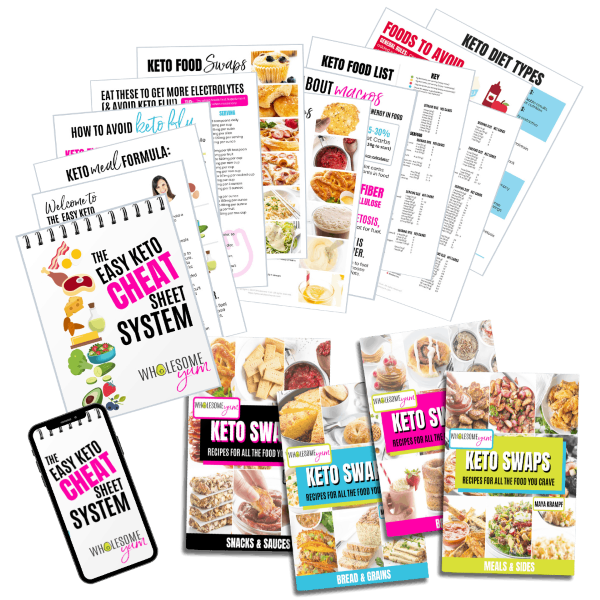
Get all this information and MORE in convenient printer-friendly format - 13 cheat sheet pages you can take with you anywhere or keep in your kitchen, plus 4 recipe cookbooks! Includes:
- Keto food list (230+ foods) - Super detailed & color-coded, with net carb counts, so you’ll know exactly what to eat.
- Foods to avoid on keto - Detailed and specific list so that you know exactly what to watch out for.
- Macros cheat sheet - Explains everything you need to know about macros to succeed on keto.
- Keto food swaps (60+ foods) - Covers virtually every food you love, so you don’t have to miss out!
- Keto meal formula - With specific food ideas, so it’s easy to mix-and-match.
- Keto flu guide - Understand what it is and exactly how to avoid it.
- Electrolyte cheat sheet - With whole food ideas + bonus keto tips.
- Keto Diet Types - Summary of 4 ways to do keto, so you can choose what fits you best.
- FOUR (4!) Keto Swaps Recipe EBooks - Dozens of recipes to replace bread, rice, potatoes, pasta, desserts, and other carbs you’d otherwise miss.
Get The Printable Keto Cheat Sheet System + 4 EBooks (Only $37)
Understanding & Counting Macros
What are macros? Simply put, “macros” is a shortened name for macronutrients, which provide energy and come in the form of fat, protein, and carbohydrates.
All three play a role in a successful keto diet plan:
- Fat – Fat acts as the primary fuel source on a keto diet, unlike a standard diet where carbohydrates are the main source. Your are in ketosis when your body has made the metabolic switch to using fat for most of its energy. In addition, it keeps you satisfied. Just keep in mind that you burn the fat from your food before burning body fat, so use fat as a lever to lose weight, maintain, or gain muscle depending on your goals. Aside from energy, fat plays an important role in metabolism, immune function, reproduction, and absorption of vitamins [ * ].
- Protein – Proteins are made up of amino acids, which are commonly referred to as the building blocks in our bodies. Proteins are crucial for the structure, function, and regulation of tissues and organs, including antibodies, enzymes, messengers, structural support for cells, transport, and muscle preservation [ * ]. On a ketogenic diet, you want to get enough protein to support all these functions. However, if you get too much protein, the excess will be converted into glucose by the body — this process is called gluconeogenesis and we want to keep it to a minimum.
- Carbohydrates – Carbs are the most crucial piece of the puzzle. In fact, restricting carbohydrate intake is technically the only thing necessary to enter a state of ketosis. While it’s commonly cited that the brain needs glucose to function, the brain is able to get most of its needed energy from ketones and the liver can make up the rest via gluconeogenesis [ * , * ]. When we talk about low carbohydrate intake on a keto diet, we usually refer to net carbs, explained below.
As a general guideline, below are the recommended macro percentages to aim for. These are the percentages of your total calorie intake that would be from fat, protein, and carbs.
Macros For A Low Carb Diet Plan:
- Fat: 40% to 70%
- Protein: 15 to 30%
- Net Carbs: 15% to 30%
Macros For A Keto Diet Plan:
- Fat: 60% to 75%
- Protein: 20% to 25%
- Net Carbs: 5% to 10%
What Are Net Carbs?
Net carbs are the carbohydrates that your body is able to digest and break down into glucose for energy.
Should You Count Total Carbs Or Net Carbs?
Some people following a ketogenic diet choose to count total carbs instead of net carbs. Some of the reasoning is that technically, soluble fiber is partially digestible, but not usually differentiated from insoluble fiber on labels. Also, some people find that their body does digest a small amount of the carbs from sweeteners, so they feel better counting them.
Unfortunately, counting total carbs makes it more difficult to fit in enough leafy greens and keto vegetables in your low carb diet. These are packed with fiber and beneficial nutrients, so you should only try that if you don’t get results with a net carb method. Also, start with reducing sweeteners and low carb treats before deciding to limit your grams of carbs to only total carbs.
Do You Have To Count Macros?
When you start a ketogenic diet plan, it’s recommended that you count macros at least in the beginning. That way, you’ll get a sense of what and how much you should be eating. However, some people have success simply sticking to low carb foods and not counting anything, while others only count net carbs, but don’t count fat and protein (this method is called lazy keto ).
How To Calculate Your Macros
If you really want to be sure that you are eating the right amounts, you need a low carb or keto macro calculator. Most calculators work for just one or the other, but the Wholesome Yum macro calculator will do it for each diet type. It will tailor the results to your body and your goals:
Calculate Your Macros Here!
What To Eat On A Keto Diet
One of the most common questions I get is, “what to eat on a keto diet?” or “what to eat on a low carb diet?” Fortunately, with the right resources, this is one of the easiest questions to answer.
In fact, the keto diet plan is probably the most flexible, sustainable eating lifestyle out there. You don’t have to feel deprived, bored or restricted. And, it doesn’t need to be complicated.
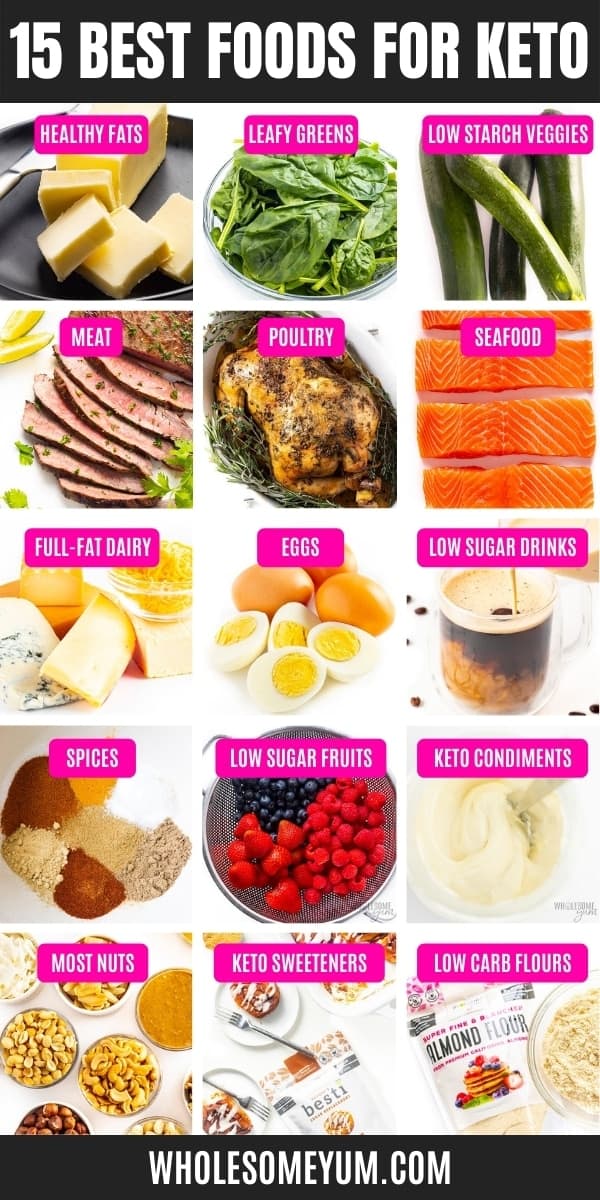
The Best Foods for a Keto Diet
This simple list summarizes what to eat on a low carb diet. And, what to eat on a keto diet is basically the same:
- Healthy fats like avocado oil, olive oil, butter, and coconut oil
- Leafy greens like lettuce, spinach, and kale
- Non-starchy vegetables that grow above ground, like zucchini, cauliflower, peppers, broccoli, asparagus, celery, and many others. Some vegetables that grow below ground, such as onions, are also okay. Get the full keto vegetables list !
- Meat like beef , pork, and lamb
- Poultry like chicken , turkey, and duck
- Seafood like salmon and other fish, shrimp, crab, and lobster
- Full-fat dairy like cheese, cream cheese, and heavy cream. Get the full keto cheese list !
- Eggs
- Sugar-free beverages like water, coffee and tea
- Herbs & spices like basil, dill and cinnamon
- Low carb condiments like mayonnaise , hot sauce and mustard
You can also enjoy these on a low carb keto diet in moderation:
- Low carb fruit like avocados (the fruit exception that doesn’t need to be in moderation), berries (all kinds!), and coconuts. Get the full keto fruit list !
- Nuts & seeds like almonds, macadamia nuts, walnuts, chia seeds, and sunflower seeds. Get the full keto nuts list !
- Sugar-free sweeteners like allulose, erythritol, monk fruit and stevia. Start with this keto sweetener – it’s natural, acts like sugar, and has the best taste of them all.
- Low carb flours like almond flour , coconut flour , and psyllium husk powder
The main difference between low carb and keto is the macronutrient profile, but the types of foods you eat are mostly the same.
These are the keto diet basics, and it’s best to start simple — meat, eggs, fats, and veggies primarily. Once you have it down, you can experiment with extras like low carb keto desserts or more advanced recipes, but it’s not necessary.
Foods to Avoid on a Low Carb Diet
Avoiding carbohydrates is probably the biggest adjustments for people starting a keto diet or low carb diet. Many of us were used to consuming carbs at every meal. Below is a list of foods to avoid:
- Grains – including wheat, bread, pasta, rice, oats, cereal, corn, etc.
- Sugar – including table sugar, candy, pastries, cakes, ice cream, chocolate, soda, juice, honey, maple syrup, etc.
- Starchy vegetables – including potatoes, sweet potatoes, parsnips, etc.
- Legumes – including beans, lentils, chickpeas, etc. (Peanuts are an exception in moderation.)
- High-sugar fruits – including bananas, pineapple, oranges, apples, grapes, etc.
- Low-fat dairy & milk – including all cow’s milk (except heavy cream is fine), low-fat cheese, etc.
- Seed & vegetable oils – especially margarine, canola oil, corn oil, grapeseed oil and soybean oil
- Processed “low carb” foods – this depends on ingredients, so read labels for hidden sugar, starch, and artificial ingredients
Get these out of your house if you can! If you have family members that are not on board, at least store these in a separate area from other foods to reduce temptation.
Also, always, always check labels for any food that has one. Avoid anything that has added sugar or starch as an ingredient, watching for different names like dextrose, maltodextrin, maple syrup, honey, corn syrup, cornstarch, potato flakes, etc. Sometimes you’ll be surprised where you might find added sugars.
Low Carb & Keto Diet Grocery List
The list above should give you an idea of the best and worst foods for a low carb diet. But if you’re starting out, it’s a good idea to know exactly what is included:
- Start with the complete low carb & keto food list – it has over 230 foods on it! It includes all the keto diet basics that you can and can’t eat, including carb counts. If you prefer to start with a shorter, less overwheming list, grab the keto grocery list for 1-2 trips to the store.
- Get discounts on keto products here – exclusive for Wholesome Yum readers!
- Check out the keto sweetener guide to help you choose the best ones and convert from one sweetener to another. You may or may not want to start with sweeteners right away, but it’s there when you’re ready.
- Buy keto ingredients here , including sweeteners, flours, syrups, baking mixes, and more.
Low Carb & Keto Recipes
If you are looking for low carb recipes or keto diet recipes, you’ve come to the right place! Every single recipe on Wholesome Yum is low carb and appropriate for the ketogenic diet.
Each recipe has 10 ingredients or less. I’m on a mission to show you that keto friendly recipes don’t have to be difficult, time consuming, or taste like “diet food”. I love sharing just how delicious and easy keto can be!
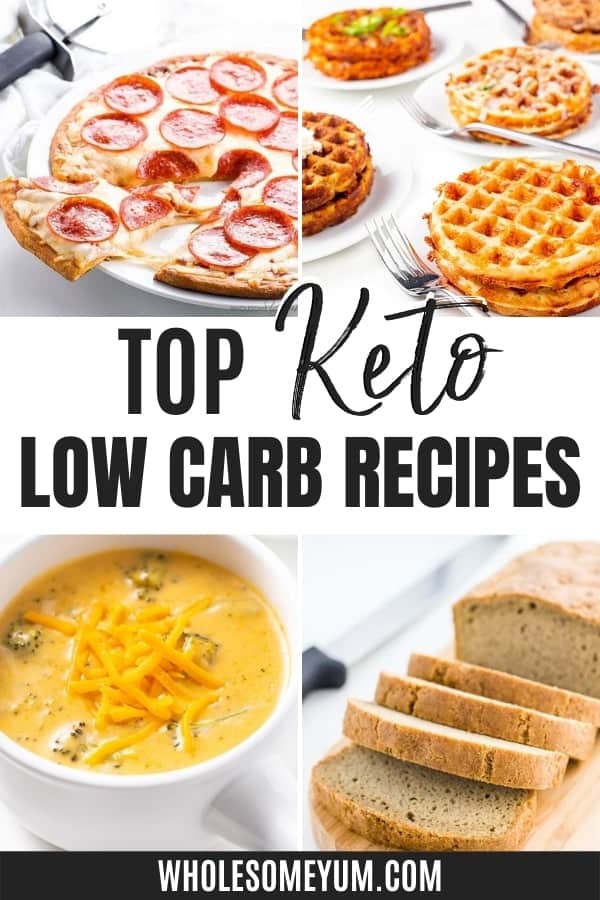
To get you started, here are a few of the most popular low carb keto recipes:
- Keto Pizza
- Healthy Taco Salad
- Keto Chaffles
- Low Carb Bread
Another good place to start is with my library of keto dinner recipes , so you can start preparing ketogenic meals. The entire recipe index is at the button below.
Browse Keto Recipes Index
Keto Meal Plans
There are several excellent places where you can get a ketogenic meal plan:
- The Wholesome Yum App provides custom weekly keto meal plans that you can adjust to your preferences, builds an automatic grocery list for you, offers nearly 1,000 recipes, and has an easy macro tracker. Available on iPhone or Android .
- A FREE 7-Day Keto Meal Plan For Beginners is available right on my website. The recipes are simple keto diet basics that anyone can make.
- The Egg Fast Diet is a short-term ketogenic meal plan designed to break through a plateau on a keto diet.
- The Easy Keto Cookbook includes a sample week meal plan, plus 100 recipes for delicious ketogenic meals.
Get The Wholesome Yum App!
Make keto easy with customized keto meal plans, automatic macro tracking, auto generated grocery list, delicious low carb recipes, and more.
Get The Wholesome Yum App
Keto Diet Benefits
Following a ketogenic diet can have numerous benefits, including:
- Weight loss – Research shows that keto diets are more effective than low fat diets for long-term weight loss [ * , * , * ].
- Stable mood & energy levels – Reducing dietary carbohydrates is linked to better cognitive function [ * , * ] and possible reductions in depression and anxiety [ * ].
- Blood sugar control – Limiting carbs is shown to improve insulin sensitivity [ * ].
- Reduced cravings & appetite – Keto may positively affect your body’s hormones that signal hunger [ * ], and signal appetite suppression in the brain [ * ].
- Lower blood pressure – Some studies suggest that a low carb diet can be more effective at lowering blood pressure for obese patients than medication [ * ].
- Higher good cholesterol – In some studies, subjects following a keto diet experienced increases in HDL cholesterol levels [ * ].
- Skin improvements – Research suggests that keto can help improve skin conditions like acne, though more studies are needed [ * ].
- Digestive support – Some studies link keto with healthy gut bacteria [ * ].
- Possibly increased lifespan – Recent rodent studies show that a low carbohydrate diet improved longevity [ * ].
- Preservation of muscle mass – Loss of muscle is a common issue when losing weight, but a very low carbohydrate diet is more effective at preserving muscle mass compared to conventional diets [ * ].
Keto Diet Side Effects
Because a low carb diet (especially a keto diet plan!) reduces the amount of water you store, this can flush out electrolytes and make you feel sick — this is called the “keto flu”. These side effects of keto are temporary while you are adjusting to a ketogenic diet, but unpleasant. They can include headache, dizziness, fatigue, restlessness, brain fog, lack of motivation, nausea, insomnia, impaired coordination, sensitivity to heat, sugar cravings, muscle soreness or weakness, and stomach issues.
Fortunately, you can avoid or eliminate these side effects by salting your food liberally, drinking broth (especially bone broth ), drinking my homemade electrolyte drink , and eating pickled vegetables. These keto diet basics are just as important as restricting carbs. Some people also choose to take supplements for electrolytes, but it’s best to first consult a doctor.
Check the complete guide to keto flu symptoms and remedies here so that you can avoid it!
Common Questions
- Is the keto diet healthy? If your keto diet is unbalanced, you may end up with deficiencies in electrolytes, B vitamins, iodine, iron, or other nutrients. However, a balanced keto diet with a focus on whole foods and healthy fats is a great, healthy choice.
- Is the keto diet safe? A keto diet is perfectly safe to try for generally healthy individuals. However, if you have any underlying health conditions, you should consult with a doctor before trying any new way of eating.
- Is the keto diet good for diabetics? Those with diabetes can benefit from a keto diet because it improves blood sugar and A1C levels [ * ]. However, it’s still important to work with a doctor when considering diet changes.
- How long does it take to enter ketosis? It usually takes about 3 days after starting a ketogenic diet to enter ketosis. However, it takes 3-4 weeks before you are “fat adapted” and burn fat efficiently. This is because the body takes a few days to burn through all the glycogen in your liver (your body stores extra glucose there and this gets depleted before you start producing ketones), and afterward, it takes some time for your body to adjust to using primarily fat for fuel.
- How to get enough fat on a keto diet? Eat foods naturally high in fat, such as eggs and fatty cuts of meat, or add dietary fats like grass fed butter and MCT oil to meals. You can also snack on fat bombs for a high-fat boost!
Conclusion: Is The Keto Diet For You?
The keto diet plan can be beneficial, enjoyable, and surprisingly easy to follow! But as always, always check with your doctor (preferably one that understands and supports a ketogenic lifestyle) before making a drastic change, especially if you take any medication. If you have the green light, use this guide for all the keto diet basics you need to get started.
How To Start A Keto Diet
Free Printable: Low Carb & Keto Food List
- Want The Keto Cheat Sheet Printable PDF System?
- The Basic Keto Meal Formula
- Understanding Macros
- Keto Food Swaps
- Keto Food List
- Electrolyte Basics
- Keto Diet Types
- Want The Keto Cheat Sheet Printable PDF System?
- Recipe Reviews
Even though I have a great guide to starting a keto diet , people often ask me for a quick keto cheat sheet they can use. That’s why I created this simple keto diet cheat sheet , so that you can have all the info you need handy. We’ll cover the basic keto formula for building meals, foods to eat and to avoid, delicious keto swaps for high-carb foods, electrolyte basics, and 4 ways to follow the keto lifestyle.
You can keep reading to view this info, or download my keto cheat sheet printable pdf to print out or save ad-free on any device (plus the pdf has more details!).
Want The Keto Cheat Sheet Printable PDF System?
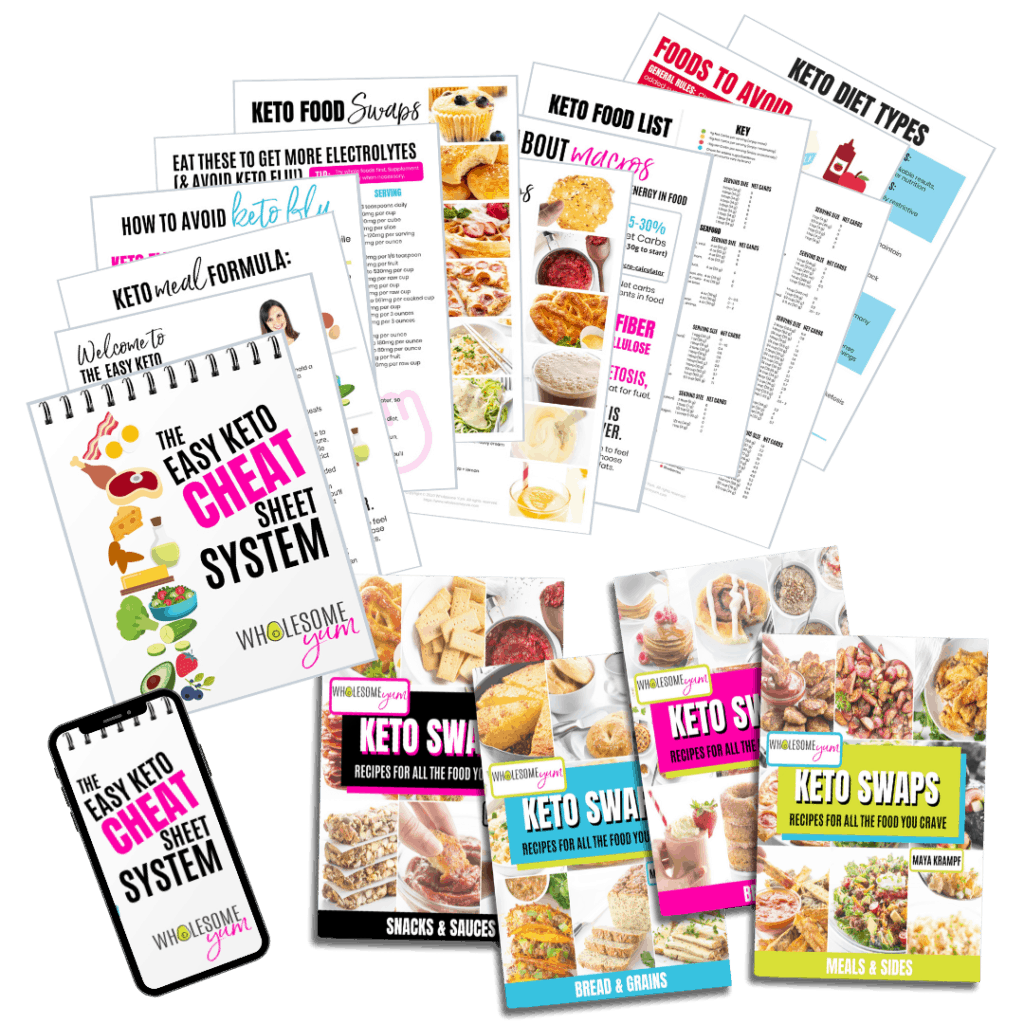
Get all this information and MORE in convenient printer-friendly format – 13 cheat sheet pages you can take with you anywhere or keep in your kitchen, plus 4 recipe cookbooks! Includes:
- Keto food list (230+ foods) – Super detailed & color-coded, with net carb counts, so you’ll know exactly what to eat.
- Foods to avoid on keto – Detailed and specific list so that you know exactly what to watch out for.
- Macros cheat sheet – Explains everything you need to know about macros to succeed on keto.
- Keto food swaps (60+ foods) – Covers virtually every food you love, so you don’t have to miss out!
- Keto meal formula – With specific food ideas, so it’s easy to mix-and-match.
- Keto flu guide – Understand what it is and exactly how to avoid it.
- Electrolyte cheat sheet – With whole food ideas + bonus keto tips.
- Keto Diet Types – Summary of 4 ways to do keto, so you can choose what fits you best.
- FOUR (4!) Keto Swaps Recipe EBooks – Dozens of recipes to replace bread, rice, potatoes, pasta, desserts, and other carbs you’d otherwise miss.
Get The Printable Keto Cheat Sheet System + EBooks (Only $37)
The Basic Keto Meal Formula
Eating keto doesn’t have to be complicated! While there are plenty of delicious easy keto recipes to choose from, you don’t even have to cook from a recipe to get started.
Simply follow the keto cheat sheet formula of protein + veggie + fat for your meals.
Be sure to choose a moderate amount of protein, only low carb vegetables (mostly ones that grow above ground), and generous fat to attain an optimal macro ratio. That’s approximately 60-75% of calories from fat, 20-25% protein, and 5-10% from carbohydrates. The table below will give you ideas for what to choose.
| Pick A Protein | Pick A Veggie | Add Fat |
|---|---|---|
| Beef Chicken Pork Eggs Lamb Turkey Fish Shellfish Protein powder Venison | Cauliflower Broccoli Zucchini Leafy Greens Cucumbers Brussels Sprouts Cabbage Asparagus Radishes Bell Peppers Jicama Celery | Butter Avocado Oil Cheese Bacon Avocado Lard Ghee Mayo Nuts MCT Oil |
Understanding Macros
Macros are macronutrients for short. They include fat, protein, and carbohydrates.
You can calculate your own macros using the macro calculator , but the macro keto cheat sheet below will explain how to look at macros when following a keto lifestyle.
Carbs Are A Limit.
Keeping carbs low is what gets you into ketosis and keeps you there. Ketosis means that you’re using fat as your primary energy source instead of sugar, and requires keeping carbs very low.
A good starting point is 20-25 grams net carbs per day, but you can experiment after a few weeks to see if your body stays in ketosis at higher levels. People who are very active may be able to do more and stay in ketosis, up to around 50 grams per day.
“Carbs are a limit” means that you set a limit for how many carbs to eat per day and don’t exceed it. You don’t have to hit that limit, so if you’re under that’s okay, just don’t go over. Ideally most of your carbs would come from low carb vegetables, and if you’re eating enough veggies, you’ll usually get close to the limit naturally.
A common misconception is that reaching ketosis requires a certain macro ratio, but it’s really only restricting your carb intake that gets you there [ * ]. In the absence of sufficient carbs to use as energy, the body will switch to using fat as fuel. This is called the metabolic state of ketosis.
Protein Is A Goal.
Protein is made up of amino acids, the building blocks of all our cells. It’s a crucial for keeping our muscles strong and for many cellular functions [ * ].
“Protein is a goal” means that you always want to eat enough protein to reach the goal each day, but not exceed it too much. You want enough for your needs, but excess protein can trigger gluconeogenesis, which is protein being converted to sugar [ * ] and can kick you out of ketosis.
Fat Is A Lever.
Fat is the primary macronutrient in a keto lifestyle, because being in ketosis means that fat is your primary fuel source. Fat as a fuel source will come from your food, and if you are losing weight, from your body.
A big advantage of a keto lifestyle is the high fat intake. It keeps you full and satisfied, making it easier to stick to, and using it as the primary fuel source makes it easier on your body to burn body fat, with a lower chance of breaking down your muscle (provided you get enough protein).
Aside from reaching your protein goal and limiting your carbs, the remainder of your calories on a keto diet comes from fat.
Don’t fear fat – it’s your main energy source on keto, and getting enough of it trains your body to use fat for fuel instead of sugar. That means that as long as you are not overdoing your overall calorie intake, you’ll efficiently burn your body fat for fuel as well.
“Fat is a lever” means that you can increase or decrease your fat intake depending on your goals and hunger levels. Increase it (along with exercise) to gain muscle, or decrease it to lose weight.
Keto Food Swaps
One of my favorite challenges is creating recipes, or just discovering, keto food swaps. These are delicious keto replacements for traditionally high-carb or high-sugar foods.
So, I created this keto diet cheat sheet with all the swaps in one place! I also have more keto food swaps in my Easy Keto Cookbook .
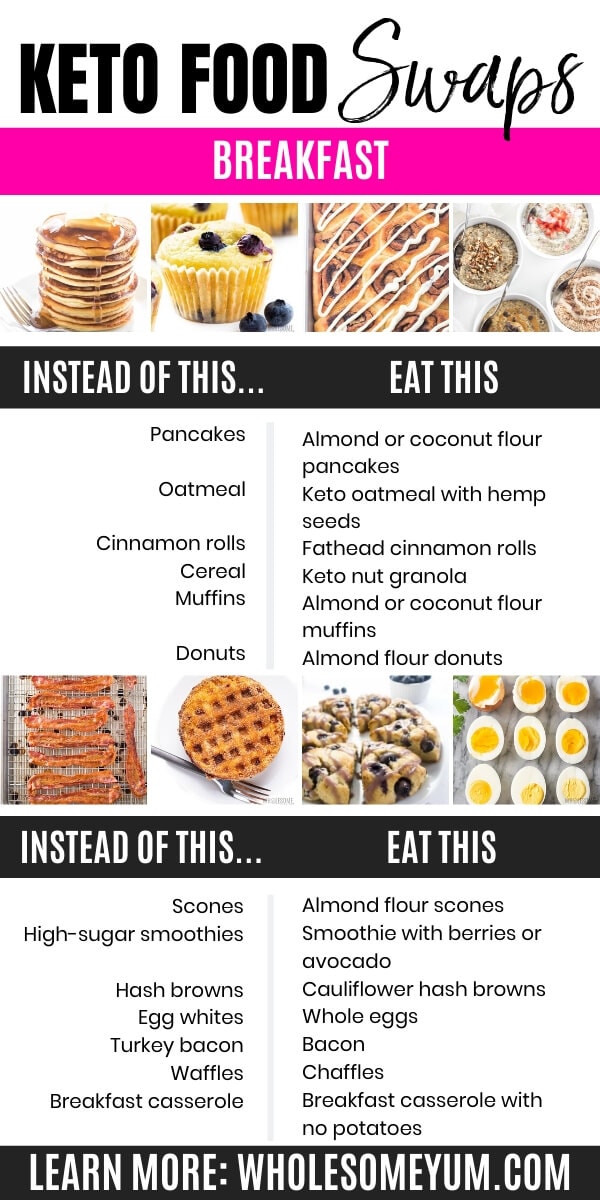
Keto Swaps For Breakfast
| Instead Of This… | Eat This |
|---|---|
| Pancakes | Almond flour pancakes or coconut flour pancakes |
| Oatmeal | Keto oatmeal with hemp seeds |
| Cinnamon rolls | Fathead cinnamon rolls |
| Cereal | Keto nut granola |
| Muffins | Almond flour muffins or coconut flour muffins |
| Donuts | Almond flour donuts |
| Scones | Almond flour scones |
| High-sugar smoothies | Smoothie with berries or avocado |
| Hash browns | Cauliflower hash browns |
| Breakfast casserole | Breakfast casserole with no potatoes |
| Egg whites | Whole eggs |
| Turkey bacon | Bacon |
| Waffles | Chaffles |
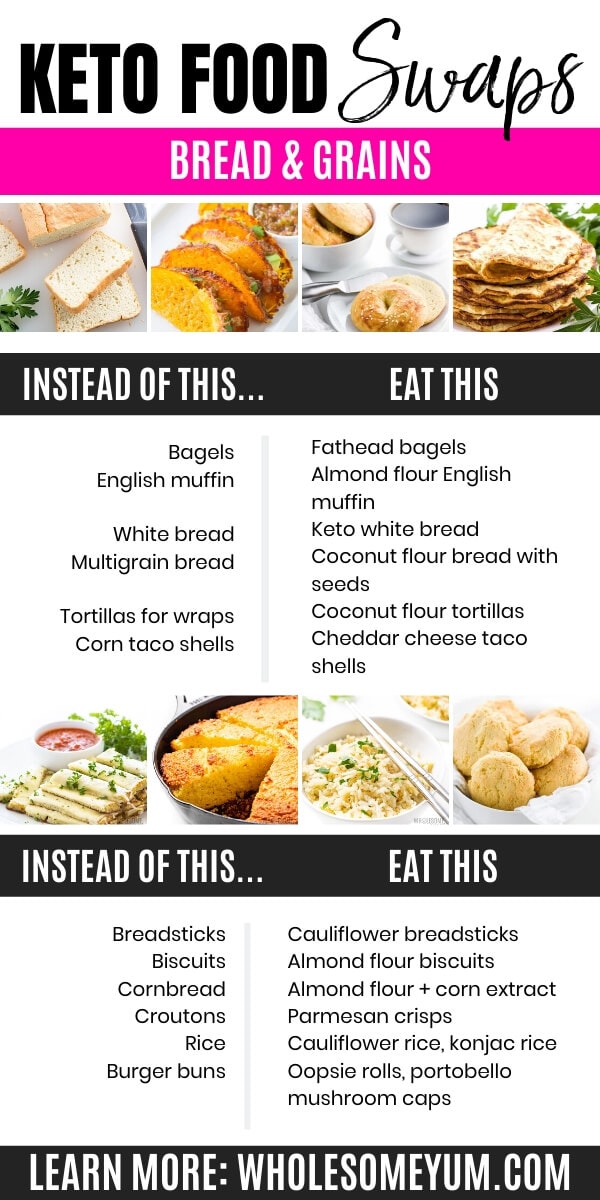
Keto Swaps For Bread
| Instead Of This… | Eat This |
|---|---|
| Bagels | Fathead bagels |
| English muffin | Almond flour English muffin |
| White bread | Keto white bread |
| Multigrain bread | Coconut flour bread with seeds |
| Tortillas for wraps | Coconut flour tortillas |
| Corn taco shells | Cheddar cheese taco shells |
| Burger buns | Oopsie rolls , portobello mushroom caps |
| Breadsticks | Cauliflower breadsticks |
| Biscuits | Almond flour biscuits |
| Cornbread | Almond flour cornbread |
| Croutons | Parmesan crisps |
| Rice | Cauliflower rice , konjac rice |
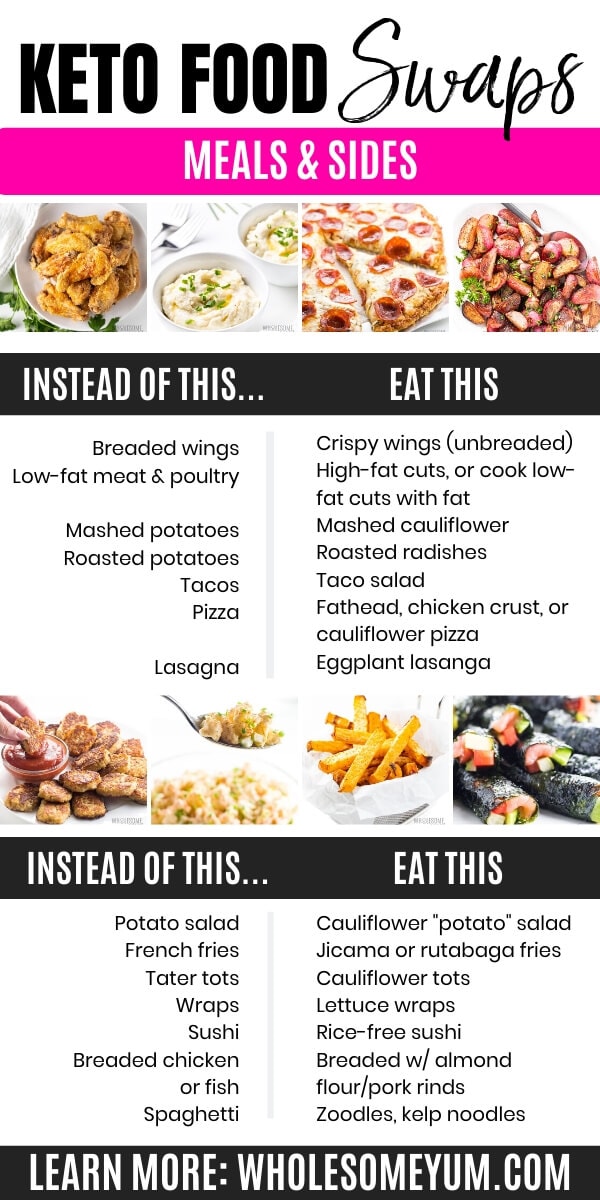
Keto Swaps For Meals & Side Dishes
| Instead Of This… | Eat This |
|---|---|
| Breaded wings | Crispy air fryer wings (unbreaded) |
| Low-fat meat & poultry | High-fat cuts, or cook low-fat cuts with fat |
| Mashed potatoes | Mashed cauliflower |
| Roasted potatoes | Roasted or fried radishes |
| Tacos | Taco salad |
| Pizza | Fathead crust , chicken crust , or cauliflower crust pizza |
| Lasagna | Eggplant lasagna |
| Potato salad | Cauliflower “potato” salad |
| French fries | Jicama , rutabaga , or zucchini fries |
| Tater tots | Cauliflower tots |
| Wraps | Lettuce wraps , almond flour tortillas |
| Sushi | Naruto-style or homemade rice-free sushi |
| Breaded chicken or fish | Breaded cuts with almond flour or pork rinds |
| Spaghetti | Zoodles , spaghetti squash , shirataki noodles, kelp noodles |
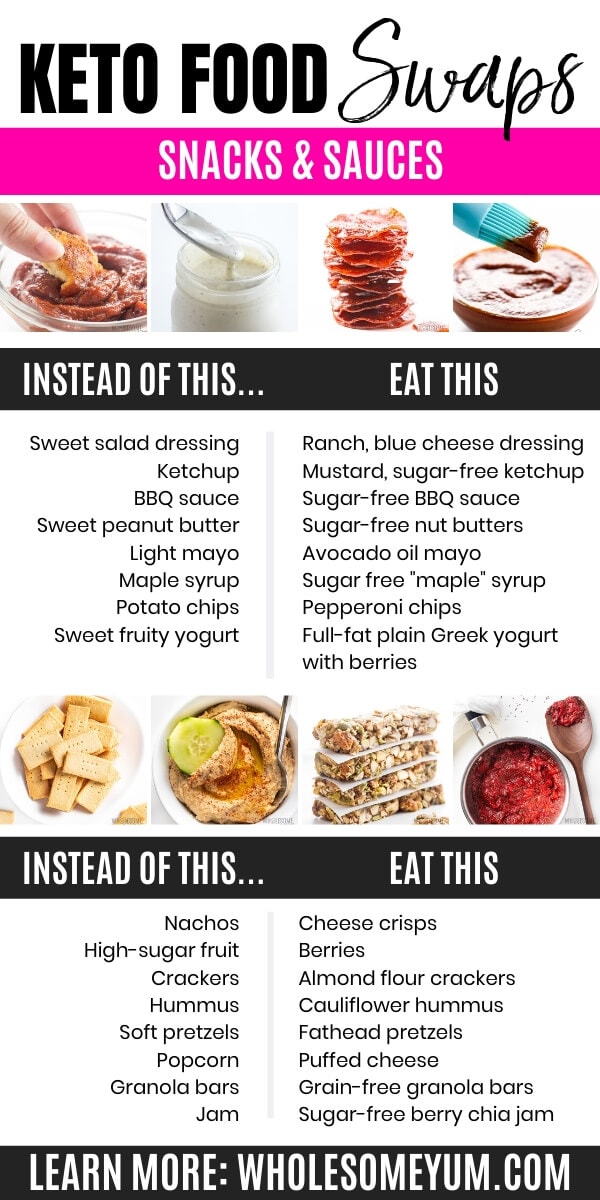
Keto Swaps For Snacks & Sauces
| Instead Of This… | Eat This |
|---|---|
| Nachos | Cheese crisps |
| High-sugar fruit | Berries & other keto fruits |
| Crackers | Almond flour crackers |
| Hummus | Cauliflower hummus |
| Soft pretzels | Fathead pretzels |
| Popcorn | Puffed cheese |
| Granola bars | Grain-free granola bars |
| Jam | Sugar-free berry chia jam |
| Sweet fruity yogurt | Full-fat plain Greek yogurt with berries |
| Sweet salad dressing | Ranch , blue cheese , or plain vinaigrette |
| Ketchup | Mustard and/or sugar-free ketchup |
| BBQ sauce | Sugar-free BBQ sauce |
| Sweetened peanut butter | Natural, sugar-free nut butters |
| Light mayo | Avocado oil mayo |
| Maple syrup | Sugar-free, maple flavored syrup |
| Potato chips | Zucchini chips , pepperoni chips , pork rinds |
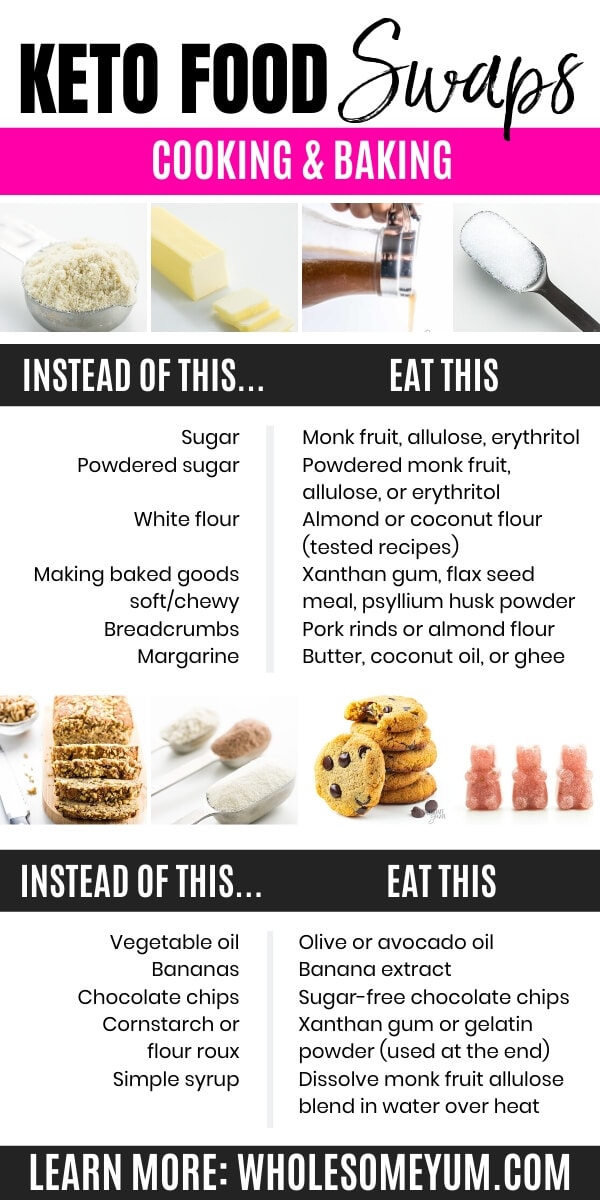
Keto Swaps For Cooking & Baking
| Instead Of This… | Eat This |
|---|---|
| Sugar | Monk fruit or allulose |
| Powdered sugar | Powdered monk fruit or allulose |
| White flour | Almond or Coconut flour (use in tested recipes) |
| Making baked goods soft/chewy | Xanthan gum, flax seed meal, psyllium husk powder |
| Breadcrumbs | Pork rinds or almond flour |
| Margarine | Butter, coconut oil, or ghee |
| Vegetable oil | Olive or avocado oil |
| Bananas | Banana extract |
| Chocolate chips | Sugar-free chocolate chips |
| Cornstarch or flour roux | Xanthan gum or gelatin powder (used at the end) |
| Simple syrup | Dissolve monk fruit allulose blend in water over heat |
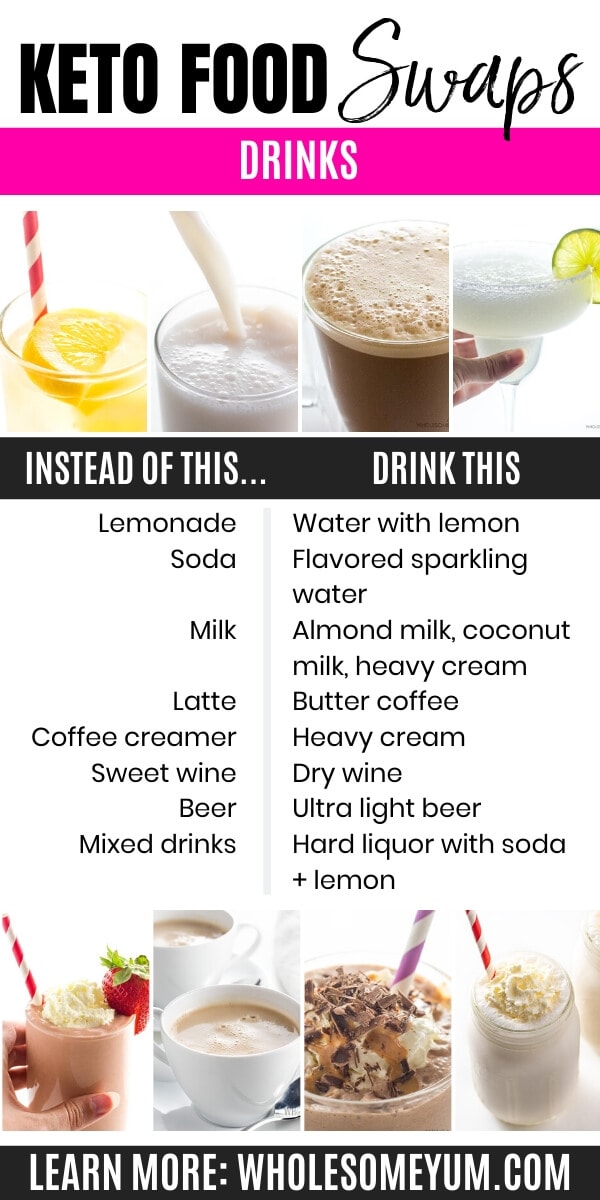
Keto Swaps For Drinks
| Instead Of This… | Eat This |
|---|---|
| Lemonade | Water with lemon |
| Soda | Flavored sparkling water |
| Milk | Almond milk, coconut milk, heavy cream |
| Latte | Butter coffee |
| Coffee creamer | Heavy cream |
| Sweet wine | Dry wine |
| Beer | Ultra light beer |
| Mixed drinks | Hard liquor with soda + lemon |
If you’re looking specifically for keto alcohol options, browse the full keto alcohol guide .
Keto Food List
When looking for a keto cheat sheet printable, the most-requested information is a keto food list.
The great thing is that keto doesn’t have to feel restrictive. It’s incredibly satisfying and there’s such a wide variety of foods you can eat!
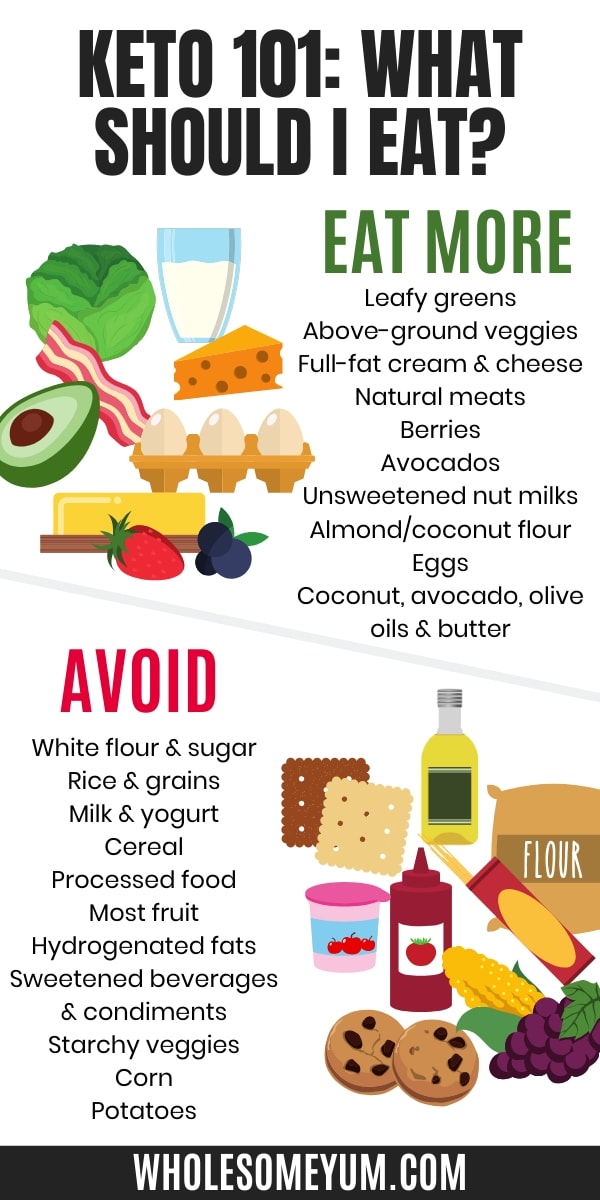
Foods To Eat On Keto
- Leafy greens – Such as spinach, chard, and lettuce.
- Above-ground veggies – Such as peppers, zucchini, and cauliflower.
- Full-fat cream & cheese – Such as heavy cream, sour cream, and full-fat hard cheeses.
- Natural meats – Such as beef, lamb, and pork.
- Berries – Such as raspberries, blackberries, and strawberries.
- Avocados
- Unsweetened nut milks – Such as almond milk and coconut milk.
- Almond flour and coconut flour
- Eggs
- Healthy fats – Such as coconut oil, avocado oil, olive oil and butter.
Foods To Avoid On Keto
- White flour & sugar
- Rice & grains – Such as barley, wheat, and corn.
- Milk & yogurt – Such as fruit on the bottom yogurt, sweetened Greek yogurt, and all milk.
- Cereal
- Processed food – Such as granola bars, candy
- Most fruit – Such as apples, bananas, and grapes
- Hydrogenated fats – Such as vegetable oil, soybean oil, and margarine
- Sweetened beverages & condiments – Such as soda, ketchup, and sweet dressings
- Starchy veggies – Such as peas, carrots, and beets.
- Potatoes – Such as sweet potatoes and white potatoes.
That’s the short keto diet cheat sheet version of all the keto food categories, but I recommend downloading the full Keto Cheat Sheet System. It includes a super detailed printable keto food list with over 100 items, including 2 color-coded pages with net carb counts, along with 6 more pages of keto cheat sheets:
Get The Keto Cheat Sheet System PDF (Only $37)
Electrolyte Basics
Getting enough electrolytes is crucial for anyone, but especially so on a keto diet. The reason is that ketosis has a diuretic effect, which increases excretion of water and electrolytes, especially sodium [ * ]. This is often the cause of the keto flu.
For more details on electrolytes and avoiding keto flu, check out the full keto flu guide here .
The important thing to know about electrolytes is that replenishing them will keep keto flu away and keep your body functioning well. I always recommend an electrolyte drink and whole food sources of anything your body needs before resorting to supplements, so I made a list of what to eat to get each of the 3 major electrolytes – sodium, magnesium and potassium.
Here’s your keto diet cheat sheet for getting electrolytes from food:
| Sodium | Magnesium | Potassium |
|---|---|---|
| Bone broth Boullion cubes Bacon Salted nuts Pickles | Seaweed Seeds Nuts Avocado Leafy greens | Potassium chloride Avocado Bone broth Spinach Broccoli Mushrooms Beef Pork |
Keto Diet Types
People follow a keto lifestyle for different reasons. Some do it just to lose weight, others are after better overall health, increased energy, and reduced inflammation.
Strictly speaking, the defining factor of a keto diet is the metabolic state of ketosis, which is achieved by restricting carbs. However, many people (myself included) also reduce or eliminate processed, inflammatory, or low-nutrient foods.
Below is your keto cheat sheet summary of the different ways that people follow keto. You choose what works best for your goals and lifestyle!
- Strict Keto – Up to 20-30g net carbs daily, count all calories and macros, and eat clean, unprocessed foods.
- Lazy Keto – Up to 20-30g net carbs daily, and track only net carbs OR eat keto foods without tracking.
- Dirty Keto – Up to 20-30g net carbs daily, with “if it fits your macros” approach including processed foods.
- Low Carb – Up to 50-100g net carbs daily, less strict.
For a more detailed listing of these different types of keto with pros and cons, grab the Easy Keto Cheat Sheet Printable PDF below!
Want The Keto Cheat Sheet Printable PDF System?
Get all this information and MORE in convenient printer-friendly format – 13 cheat sheet pages you can take with you anywhere or keep in your kitchen, plus 4 recipe cookbooks! Includes:
- Keto food list (230+ foods) – Super detailed & color-coded, with net carb counts, so you’ll know exactly what to eat.
- Foods to avoid on keto – Detailed and specific list so that you know exactly what to watch out for.
- Macros cheat sheet – Explains everything you need to know about macros to succeed on keto.
- Keto food swaps (60+ swaps) – Covers virtually every food you love, so you don’t have to miss out!
- Keto meal formula – With specific food ideas, so it’s easy to mix-and-match.
- Keto flu guide – Understand what it is and exactly how to avoid it.
- Electrolyte cheat sheet – With whole food ideas + bonus keto tips.
- Keto Diet Types – Summary of 4 ways to do keto, so you can choose what fits you best.
- FOUR (4!) Keto Swaps Recipe EBooks – Dozens of recipes to replace bread, rice, potatoes, pasta, desserts, and other carbs you’d otherwise miss.
Get The Printable Keto Cheat Sheet System (75 pages, Only $37!)
Free Printable: Low Carb & Keto Food List
- What Is A Low Carb Diet Plan?
- What Is The Keto Diet?
- Keto Diet Rules: How To Start Keto
- Get The Printable Keto Cheat Sheet System
- Understanding & Counting Macros
- What To Eat On A Keto Diet
- Low Carb & Keto Recipes
- Keto Meal Plans
- Keto Diet Benefits
- Keto Diet Side Effects
- Common Questions
- Conclusion: Is The Keto Diet For You?
- Recipe Reviews
Welcome to the ultimate guide to the keto diet plan, a form of low carb diet. If you are new to Wholesome Yum, or just starting out with this lifestyle, you’ve come to the right place. This guide will show you everything you need to know about how to start a keto diet , including keto diet basics, how to understand and calculate macros, what foods to eat, recipes to make, how to avoid side effects, and more. Be sure to check out all the keto diet recipes and the keto diet app , too!
JOIN THE EASY KETO CHALLENGE!
Join 300,000+ others to get this free guide to kickstart keto (everything you need to know, broken up into 10 doable days!) and get support.
What Is A Low Carb Diet Plan?
A low carb diet plan is a way of eating that is high in fat, moderate in protein and low in carbohydrates. It ends the rollercoaster of blood sugar spikes and crashes, allowing the body to burn fat.
There are different variations of low carbohydrate diets. The keto diet plan is a special type of low carb diet, with added characteristics. Optimal carb intake will vary depending on your insulin tolerance and activity level, but on average, these are the common numbers of carbs:
- Keto diet – Under 20g net carbs per day (sometimes under 25g or 30g works)
- Low carb diet – Under 50g net carbs per day
- Moderate low carb diet – Under 100g net carbs per day
Some people opt to count carbs diligently and some choose to simply focus on eat low carb or keto foods. For comparison, according to the Dietary Guidelines For Americans , a Standard American diet contains between 225 and 325 grams of carbohydrates per day.
What Is The Keto Diet?
The ketogenic diet, or keto diet plan, is a specific type of low carb diet that is focused on a specific ratio of macronutrients (or macros for short — these include fat, protein, and carbohydrates), with a goal of reaching a state called ketosis .
There are different ways to follow this diet, including clean keto (focusing on whole foods and nutrients), dirty keto, and lazy keto , among others, but ketosis is the goal with all of them. The keto diet basics below apply to all of them, as well.
What Is Ketosis?
Ketosis is a metabolic state in which the body burns fat for fuel instead of carbs. It’s very effective for weight loss, energy, and mental clarity [ * , * , * , * ]. The body enters a ketogenic state when carbs are restricted for extended periods, through a low carb diet, fasting [ * ], or starvation [ * ].
How Does The Keto Diet Work?
Unlike a low carb diet, ketosis is the primary goal of the keto diet plan. We achieve it by severely limiting carbohydrate intake, not necessarily calories, though calories are often restricted as a byproduct.
The core of how the keto diet works boils down to two things:
- In the absence of carbohydrates, the body switches to burning fat for fuel instead of glucose. When carbs are restricted and your body runs out of glucose, your body turns to fat in food and fat stores for fuel instead. Your livers breaks down the fat into ketones, small energy molecules that your body can use for energy [ * ].
- A ketogenic diet keeps insulin levels low. Insulin is a signal for your body to hold onto its fat stores, so low levels help your body access its fat stores for energy [ * ]. This regulates your blood sugar levels as well.
Signs of ketosis include increased energy and focus, decreased appetite, and changes in smell of breath or urine. You can test yourself for ketosis using ketone test strips (use code WY20 for 20% off!). A blood monitor is the most accurate, but not usually necessary if you follow the keto diet rules.
Keto Diet Rules: How To Start Keto
If you want to start a keto diet or low carb diet plan, it can be intimidating. I get it! I’ve been doing this for almost a decade (and it goes to show this is a sustainable lifestyle!), but it wasn’t always easy. We all have to start somewhere. Just start — you got this!
Whether you’re looking for how to start a keto diet or a low carb diet, there are lots of similarities. Let’s make it as easy as possible…
Easy Steps For Starting A Keto Diet
The main point to remember when starting a keto diet is this:
RULE #1: Restrict Carbohydrates. This is the most crucial part! Restrict to less than 20g or 25g net carbs per day for a keto diet plan (some people can get away with under 30g). For a low carb diet, aim for under 50g net carbs per day. Some variations limit to somewhere between 50-100g per day, particularly if you are more active.
Stay below your carb limit and you’re most of the way there! But to ensure your success, here are some additional tips for getting started on a keto diet — and the same applies for a low carb diet as well:
- Limit protein intake. Contrary to popular belief, keto diets and low carb diets are not high protein diets! Low carb is generally higher in protein than keto, but be careful with both. High protein diets can stress the kidneys, and besides, excess protein converts to glucose. Make your protein intake a goal to meet each day, but more than that is not better.
- Use fat as a lever. We’ve been taught to fear fat, but don’t! Both keto and low carb are forms of a high-fat diet. Fat is our source of energy as well as satiety. The key to understand, though, is that fat is a lever on a low carb or keto diet. Carbs and protein stay constant, and fat is the one you increase or decrease (push the lever up or down) to gain or lose weight, respectively. So if your goal is weight loss, eat enough fat to be satisfied, but there’s no need to “get your fats in” once you’re satisfied.
- Drink lots of water. This is especially crucial on a low carb or keto diet. Why? When you eat carbs, your body stores the extra as glycogen in the liver, where they are bound to water molecules. Eating low carb depletes this glycogen, which allows you to burn fat. But it also means you are storing less water, making it easier to get dehydrated. Instead of the traditional recommendation of 8 cups of water per day, aim for 16 cups when following a low carb lifestyle.
- Keep up electrolytes. The major electrolytes in our bodies are sodium, potassium and magnesium. It’s crucial to get enough of these so that you don’t experience these side effects — they are temporary, but avoidable. Read more about side effects and their remedies below.
- Eat only when you are hungry. Get out of the mindset that you need to eat 4-6 meals per day or constantly snack. Eating too frequently on a keto or low carb diet is not necessary, and can affect weight loss. Eat when you’re hungry, but if you aren’t, don’t. Eating fewer carbs will make this much easier, as this naturally suppresses appetite.
- Focus on whole foods. Although eating natural or whole foods is technically not 100% required to restrict carbohydrates, eating processed foods will not help you get rid of cravings or be good for your body. Check the section below for more on what low carb foods are best.
- Exercise. This is not required for a low carb diet, but recommended. You’ll feel better, improve your health, and if your goal is weight loss, it will happen faster!
Keto Diet Tips For Beginners
The steps above are the most important, but to set yourself up for success, read over these keto diet tips for beginners , too.
Get The Printable Keto Cheat Sheet System
Get all this information and MORE in convenient printer-friendly format - 13 cheat sheet pages you can take with you anywhere or keep in your kitchen, plus 4 recipe cookbooks! Includes:
- Keto food list (230+ foods) - Super detailed & color-coded, with net carb counts, so you’ll know exactly what to eat.
- Foods to avoid on keto - Detailed and specific list so that you know exactly what to watch out for.
- Macros cheat sheet - Explains everything you need to know about macros to succeed on keto.
- Keto food swaps (60+ foods) - Covers virtually every food you love, so you don’t have to miss out!
- Keto meal formula - With specific food ideas, so it’s easy to mix-and-match.
- Keto flu guide - Understand what it is and exactly how to avoid it.
- Electrolyte cheat sheet - With whole food ideas + bonus keto tips.
- Keto Diet Types - Summary of 4 ways to do keto, so you can choose what fits you best.
- FOUR (4!) Keto Swaps Recipe EBooks - Dozens of recipes to replace bread, rice, potatoes, pasta, desserts, and other carbs you’d otherwise miss.
Get The Printable Keto Cheat Sheet System + 4 EBooks (Only $37)
Understanding & Counting Macros
What are macros? Simply put, “macros” is a shortened name for macronutrients, which provide energy and come in the form of fat, protein, and carbohydrates.
All three play a role in a successful keto diet plan:
- Fat – Fat acts as the primary fuel source on a keto diet, unlike a standard diet where carbohydrates are the main source. Your are in ketosis when your body has made the metabolic switch to using fat for most of its energy. In addition, it keeps you satisfied. Just keep in mind that you burn the fat from your food before burning body fat, so use fat as a lever to lose weight, maintain, or gain muscle depending on your goals. Aside from energy, fat plays an important role in metabolism, immune function, reproduction, and absorption of vitamins [ * ].
- Protein – Proteins are made up of amino acids, which are commonly referred to as the building blocks in our bodies. Proteins are crucial for the structure, function, and regulation of tissues and organs, including antibodies, enzymes, messengers, structural support for cells, transport, and muscle preservation [ * ]. On a ketogenic diet, you want to get enough protein to support all these functions. However, if you get too much protein, the excess will be converted into glucose by the body — this process is called gluconeogenesis and we want to keep it to a minimum.
- Carbohydrates – Carbs are the most crucial piece of the puzzle. In fact, restricting carbohydrate intake is technically the only thing necessary to enter a state of ketosis. While it’s commonly cited that the brain needs glucose to function, the brain is able to get most of its needed energy from ketones and the liver can make up the rest via gluconeogenesis [ * , * ]. When we talk about low carbohydrate intake on a keto diet, we usually refer to net carbs, explained below.
As a general guideline, below are the recommended macro percentages to aim for. These are the percentages of your total calorie intake that would be from fat, protein, and carbs.
Macros For A Low Carb Diet Plan:
- Fat: 40% to 70%
- Protein: 15 to 30%
- Net Carbs: 15% to 30%
Macros For A Keto Diet Plan:
- Fat: 60% to 75%
- Protein: 20% to 25%
- Net Carbs: 5% to 10%
What Are Net Carbs?
Net carbs are the carbohydrates that your body is able to digest and break down into glucose for energy.
Should You Count Total Carbs Or Net Carbs?
Some people following a ketogenic diet choose to count total carbs instead of net carbs. Some of the reasoning is that technically, soluble fiber is partially digestible, but not usually differentiated from insoluble fiber on labels. Also, some people find that their body does digest a small amount of the carbs from sweeteners, so they feel better counting them.
Unfortunately, counting total carbs makes it more difficult to fit in enough leafy greens and keto vegetables in your low carb diet. These are packed with fiber and beneficial nutrients, so you should only try that if you don’t get results with a net carb method. Also, start with reducing sweeteners and low carb treats before deciding to limit your grams of carbs to only total carbs.
Do You Have To Count Macros?
When you start a ketogenic diet plan, it’s recommended that you count macros at least in the beginning. That way, you’ll get a sense of what and how much you should be eating. However, some people have success simply sticking to low carb foods and not counting anything, while others only count net carbs, but don’t count fat and protein (this method is called lazy keto ).
How To Calculate Your Macros
If you really want to be sure that you are eating the right amounts, you need a low carb or keto macro calculator. Most calculators work for just one or the other, but the Wholesome Yum macro calculator will do it for each diet type. It will tailor the results to your body and your goals:
Calculate Your Macros Here!
What To Eat On A Keto Diet
One of the most common questions I get is, “what to eat on a keto diet?” or “what to eat on a low carb diet?” Fortunately, with the right resources, this is one of the easiest questions to answer.
In fact, the keto diet plan is probably the most flexible, sustainable eating lifestyle out there. You don’t have to feel deprived, bored or restricted. And, it doesn’t need to be complicated.
The Best Foods for a Keto Diet
This simple list summarizes what to eat on a low carb diet. And, what to eat on a keto diet is basically the same:
- Healthy fats like avocado oil, olive oil, butter, and coconut oil
- Leafy greens like lettuce, spinach, and kale
- Non-starchy vegetables that grow above ground, like zucchini, cauliflower, peppers, broccoli, asparagus, celery, and many others. Some vegetables that grow below ground, such as onions, are also okay. Get the full keto vegetables list !
- Meat like beef , pork, and lamb
- Poultry like chicken , turkey, and duck
- Seafood like salmon and other fish, shrimp, crab, and lobster
- Full-fat dairy like cheese, cream cheese, and heavy cream. Get the full keto cheese list !
- Eggs
- Sugar-free beverages like water, coffee and tea
- Herbs & spices like basil, dill and cinnamon
- Low carb condiments like mayonnaise , hot sauce and mustard
You can also enjoy these on a low carb keto diet in moderation:
- Low carb fruit like avocados (the fruit exception that doesn’t need to be in moderation), berries (all kinds!), and coconuts. Get the full keto fruit list !
- Nuts & seeds like almonds, macadamia nuts, walnuts, chia seeds, and sunflower seeds. Get the full keto nuts list !
- Sugar-free sweeteners like allulose, erythritol, monk fruit and stevia. Start with this keto sweetener – it’s natural, acts like sugar, and has the best taste of them all.
- Low carb flours like almond flour , coconut flour , and psyllium husk powder
The main difference between low carb and keto is the macronutrient profile, but the types of foods you eat are mostly the same.
These are the keto diet basics, and it’s best to start simple — meat, eggs, fats, and veggies primarily. Once you have it down, you can experiment with extras like low carb keto desserts or more advanced recipes, but it’s not necessary.
Foods to Avoid on a Low Carb Diet
Avoiding carbohydrates is probably the biggest adjustments for people starting a keto diet or low carb diet. Many of us were used to consuming carbs at every meal. Below is a list of foods to avoid:
- Grains – including wheat, bread, pasta, rice, oats, cereal, corn, etc.
- Sugar – including table sugar, candy, pastries, cakes, ice cream, chocolate, soda, juice, honey, maple syrup, etc.
- Starchy vegetables – including potatoes, sweet potatoes, parsnips, etc.
- Legumes – including beans, lentils, chickpeas, etc. (Peanuts are an exception in moderation.)
- High-sugar fruits – including bananas, pineapple, oranges, apples, grapes, etc.
- Low-fat dairy & milk – including all cow’s milk (except heavy cream is fine), low-fat cheese, etc.
- Seed & vegetable oils – especially margarine, canola oil, corn oil, grapeseed oil and soybean oil
- Processed “low carb” foods – this depends on ingredients, so read labels for hidden sugar, starch, and artificial ingredients
Get these out of your house if you can! If you have family members that are not on board, at least store these in a separate area from other foods to reduce temptation.
Also, always, always check labels for any food that has one. Avoid anything that has added sugar or starch as an ingredient, watching for different names like dextrose, maltodextrin, maple syrup, honey, corn syrup, cornstarch, potato flakes, etc. Sometimes you’ll be surprised where you might find added sugars.
Low Carb & Keto Diet Grocery List
The list above should give you an idea of the best and worst foods for a low carb diet. But if you’re starting out, it’s a good idea to know exactly what is included:
- Start with the complete low carb & keto food list – it has over 230 foods on it! It includes all the keto diet basics that you can and can’t eat, including carb counts. If you prefer to start with a shorter, less overwheming list, grab the keto grocery list for 1-2 trips to the store.
- Get discounts on keto products here – exclusive for Wholesome Yum readers!
- Check out the keto sweetener guide to help you choose the best ones and convert from one sweetener to another. You may or may not want to start with sweeteners right away, but it’s there when you’re ready.
- Buy keto ingredients here , including sweeteners, flours, syrups, baking mixes, and more.
Low Carb & Keto Recipes
If you are looking for low carb recipes or keto diet recipes, you’ve come to the right place! Every single recipe on Wholesome Yum is low carb and appropriate for the ketogenic diet.
Each recipe has 10 ingredients or less. I’m on a mission to show you that keto friendly recipes don’t have to be difficult, time consuming, or taste like “diet food”. I love sharing just how delicious and easy keto can be!
To get you started, here are a few of the most popular low carb keto recipes:
- Keto Pizza
- Healthy Taco Salad
- Keto Chaffles
- Low Carb Bread
Another good place to start is with my library of keto dinner recipes , so you can start preparing ketogenic meals. The entire recipe index is at the button below.
Browse Keto Recipes Index
Keto Meal Plans
There are several excellent places where you can get a ketogenic meal plan:
- The Wholesome Yum App provides custom weekly keto meal plans that you can adjust to your preferences, builds an automatic grocery list for you, offers nearly 1,000 recipes, and has an easy macro tracker. Available on iPhone or Android .
- A FREE 7-Day Keto Meal Plan For Beginners is available right on my website. The recipes are simple keto diet basics that anyone can make.
- The Egg Fast Diet is a short-term ketogenic meal plan designed to break through a plateau on a keto diet.
- The Easy Keto Cookbook includes a sample week meal plan, plus 100 recipes for delicious ketogenic meals.
Get The Wholesome Yum App!
Make keto easy with customized keto meal plans, automatic macro tracking, auto generated grocery list, delicious low carb recipes, and more.
Get The Wholesome Yum App
Keto Diet Benefits
Following a ketogenic diet can have numerous benefits, including:
- Weight loss – Research shows that keto diets are more effective than low fat diets for long-term weight loss [ * , * , * ].
- Stable mood & energy levels – Reducing dietary carbohydrates is linked to better cognitive function [ * , * ] and possible reductions in depression and anxiety [ * ].
- Blood sugar control – Limiting carbs is shown to improve insulin sensitivity [ * ].
- Reduced cravings & appetite – Keto may positively affect your body’s hormones that signal hunger [ * ], and signal appetite suppression in the brain [ * ].
- Lower blood pressure – Some studies suggest that a low carb diet can be more effective at lowering blood pressure for obese patients than medication [ * ].
- Higher good cholesterol – In some studies, subjects following a keto diet experienced increases in HDL cholesterol levels [ * ].
- Skin improvements – Research suggests that keto can help improve skin conditions like acne, though more studies are needed [ * ].
- Digestive support – Some studies link keto with healthy gut bacteria [ * ].
- Possibly increased lifespan – Recent rodent studies show that a low carbohydrate diet improved longevity [ * ].
- Preservation of muscle mass – Loss of muscle is a common issue when losing weight, but a very low carbohydrate diet is more effective at preserving muscle mass compared to conventional diets [ * ].
Keto Diet Side Effects
Because a low carb diet (especially a keto diet plan!) reduces the amount of water you store, this can flush out electrolytes and make you feel sick — this is called the “keto flu”. These side effects of keto are temporary while you are adjusting to a ketogenic diet, but unpleasant. They can include headache, dizziness, fatigue, restlessness, brain fog, lack of motivation, nausea, insomnia, impaired coordination, sensitivity to heat, sugar cravings, muscle soreness or weakness, and stomach issues.
Fortunately, you can avoid or eliminate these side effects by salting your food liberally, drinking broth (especially bone broth ), drinking my homemade electrolyte drink , and eating pickled vegetables. These keto diet basics are just as important as restricting carbs. Some people also choose to take supplements for electrolytes, but it’s best to first consult a doctor.
Check the complete guide to keto flu symptoms and remedies here so that you can avoid it!
Common Questions
- Is the keto diet healthy? If your keto diet is unbalanced, you may end up with deficiencies in electrolytes, B vitamins, iodine, iron, or other nutrients. However, a balanced keto diet with a focus on whole foods and healthy fats is a great, healthy choice.
- Is the keto diet safe? A keto diet is perfectly safe to try for generally healthy individuals. However, if you have any underlying health conditions, you should consult with a doctor before trying any new way of eating.
- Is the keto diet good for diabetics? Those with diabetes can benefit from a keto diet because it improves blood sugar and A1C levels [ * ]. However, it’s still important to work with a doctor when considering diet changes.
- How long does it take to enter ketosis? It usually takes about 3 days after starting a ketogenic diet to enter ketosis. However, it takes 3-4 weeks before you are “fat adapted” and burn fat efficiently. This is because the body takes a few days to burn through all the glycogen in your liver (your body stores extra glucose there and this gets depleted before you start producing ketones), and afterward, it takes some time for your body to adjust to using primarily fat for fuel.
- How to get enough fat on a keto diet? Eat foods naturally high in fat, such as eggs and fatty cuts of meat, or add dietary fats like grass fed butter and MCT oil to meals. You can also snack on fat bombs for a high-fat boost!
Conclusion: Is The Keto Diet For You?
The keto diet plan can be beneficial, enjoyable, and surprisingly easy to follow! But as always, always check with your doctor (preferably one that understands and supports a ketogenic lifestyle) before making a drastic change, especially if you take any medication. If you have the green light, use this guide for all the keto diet basics you need to get started.
How To Start A Keto Diet
Free Printable: Low Carb & Keto Food List
- What Is A Low Carb Diet Plan?
- What Is The Keto Diet?
- Keto Diet Rules: How To Start Keto
- Get The Printable Keto Cheat Sheet System
- Understanding & Counting Macros
- What To Eat On A Keto Diet
- Low Carb & Keto Recipes
- Keto Meal Plans
- Keto Diet Benefits
- Keto Diet Side Effects
- Common Questions
- Conclusion: Is The Keto Diet For You?
- Recipe Reviews
Welcome to the ultimate guide to the keto diet plan, a form of low carb diet. If you are new to Wholesome Yum, or just starting out with this lifestyle, you’ve come to the right place. This guide will show you everything you need to know about how to start a keto diet , including keto diet basics, how to understand and calculate macros, what foods to eat, recipes to make, how to avoid side effects, and more. Be sure to check out all the keto diet recipes and the keto diet app , too!
JOIN THE EASY KETO CHALLENGE!
Join 300,000+ others to get this free guide to kickstart keto (everything you need to know, broken up into 10 doable days!) and get support.
What Is A Low Carb Diet Plan?
A low carb diet plan is a way of eating that is high in fat, moderate in protein and low in carbohydrates. It ends the rollercoaster of blood sugar spikes and crashes, allowing the body to burn fat.
There are different variations of low carbohydrate diets. The keto diet plan is a special type of low carb diet, with added characteristics. Optimal carb intake will vary depending on your insulin tolerance and activity level, but on average, these are the common numbers of carbs:
- Keto diet – Under 20g net carbs per day (sometimes under 25g or 30g works)
- Low carb diet – Under 50g net carbs per day
- Moderate low carb diet – Under 100g net carbs per day
Some people opt to count carbs diligently and some choose to simply focus on eat low carb or keto foods. For comparison, according to the Dietary Guidelines For Americans , a Standard American diet contains between 225 and 325 grams of carbohydrates per day.
What Is The Keto Diet?
The ketogenic diet, or keto diet plan, is a specific type of low carb diet that is focused on a specific ratio of macronutrients (or macros for short — these include fat, protein, and carbohydrates), with a goal of reaching a state called ketosis .
There are different ways to follow this diet, including clean keto (focusing on whole foods and nutrients), dirty keto, and lazy keto , among others, but ketosis is the goal with all of them. The keto diet basics below apply to all of them, as well.
What Is Ketosis?
Ketosis is a metabolic state in which the body burns fat for fuel instead of carbs. It’s very effective for weight loss, energy, and mental clarity [ * , * , * , * ]. The body enters a ketogenic state when carbs are restricted for extended periods, through a low carb diet, fasting [ * ], or starvation [ * ].
How Does The Keto Diet Work?
Unlike a low carb diet, ketosis is the primary goal of the keto diet plan. We achieve it by severely limiting carbohydrate intake, not necessarily calories, though calories are often restricted as a byproduct.
The core of how the keto diet works boils down to two things:
- In the absence of carbohydrates, the body switches to burning fat for fuel instead of glucose. When carbs are restricted and your body runs out of glucose, your body turns to fat in food and fat stores for fuel instead. Your livers breaks down the fat into ketones, small energy molecules that your body can use for energy [ * ].
- A ketogenic diet keeps insulin levels low. Insulin is a signal for your body to hold onto its fat stores, so low levels help your body access its fat stores for energy [ * ]. This regulates your blood sugar levels as well.
Signs of ketosis include increased energy and focus, decreased appetite, and changes in smell of breath or urine. You can test yourself for ketosis using ketone test strips (use code WY20 for 20% off!). A blood monitor is the most accurate, but not usually necessary if you follow the keto diet rules.
Keto Diet Rules: How To Start Keto
If you want to start a keto diet or low carb diet plan, it can be intimidating. I get it! I’ve been doing this for almost a decade (and it goes to show this is a sustainable lifestyle!), but it wasn’t always easy. We all have to start somewhere. Just start — you got this!
Whether you’re looking for how to start a keto diet or a low carb diet, there are lots of similarities. Let’s make it as easy as possible…
Easy Steps For Starting A Keto Diet
The main point to remember when starting a keto diet is this:
RULE #1: Restrict Carbohydrates. This is the most crucial part! Restrict to less than 20g or 25g net carbs per day for a keto diet plan (some people can get away with under 30g). For a low carb diet, aim for under 50g net carbs per day. Some variations limit to somewhere between 50-100g per day, particularly if you are more active.
Stay below your carb limit and you’re most of the way there! But to ensure your success, here are some additional tips for getting started on a keto diet — and the same applies for a low carb diet as well:
- Limit protein intake. Contrary to popular belief, keto diets and low carb diets are not high protein diets! Low carb is generally higher in protein than keto, but be careful with both. High protein diets can stress the kidneys, and besides, excess protein converts to glucose. Make your protein intake a goal to meet each day, but more than that is not better.
- Use fat as a lever. We’ve been taught to fear fat, but don’t! Both keto and low carb are forms of a high-fat diet. Fat is our source of energy as well as satiety. The key to understand, though, is that fat is a lever on a low carb or keto diet. Carbs and protein stay constant, and fat is the one you increase or decrease (push the lever up or down) to gain or lose weight, respectively. So if your goal is weight loss, eat enough fat to be satisfied, but there’s no need to “get your fats in” once you’re satisfied.
- Drink lots of water. This is especially crucial on a low carb or keto diet. Why? When you eat carbs, your body stores the extra as glycogen in the liver, where they are bound to water molecules. Eating low carb depletes this glycogen, which allows you to burn fat. But it also means you are storing less water, making it easier to get dehydrated. Instead of the traditional recommendation of 8 cups of water per day, aim for 16 cups when following a low carb lifestyle.
- Keep up electrolytes. The major electrolytes in our bodies are sodium, potassium and magnesium. It’s crucial to get enough of these so that you don’t experience these side effects — they are temporary, but avoidable. Read more about side effects and their remedies below.
- Eat only when you are hungry. Get out of the mindset that you need to eat 4-6 meals per day or constantly snack. Eating too frequently on a keto or low carb diet is not necessary, and can affect weight loss. Eat when you’re hungry, but if you aren’t, don’t. Eating fewer carbs will make this much easier, as this naturally suppresses appetite.
- Focus on whole foods. Although eating natural or whole foods is technically not 100% required to restrict carbohydrates, eating processed foods will not help you get rid of cravings or be good for your body. Check the section below for more on what low carb foods are best.
- Exercise. This is not required for a low carb diet, but recommended. You’ll feel better, improve your health, and if your goal is weight loss, it will happen faster!
Keto Diet Tips For Beginners
The steps above are the most important, but to set yourself up for success, read over these keto diet tips for beginners , too.
Get The Printable Keto Cheat Sheet System
Get all this information and MORE in convenient printer-friendly format - 13 cheat sheet pages you can take with you anywhere or keep in your kitchen, plus 4 recipe cookbooks! Includes:
- Keto food list (230+ foods) - Super detailed & color-coded, with net carb counts, so you’ll know exactly what to eat.
- Foods to avoid on keto - Detailed and specific list so that you know exactly what to watch out for.
- Macros cheat sheet - Explains everything you need to know about macros to succeed on keto.
- Keto food swaps (60+ foods) - Covers virtually every food you love, so you don’t have to miss out!
- Keto meal formula - With specific food ideas, so it’s easy to mix-and-match.
- Keto flu guide - Understand what it is and exactly how to avoid it.
- Electrolyte cheat sheet - With whole food ideas + bonus keto tips.
- Keto Diet Types - Summary of 4 ways to do keto, so you can choose what fits you best.
- FOUR (4!) Keto Swaps Recipe EBooks - Dozens of recipes to replace bread, rice, potatoes, pasta, desserts, and other carbs you’d otherwise miss.
Get The Printable Keto Cheat Sheet System + 4 EBooks (Only $37)
Understanding & Counting Macros
What are macros? Simply put, “macros” is a shortened name for macronutrients, which provide energy and come in the form of fat, protein, and carbohydrates.
All three play a role in a successful keto diet plan:
- Fat – Fat acts as the primary fuel source on a keto diet, unlike a standard diet where carbohydrates are the main source. Your are in ketosis when your body has made the metabolic switch to using fat for most of its energy. In addition, it keeps you satisfied. Just keep in mind that you burn the fat from your food before burning body fat, so use fat as a lever to lose weight, maintain, or gain muscle depending on your goals. Aside from energy, fat plays an important role in metabolism, immune function, reproduction, and absorption of vitamins [ * ].
- Protein – Proteins are made up of amino acids, which are commonly referred to as the building blocks in our bodies. Proteins are crucial for the structure, function, and regulation of tissues and organs, including antibodies, enzymes, messengers, structural support for cells, transport, and muscle preservation [ * ]. On a ketogenic diet, you want to get enough protein to support all these functions. However, if you get too much protein, the excess will be converted into glucose by the body — this process is called gluconeogenesis and we want to keep it to a minimum.
- Carbohydrates – Carbs are the most crucial piece of the puzzle. In fact, restricting carbohydrate intake is technically the only thing necessary to enter a state of ketosis. While it’s commonly cited that the brain needs glucose to function, the brain is able to get most of its needed energy from ketones and the liver can make up the rest via gluconeogenesis [ * , * ]. When we talk about low carbohydrate intake on a keto diet, we usually refer to net carbs, explained below.
As a general guideline, below are the recommended macro percentages to aim for. These are the percentages of your total calorie intake that would be from fat, protein, and carbs.
Macros For A Low Carb Diet Plan:
- Fat: 40% to 70%
- Protein: 15 to 30%
- Net Carbs: 15% to 30%
Macros For A Keto Diet Plan:
- Fat: 60% to 75%
- Protein: 20% to 25%
- Net Carbs: 5% to 10%
What Are Net Carbs?
Net carbs are the carbohydrates that your body is able to digest and break down into glucose for energy.
Should You Count Total Carbs Or Net Carbs?
Some people following a ketogenic diet choose to count total carbs instead of net carbs. Some of the reasoning is that technically, soluble fiber is partially digestible, but not usually differentiated from insoluble fiber on labels. Also, some people find that their body does digest a small amount of the carbs from sweeteners, so they feel better counting them.
Unfortunately, counting total carbs makes it more difficult to fit in enough leafy greens and keto vegetables in your low carb diet. These are packed with fiber and beneficial nutrients, so you should only try that if you don’t get results with a net carb method. Also, start with reducing sweeteners and low carb treats before deciding to limit your grams of carbs to only total carbs.
Do You Have To Count Macros?
When you start a ketogenic diet plan, it’s recommended that you count macros at least in the beginning. That way, you’ll get a sense of what and how much you should be eating. However, some people have success simply sticking to low carb foods and not counting anything, while others only count net carbs, but don’t count fat and protein (this method is called lazy keto ).
How To Calculate Your Macros
If you really want to be sure that you are eating the right amounts, you need a low carb or keto macro calculator. Most calculators work for just one or the other, but the Wholesome Yum macro calculator will do it for each diet type. It will tailor the results to your body and your goals:
Calculate Your Macros Here!
What To Eat On A Keto Diet
One of the most common questions I get is, “what to eat on a keto diet?” or “what to eat on a low carb diet?” Fortunately, with the right resources, this is one of the easiest questions to answer.
In fact, the keto diet plan is probably the most flexible, sustainable eating lifestyle out there. You don’t have to feel deprived, bored or restricted. And, it doesn’t need to be complicated.
The Best Foods for a Keto Diet
This simple list summarizes what to eat on a low carb diet. And, what to eat on a keto diet is basically the same:
- Healthy fats like avocado oil, olive oil, butter, and coconut oil
- Leafy greens like lettuce, spinach, and kale
- Non-starchy vegetables that grow above ground, like zucchini, cauliflower, peppers, broccoli, asparagus, celery, and many others. Some vegetables that grow below ground, such as onions, are also okay. Get the full keto vegetables list !
- Meat like beef , pork, and lamb
- Poultry like chicken , turkey, and duck
- Seafood like salmon and other fish, shrimp, crab, and lobster
- Full-fat dairy like cheese, cream cheese, and heavy cream. Get the full keto cheese list !
- Eggs
- Sugar-free beverages like water, coffee and tea
- Herbs & spices like basil, dill and cinnamon
- Low carb condiments like mayonnaise , hot sauce and mustard
You can also enjoy these on a low carb keto diet in moderation:
- Low carb fruit like avocados (the fruit exception that doesn’t need to be in moderation), berries (all kinds!), and coconuts. Get the full keto fruit list !
- Nuts & seeds like almonds, macadamia nuts, walnuts, chia seeds, and sunflower seeds. Get the full keto nuts list !
- Sugar-free sweeteners like allulose, erythritol, monk fruit and stevia. Start with this keto sweetener – it’s natural, acts like sugar, and has the best taste of them all.
- Low carb flours like almond flour , coconut flour , and psyllium husk powder
The main difference between low carb and keto is the macronutrient profile, but the types of foods you eat are mostly the same.
These are the keto diet basics, and it’s best to start simple — meat, eggs, fats, and veggies primarily. Once you have it down, you can experiment with extras like low carb keto desserts or more advanced recipes, but it’s not necessary.
Foods to Avoid on a Low Carb Diet
Avoiding carbohydrates is probably the biggest adjustments for people starting a keto diet or low carb diet. Many of us were used to consuming carbs at every meal. Below is a list of foods to avoid:
- Grains – including wheat, bread, pasta, rice, oats, cereal, corn, etc.
- Sugar – including table sugar, candy, pastries, cakes, ice cream, chocolate, soda, juice, honey, maple syrup, etc.
- Starchy vegetables – including potatoes, sweet potatoes, parsnips, etc.
- Legumes – including beans, lentils, chickpeas, etc. (Peanuts are an exception in moderation.)
- High-sugar fruits – including bananas, pineapple, oranges, apples, grapes, etc.
- Low-fat dairy & milk – including all cow’s milk (except heavy cream is fine), low-fat cheese, etc.
- Seed & vegetable oils – especially margarine, canola oil, corn oil, grapeseed oil and soybean oil
- Processed “low carb” foods – this depends on ingredients, so read labels for hidden sugar, starch, and artificial ingredients
Get these out of your house if you can! If you have family members that are not on board, at least store these in a separate area from other foods to reduce temptation.
Also, always, always check labels for any food that has one. Avoid anything that has added sugar or starch as an ingredient, watching for different names like dextrose, maltodextrin, maple syrup, honey, corn syrup, cornstarch, potato flakes, etc. Sometimes you’ll be surprised where you might find added sugars.
Low Carb & Keto Diet Grocery List
The list above should give you an idea of the best and worst foods for a low carb diet. But if you’re starting out, it’s a good idea to know exactly what is included:
- Start with the complete low carb & keto food list – it has over 230 foods on it! It includes all the keto diet basics that you can and can’t eat, including carb counts. If you prefer to start with a shorter, less overwheming list, grab the keto grocery list for 1-2 trips to the store.
- Get discounts on keto products here – exclusive for Wholesome Yum readers!
- Check out the keto sweetener guide to help you choose the best ones and convert from one sweetener to another. You may or may not want to start with sweeteners right away, but it’s there when you’re ready.
- Buy keto ingredients here , including sweeteners, flours, syrups, baking mixes, and more.
Low Carb & Keto Recipes
If you are looking for low carb recipes or keto diet recipes, you’ve come to the right place! Every single recipe on Wholesome Yum is low carb and appropriate for the ketogenic diet.
Each recipe has 10 ingredients or less. I’m on a mission to show you that keto friendly recipes don’t have to be difficult, time consuming, or taste like “diet food”. I love sharing just how delicious and easy keto can be!
To get you started, here are a few of the most popular low carb keto recipes:
- Keto Pizza
- Healthy Taco Salad
- Keto Chaffles
- Low Carb Bread
Another good place to start is with my library of keto dinner recipes , so you can start preparing ketogenic meals. The entire recipe index is at the button below.
Browse Keto Recipes Index
Keto Meal Plans
There are several excellent places where you can get a ketogenic meal plan:
- The Wholesome Yum App provides custom weekly keto meal plans that you can adjust to your preferences, builds an automatic grocery list for you, offers nearly 1,000 recipes, and has an easy macro tracker. Available on iPhone or Android .
- A FREE 7-Day Keto Meal Plan For Beginners is available right on my website. The recipes are simple keto diet basics that anyone can make.
- The Egg Fast Diet is a short-term ketogenic meal plan designed to break through a plateau on a keto diet.
- The Easy Keto Cookbook includes a sample week meal plan, plus 100 recipes for delicious ketogenic meals.
Get The Wholesome Yum App!
Make keto easy with customized keto meal plans, automatic macro tracking, auto generated grocery list, delicious low carb recipes, and more.
Get The Wholesome Yum App
Keto Diet Benefits
Following a ketogenic diet can have numerous benefits, including:
- Weight loss – Research shows that keto diets are more effective than low fat diets for long-term weight loss [ * , * , * ].
- Stable mood & energy levels – Reducing dietary carbohydrates is linked to better cognitive function [ * , * ] and possible reductions in depression and anxiety [ * ].
- Blood sugar control – Limiting carbs is shown to improve insulin sensitivity [ * ].
- Reduced cravings & appetite – Keto may positively affect your body’s hormones that signal hunger [ * ], and signal appetite suppression in the brain [ * ].
- Lower blood pressure – Some studies suggest that a low carb diet can be more effective at lowering blood pressure for obese patients than medication [ * ].
- Higher good cholesterol – In some studies, subjects following a keto diet experienced increases in HDL cholesterol levels [ * ].
- Skin improvements – Research suggests that keto can help improve skin conditions like acne, though more studies are needed [ * ].
- Digestive support – Some studies link keto with healthy gut bacteria [ * ].
- Possibly increased lifespan – Recent rodent studies show that a low carbohydrate diet improved longevity [ * ].
- Preservation of muscle mass – Loss of muscle is a common issue when losing weight, but a very low carbohydrate diet is more effective at preserving muscle mass compared to conventional diets [ * ].
Keto Diet Side Effects
Because a low carb diet (especially a keto diet plan!) reduces the amount of water you store, this can flush out electrolytes and make you feel sick — this is called the “keto flu”. These side effects of keto are temporary while you are adjusting to a ketogenic diet, but unpleasant. They can include headache, dizziness, fatigue, restlessness, brain fog, lack of motivation, nausea, insomnia, impaired coordination, sensitivity to heat, sugar cravings, muscle soreness or weakness, and stomach issues.
Fortunately, you can avoid or eliminate these side effects by salting your food liberally, drinking broth (especially bone broth ), drinking my homemade electrolyte drink , and eating pickled vegetables. These keto diet basics are just as important as restricting carbs. Some people also choose to take supplements for electrolytes, but it’s best to first consult a doctor.
Check the complete guide to keto flu symptoms and remedies here so that you can avoid it!
Common Questions
- Is the keto diet healthy? If your keto diet is unbalanced, you may end up with deficiencies in electrolytes, B vitamins, iodine, iron, or other nutrients. However, a balanced keto diet with a focus on whole foods and healthy fats is a great, healthy choice.
- Is the keto diet safe? A keto diet is perfectly safe to try for generally healthy individuals. However, if you have any underlying health conditions, you should consult with a doctor before trying any new way of eating.
- Is the keto diet good for diabetics? Those with diabetes can benefit from a keto diet because it improves blood sugar and A1C levels [ * ]. However, it’s still important to work with a doctor when considering diet changes.
- How long does it take to enter ketosis? It usually takes about 3 days after starting a ketogenic diet to enter ketosis. However, it takes 3-4 weeks before you are “fat adapted” and burn fat efficiently. This is because the body takes a few days to burn through all the glycogen in your liver (your body stores extra glucose there and this gets depleted before you start producing ketones), and afterward, it takes some time for your body to adjust to using primarily fat for fuel.
- How to get enough fat on a keto diet? Eat foods naturally high in fat, such as eggs and fatty cuts of meat, or add dietary fats like grass fed butter and MCT oil to meals. You can also snack on fat bombs for a high-fat boost!
Conclusion: Is The Keto Diet For You?
The keto diet plan can be beneficial, enjoyable, and surprisingly easy to follow! But as always, always check with your doctor (preferably one that understands and supports a ketogenic lifestyle) before making a drastic change, especially if you take any medication. If you have the green light, use this guide for all the keto diet basics you need to get started.
How To Start A Keto Diet
Free Printable: Low Carb & Keto Food List
- What Is A Low Carb Diet Plan?
- What Is The Keto Diet?
- Keto Diet Rules: How To Start Keto
- Get The Printable Keto Cheat Sheet System
- Understanding & Counting Macros
- What To Eat On A Keto Diet
- Low Carb & Keto Recipes
- Keto Meal Plans
- Keto Diet Benefits
- Keto Diet Side Effects
- Common Questions
- Conclusion: Is The Keto Diet For You?
- Recipe Reviews
Welcome to the ultimate guide to the keto diet plan, a form of low carb diet. If you are new to Wholesome Yum, or just starting out with this lifestyle, you’ve come to the right place. This guide will show you everything you need to know about how to start a keto diet , including keto diet basics, how to understand and calculate macros, what foods to eat, recipes to make, how to avoid side effects, and more. Be sure to check out all the keto diet recipes and the keto diet app , too!
JOIN THE EASY KETO CHALLENGE!
Join 300,000+ others to get this free guide to kickstart keto (everything you need to know, broken up into 10 doable days!) and get support.
What Is A Low Carb Diet Plan?
A low carb diet plan is a way of eating that is high in fat, moderate in protein and low in carbohydrates. It ends the rollercoaster of blood sugar spikes and crashes, allowing the body to burn fat.
There are different variations of low carbohydrate diets. The keto diet plan is a special type of low carb diet, with added characteristics. Optimal carb intake will vary depending on your insulin tolerance and activity level, but on average, these are the common numbers of carbs:
- Keto diet – Under 20g net carbs per day (sometimes under 25g or 30g works)
- Low carb diet – Under 50g net carbs per day
- Moderate low carb diet – Under 100g net carbs per day
Some people opt to count carbs diligently and some choose to simply focus on eat low carb or keto foods. For comparison, according to the Dietary Guidelines For Americans , a Standard American diet contains between 225 and 325 grams of carbohydrates per day.
What Is The Keto Diet?
The ketogenic diet, or keto diet plan, is a specific type of low carb diet that is focused on a specific ratio of macronutrients (or macros for short — these include fat, protein, and carbohydrates), with a goal of reaching a state called ketosis .
There are different ways to follow this diet, including clean keto (focusing on whole foods and nutrients), dirty keto, and lazy keto , among others, but ketosis is the goal with all of them. The keto diet basics below apply to all of them, as well.
What Is Ketosis?
Ketosis is a metabolic state in which the body burns fat for fuel instead of carbs. It’s very effective for weight loss, energy, and mental clarity [ * , * , * , * ]. The body enters a ketogenic state when carbs are restricted for extended periods, through a low carb diet, fasting [ * ], or starvation [ * ].
How Does The Keto Diet Work?
Unlike a low carb diet, ketosis is the primary goal of the keto diet plan. We achieve it by severely limiting carbohydrate intake, not necessarily calories, though calories are often restricted as a byproduct.
The core of how the keto diet works boils down to two things:
- In the absence of carbohydrates, the body switches to burning fat for fuel instead of glucose. When carbs are restricted and your body runs out of glucose, your body turns to fat in food and fat stores for fuel instead. Your livers breaks down the fat into ketones, small energy molecules that your body can use for energy [ * ].
- A ketogenic diet keeps insulin levels low. Insulin is a signal for your body to hold onto its fat stores, so low levels help your body access its fat stores for energy [ * ]. This regulates your blood sugar levels as well.
Signs of ketosis include increased energy and focus, decreased appetite, and changes in smell of breath or urine. You can test yourself for ketosis using ketone test strips (use code WY20 for 20% off!). A blood monitor is the most accurate, but not usually necessary if you follow the keto diet rules.
Keto Diet Rules: How To Start Keto
If you want to start a keto diet or low carb diet plan, it can be intimidating. I get it! I’ve been doing this for almost a decade (and it goes to show this is a sustainable lifestyle!), but it wasn’t always easy. We all have to start somewhere. Just start — you got this!
Whether you’re looking for how to start a keto diet or a low carb diet, there are lots of similarities. Let’s make it as easy as possible…
Easy Steps For Starting A Keto Diet
The main point to remember when starting a keto diet is this:
RULE #1: Restrict Carbohydrates. This is the most crucial part! Restrict to less than 20g or 25g net carbs per day for a keto diet plan (some people can get away with under 30g). For a low carb diet, aim for under 50g net carbs per day. Some variations limit to somewhere between 50-100g per day, particularly if you are more active.
Stay below your carb limit and you’re most of the way there! But to ensure your success, here are some additional tips for getting started on a keto diet — and the same applies for a low carb diet as well:
- Limit protein intake. Contrary to popular belief, keto diets and low carb diets are not high protein diets! Low carb is generally higher in protein than keto, but be careful with both. High protein diets can stress the kidneys, and besides, excess protein converts to glucose. Make your protein intake a goal to meet each day, but more than that is not better.
- Use fat as a lever. We’ve been taught to fear fat, but don’t! Both keto and low carb are forms of a high-fat diet. Fat is our source of energy as well as satiety. The key to understand, though, is that fat is a lever on a low carb or keto diet. Carbs and protein stay constant, and fat is the one you increase or decrease (push the lever up or down) to gain or lose weight, respectively. So if your goal is weight loss, eat enough fat to be satisfied, but there’s no need to “get your fats in” once you’re satisfied.
- Drink lots of water. This is especially crucial on a low carb or keto diet. Why? When you eat carbs, your body stores the extra as glycogen in the liver, where they are bound to water molecules. Eating low carb depletes this glycogen, which allows you to burn fat. But it also means you are storing less water, making it easier to get dehydrated. Instead of the traditional recommendation of 8 cups of water per day, aim for 16 cups when following a low carb lifestyle.
- Keep up electrolytes. The major electrolytes in our bodies are sodium, potassium and magnesium. It’s crucial to get enough of these so that you don’t experience these side effects — they are temporary, but avoidable. Read more about side effects and their remedies below.
- Eat only when you are hungry. Get out of the mindset that you need to eat 4-6 meals per day or constantly snack. Eating too frequently on a keto or low carb diet is not necessary, and can affect weight loss. Eat when you’re hungry, but if you aren’t, don’t. Eating fewer carbs will make this much easier, as this naturally suppresses appetite.
- Focus on whole foods. Although eating natural or whole foods is technically not 100% required to restrict carbohydrates, eating processed foods will not help you get rid of cravings or be good for your body. Check the section below for more on what low carb foods are best.
- Exercise. This is not required for a low carb diet, but recommended. You’ll feel better, improve your health, and if your goal is weight loss, it will happen faster!
Keto Diet Tips For Beginners
The steps above are the most important, but to set yourself up for success, read over these keto diet tips for beginners , too.
Get The Printable Keto Cheat Sheet System
Get all this information and MORE in convenient printer-friendly format - 13 cheat sheet pages you can take with you anywhere or keep in your kitchen, plus 4 recipe cookbooks! Includes:
- Keto food list (230+ foods) - Super detailed & color-coded, with net carb counts, so you’ll know exactly what to eat.
- Foods to avoid on keto - Detailed and specific list so that you know exactly what to watch out for.
- Macros cheat sheet - Explains everything you need to know about macros to succeed on keto.
- Keto food swaps (60+ foods) - Covers virtually every food you love, so you don’t have to miss out!
- Keto meal formula - With specific food ideas, so it’s easy to mix-and-match.
- Keto flu guide - Understand what it is and exactly how to avoid it.
- Electrolyte cheat sheet - With whole food ideas + bonus keto tips.
- Keto Diet Types - Summary of 4 ways to do keto, so you can choose what fits you best.
- FOUR (4!) Keto Swaps Recipe EBooks - Dozens of recipes to replace bread, rice, potatoes, pasta, desserts, and other carbs you’d otherwise miss.
Get The Printable Keto Cheat Sheet System + 4 EBooks (Only $37)
Understanding & Counting Macros
What are macros? Simply put, “macros” is a shortened name for macronutrients, which provide energy and come in the form of fat, protein, and carbohydrates.
All three play a role in a successful keto diet plan:
- Fat – Fat acts as the primary fuel source on a keto diet, unlike a standard diet where carbohydrates are the main source. Your are in ketosis when your body has made the metabolic switch to using fat for most of its energy. In addition, it keeps you satisfied. Just keep in mind that you burn the fat from your food before burning body fat, so use fat as a lever to lose weight, maintain, or gain muscle depending on your goals. Aside from energy, fat plays an important role in metabolism, immune function, reproduction, and absorption of vitamins [ * ].
- Protein – Proteins are made up of amino acids, which are commonly referred to as the building blocks in our bodies. Proteins are crucial for the structure, function, and regulation of tissues and organs, including antibodies, enzymes, messengers, structural support for cells, transport, and muscle preservation [ * ]. On a ketogenic diet, you want to get enough protein to support all these functions. However, if you get too much protein, the excess will be converted into glucose by the body — this process is called gluconeogenesis and we want to keep it to a minimum.
- Carbohydrates – Carbs are the most crucial piece of the puzzle. In fact, restricting carbohydrate intake is technically the only thing necessary to enter a state of ketosis. While it’s commonly cited that the brain needs glucose to function, the brain is able to get most of its needed energy from ketones and the liver can make up the rest via gluconeogenesis [ * , * ]. When we talk about low carbohydrate intake on a keto diet, we usually refer to net carbs, explained below.
As a general guideline, below are the recommended macro percentages to aim for. These are the percentages of your total calorie intake that would be from fat, protein, and carbs.
Macros For A Low Carb Diet Plan:
- Fat: 40% to 70%
- Protein: 15 to 30%
- Net Carbs: 15% to 30%
Macros For A Keto Diet Plan:
- Fat: 60% to 75%
- Protein: 20% to 25%
- Net Carbs: 5% to 10%
What Are Net Carbs?
Net carbs are the carbohydrates that your body is able to digest and break down into glucose for energy.
Should You Count Total Carbs Or Net Carbs?
Some people following a ketogenic diet choose to count total carbs instead of net carbs. Some of the reasoning is that technically, soluble fiber is partially digestible, but not usually differentiated from insoluble fiber on labels. Also, some people find that their body does digest a small amount of the carbs from sweeteners, so they feel better counting them.
Unfortunately, counting total carbs makes it more difficult to fit in enough leafy greens and keto vegetables in your low carb diet. These are packed with fiber and beneficial nutrients, so you should only try that if you don’t get results with a net carb method. Also, start with reducing sweeteners and low carb treats before deciding to limit your grams of carbs to only total carbs.
Do You Have To Count Macros?
When you start a ketogenic diet plan, it’s recommended that you count macros at least in the beginning. That way, you’ll get a sense of what and how much you should be eating. However, some people have success simply sticking to low carb foods and not counting anything, while others only count net carbs, but don’t count fat and protein (this method is called lazy keto ).
How To Calculate Your Macros
If you really want to be sure that you are eating the right amounts, you need a low carb or keto macro calculator. Most calculators work for just one or the other, but the Wholesome Yum macro calculator will do it for each diet type. It will tailor the results to your body and your goals:
Calculate Your Macros Here!
What To Eat On A Keto Diet
One of the most common questions I get is, “what to eat on a keto diet?” or “what to eat on a low carb diet?” Fortunately, with the right resources, this is one of the easiest questions to answer.
In fact, the keto diet plan is probably the most flexible, sustainable eating lifestyle out there. You don’t have to feel deprived, bored or restricted. And, it doesn’t need to be complicated.
The Best Foods for a Keto Diet
This simple list summarizes what to eat on a low carb diet. And, what to eat on a keto diet is basically the same:
- Healthy fats like avocado oil, olive oil, butter, and coconut oil
- Leafy greens like lettuce, spinach, and kale
- Non-starchy vegetables that grow above ground, like zucchini, cauliflower, peppers, broccoli, asparagus, celery, and many others. Some vegetables that grow below ground, such as onions, are also okay. Get the full keto vegetables list !
- Meat like beef , pork, and lamb
- Poultry like chicken , turkey, and duck
- Seafood like salmon and other fish, shrimp, crab, and lobster
- Full-fat dairy like cheese, cream cheese, and heavy cream. Get the full keto cheese list !
- Eggs
- Sugar-free beverages like water, coffee and tea
- Herbs & spices like basil, dill and cinnamon
- Low carb condiments like mayonnaise , hot sauce and mustard
You can also enjoy these on a low carb keto diet in moderation:
- Low carb fruit like avocados (the fruit exception that doesn’t need to be in moderation), berries (all kinds!), and coconuts. Get the full keto fruit list !
- Nuts & seeds like almonds, macadamia nuts, walnuts, chia seeds, and sunflower seeds. Get the full keto nuts list !
- Sugar-free sweeteners like allulose, erythritol, monk fruit and stevia. Start with this keto sweetener – it’s natural, acts like sugar, and has the best taste of them all.
- Low carb flours like almond flour , coconut flour , and psyllium husk powder
The main difference between low carb and keto is the macronutrient profile, but the types of foods you eat are mostly the same.
These are the keto diet basics, and it’s best to start simple — meat, eggs, fats, and veggies primarily. Once you have it down, you can experiment with extras like low carb keto desserts or more advanced recipes, but it’s not necessary.
Foods to Avoid on a Low Carb Diet
Avoiding carbohydrates is probably the biggest adjustments for people starting a keto diet or low carb diet. Many of us were used to consuming carbs at every meal. Below is a list of foods to avoid:
- Grains – including wheat, bread, pasta, rice, oats, cereal, corn, etc.
- Sugar – including table sugar, candy, pastries, cakes, ice cream, chocolate, soda, juice, honey, maple syrup, etc.
- Starchy vegetables – including potatoes, sweet potatoes, parsnips, etc.
- Legumes – including beans, lentils, chickpeas, etc. (Peanuts are an exception in moderation.)
- High-sugar fruits – including bananas, pineapple, oranges, apples, grapes, etc.
- Low-fat dairy & milk – including all cow’s milk (except heavy cream is fine), low-fat cheese, etc.
- Seed & vegetable oils – especially margarine, canola oil, corn oil, grapeseed oil and soybean oil
- Processed “low carb” foods – this depends on ingredients, so read labels for hidden sugar, starch, and artificial ingredients
Get these out of your house if you can! If you have family members that are not on board, at least store these in a separate area from other foods to reduce temptation.
Also, always, always check labels for any food that has one. Avoid anything that has added sugar or starch as an ingredient, watching for different names like dextrose, maltodextrin, maple syrup, honey, corn syrup, cornstarch, potato flakes, etc. Sometimes you’ll be surprised where you might find added sugars.
Low Carb & Keto Diet Grocery List
The list above should give you an idea of the best and worst foods for a low carb diet. But if you’re starting out, it’s a good idea to know exactly what is included:
- Start with the complete low carb & keto food list – it has over 230 foods on it! It includes all the keto diet basics that you can and can’t eat, including carb counts. If you prefer to start with a shorter, less overwheming list, grab the keto grocery list for 1-2 trips to the store.
- Get discounts on keto products here – exclusive for Wholesome Yum readers!
- Check out the keto sweetener guide to help you choose the best ones and convert from one sweetener to another. You may or may not want to start with sweeteners right away, but it’s there when you’re ready.
- Buy keto ingredients here , including sweeteners, flours, syrups, baking mixes, and more.
Low Carb & Keto Recipes
If you are looking for low carb recipes or keto diet recipes, you’ve come to the right place! Every single recipe on Wholesome Yum is low carb and appropriate for the ketogenic diet.
Each recipe has 10 ingredients or less. I’m on a mission to show you that keto friendly recipes don’t have to be difficult, time consuming, or taste like “diet food”. I love sharing just how delicious and easy keto can be!
To get you started, here are a few of the most popular low carb keto recipes:
- Keto Pizza
- Healthy Taco Salad
- Keto Chaffles
- Low Carb Bread
Another good place to start is with my library of keto dinner recipes , so you can start preparing ketogenic meals. The entire recipe index is at the button below.
Browse Keto Recipes Index
Keto Meal Plans
There are several excellent places where you can get a ketogenic meal plan:
- The Wholesome Yum App provides custom weekly keto meal plans that you can adjust to your preferences, builds an automatic grocery list for you, offers nearly 1,000 recipes, and has an easy macro tracker. Available on iPhone or Android .
- A FREE 7-Day Keto Meal Plan For Beginners is available right on my website. The recipes are simple keto diet basics that anyone can make.
- The Egg Fast Diet is a short-term ketogenic meal plan designed to break through a plateau on a keto diet.
- The Easy Keto Cookbook includes a sample week meal plan, plus 100 recipes for delicious ketogenic meals.
Get The Wholesome Yum App!
Make keto easy with customized keto meal plans, automatic macro tracking, auto generated grocery list, delicious low carb recipes, and more.
Get The Wholesome Yum App
Keto Diet Benefits
Following a ketogenic diet can have numerous benefits, including:
- Weight loss – Research shows that keto diets are more effective than low fat diets for long-term weight loss [ * , * , * ].
- Stable mood & energy levels – Reducing dietary carbohydrates is linked to better cognitive function [ * , * ] and possible reductions in depression and anxiety [ * ].
- Blood sugar control – Limiting carbs is shown to improve insulin sensitivity [ * ].
- Reduced cravings & appetite – Keto may positively affect your body’s hormones that signal hunger [ * ], and signal appetite suppression in the brain [ * ].
- Lower blood pressure – Some studies suggest that a low carb diet can be more effective at lowering blood pressure for obese patients than medication [ * ].
- Higher good cholesterol – In some studies, subjects following a keto diet experienced increases in HDL cholesterol levels [ * ].
- Skin improvements – Research suggests that keto can help improve skin conditions like acne, though more studies are needed [ * ].
- Digestive support – Some studies link keto with healthy gut bacteria [ * ].
- Possibly increased lifespan – Recent rodent studies show that a low carbohydrate diet improved longevity [ * ].
- Preservation of muscle mass – Loss of muscle is a common issue when losing weight, but a very low carbohydrate diet is more effective at preserving muscle mass compared to conventional diets [ * ].
Keto Diet Side Effects
Because a low carb diet (especially a keto diet plan!) reduces the amount of water you store, this can flush out electrolytes and make you feel sick — this is called the “keto flu”. These side effects of keto are temporary while you are adjusting to a ketogenic diet, but unpleasant. They can include headache, dizziness, fatigue, restlessness, brain fog, lack of motivation, nausea, insomnia, impaired coordination, sensitivity to heat, sugar cravings, muscle soreness or weakness, and stomach issues.
Fortunately, you can avoid or eliminate these side effects by salting your food liberally, drinking broth (especially bone broth ), drinking my homemade electrolyte drink , and eating pickled vegetables. These keto diet basics are just as important as restricting carbs. Some people also choose to take supplements for electrolytes, but it’s best to first consult a doctor.
Check the complete guide to keto flu symptoms and remedies here so that you can avoid it!
Common Questions
- Is the keto diet healthy? If your keto diet is unbalanced, you may end up with deficiencies in electrolytes, B vitamins, iodine, iron, or other nutrients. However, a balanced keto diet with a focus on whole foods and healthy fats is a great, healthy choice.
- Is the keto diet safe? A keto diet is perfectly safe to try for generally healthy individuals. However, if you have any underlying health conditions, you should consult with a doctor before trying any new way of eating.
- Is the keto diet good for diabetics? Those with diabetes can benefit from a keto diet because it improves blood sugar and A1C levels [ * ]. However, it’s still important to work with a doctor when considering diet changes.
- How long does it take to enter ketosis? It usually takes about 3 days after starting a ketogenic diet to enter ketosis. However, it takes 3-4 weeks before you are “fat adapted” and burn fat efficiently. This is because the body takes a few days to burn through all the glycogen in your liver (your body stores extra glucose there and this gets depleted before you start producing ketones), and afterward, it takes some time for your body to adjust to using primarily fat for fuel.
- How to get enough fat on a keto diet? Eat foods naturally high in fat, such as eggs and fatty cuts of meat, or add dietary fats like grass fed butter and MCT oil to meals. You can also snack on fat bombs for a high-fat boost!
Conclusion: Is The Keto Diet For You?
The keto diet plan can be beneficial, enjoyable, and surprisingly easy to follow! But as always, always check with your doctor (preferably one that understands and supports a ketogenic lifestyle) before making a drastic change, especially if you take any medication. If you have the green light, use this guide for all the keto diet basics you need to get started.
How To Start A Keto Diet
