Free Printable: Low Carb & Keto Food List
- Types Of Sugar Substitutes
- Sugar Alcohol Sugar Substitutes: Erythritol & Xylitol
- Plant-Based Keto Sweeteners: Monk Fruit & Stevia
- The Best Sugar Substitute: Allulose
- Liquid Healthy Sweeteners: Syrups With Natural Sugar
- Granulated Sugar Alternatives: Date & Coconut Sugar
- Artificial Sweeteners & Why To Avoid Them
- Best & Worst Sweeteners For Diabetics Or Keto
- Side Effects Of Sugar Substitutes & How To Avoid Them
- Baking Sweetener Considerations
- Comparison Of Sugar Substitutes For Baking
- Brown Sugar Substitutes
- Powdered Sugar Substitutes
- Conclusion: Using Sugar Alternatives
- Recipe Reviews
It’s here: the ultimate guide to sugar substitutes for baking , cooking, keto desserts , beverages, and everything in between! I get a lot of questions from people asking about the best sugar alternatives , the right keto sweeteners to use for a low carb lifestyle or diabetes, or simply how to cut refined sugar for better health or avoiding weight gain. Most of the keto options make excellent sweeteners for diabetics as well.
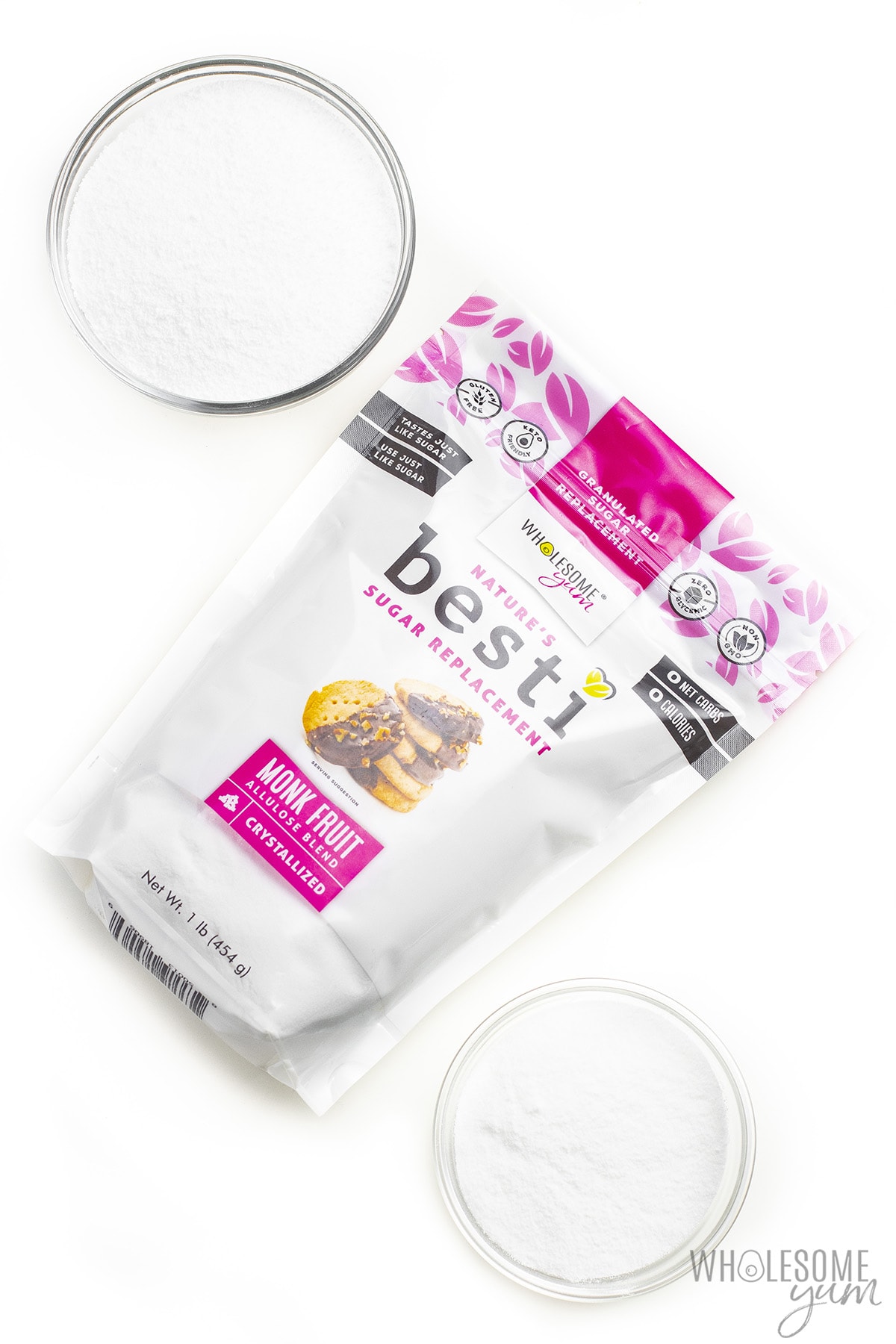
Not sure which keto sweetener to try first? I highly recommend starting with Besti Monk Fruit Allulose Blend ! It tastes and bakes just like sugar, but unlike other brands of monk fruit, it also dissolves and browns like sugar as well.
If you’re interested in keto sweeteners, also check my keto foods list . You can also use my sweetener conversion chart to convert between different sugar alternatives.
Types Of Sugar Substitutes

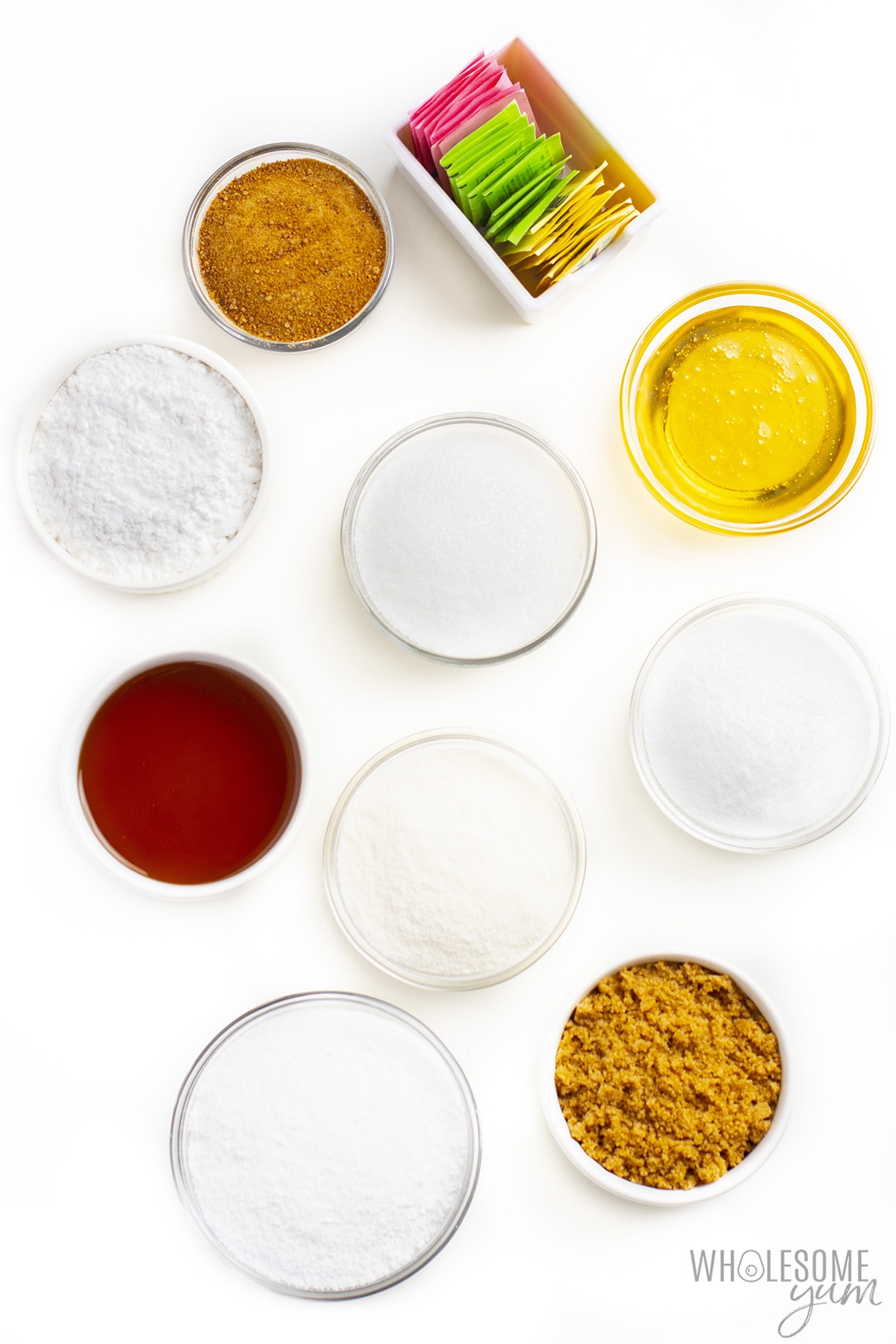
For when you want that sweet taste without resorting to white sugar, there are many types of sugar substitutes to choose from. Below is an overview of all the different kinds, and we’ll cover the properties, pros, and cons of each in this article.
- Sugar Alcohols – Erythritol, xylitol, and others polyols (ending with “ol”).
- Plant-Based Sweeteners – Monk fruit, stevia, and chicory root.
- Allulose – A new natural keto sweetener that’s in a category by itself. (I’ll explain why below!)
- Syrups – Honey, maple syrup, and agave.
- Date & Coconut Sugar – Natural sugars sourced from dates and coconut.
- Artificial Sweeteners – Asparatame, saccharin, acesulfame potassium, and sucralose.
- Brown Sugar Substitutes – Variations of one of the above.
- Powdered Sugar Substitutes – Any of the above ground to a fine powder.
One of the most significant measuring tools for sugar alternatives is glycemic index ( GI ), which measures how much they increase blood sugar levels. The lower, the better, but there are other factors outlined below.

Sugar Alcohol Sugar Substitutes: Erythritol & Xylitol
Sugar alcohols are sugar substitutes that can occur naturally in fruits and vegetables, or be produced by fermenting plant sugars. Because the body either does not absorb or metabolize them, they contain fewer calories (some of them have none — making them “non-nutritive sweeteners”) and have a smaller effect on blood glucose levels than sugar does.
Erythritol Sweetener
Erythritol sweetener is my favorite of the sugar alcohols and a very popular keto sweetener. It has very little aftertaste, aside from a slight cooling sensation if used in large quantities. It’s 70% as sweet as sugar.
Erythritol is naturally occurring in many fruits, but the granulated kind is made by fermenting glucose, usually from corn. However, because of how fermentation works, there is no corn remaining in the end product.
Erythritol has a glycemic index of 0, meaning it does not spike insulin. In comparison, xylitol has a glycemic index of 7, maltitol has a glycemic index of 35, and sucrose (table sugar) has a glycemic index of 65. The higher the number, the worse they are as sweeteners for diabetics.
Is Erythritol Keto?
Yes, absolutely! Because it is not metabolized, erythritol is keto and suitable for low carb diets. It has 0 grams net carbs.
Xylitol Sweetener
Xylitol is another popular natural sugar alcohol, made by fermenting corn (in the same way as erythritol) or birch.
Is Xylitol Keto?
Yes, xylitol is keto friendly, but less so than other sugar substitutes. Our bodies don’t absorb most of it, but since its glycemic index is 7 (not zero like many other sugar alternatives), it can still spike blood glucose and insulin slightly.
Other Sugar Alcohols
There are many other sugar alcohols, but they have less desirable qualities. Maltitol, sorbitol, mannitol, and isomalt are the most common ones used in commercially packaged “sugar-free” products. Unfortunately, these can actually have a substantial effect on blood sugar. They also cause stomach upset and diarrhea more often than erythritol and xylitol do. I recommend avoiding them.
Benefits Of Erythritol & Xylitol:
- Erythritol – Since this sugar substitute has no calories, no carbs, no sugar, does not raise blood glucose levels, and tastes great, that makes it an almost perfect low carb sugar substitute. As a bonus, it can reduce absorption of fructose, which is not good for us. Erythritol also has anti-oxidant properties and can remove free radicals in the bloodstream [ * ].
- Xylitol – One of the biggest advantages of xylitol is that it measures 1:1 like sugar in terms of sweetness. Unlike erythritol, it has no aftertaste (or cooling effect) and tastes closer to sugar. Toothpaste often contains xylitol, because it can actually help prevent tooth decay [ * ].
To learn about the pros and cons of baking with erythritol, see the Comparison Of Sugar Substitutes For Baking section below.
Plant-Based Keto Sweeteners: Monk Fruit & Stevia
Plant-based healthy sweeteners are derived from plants like monk fruit, stevia, and chicory root. Their sweetness comes from extracts or prebiotic fibers. These are natural sweeteners and are not artificial, but watch for additives on ingredient labels.
Pure monk fruit and stevia sugar substitutes (with no added ingredients) have a very concentrated sweetness, hundreds of times as sweet as sugar. This is why they are often called high-intensity sweeteners . They can be bitter on their own and are difficult to use in baking in their concentrated form. Because of this, most brands blend them with other ingredients, such as erythritol (good), maltodextrin or dextrose (not good — these are other names for sugar), or allulose (great — and this is what Besti Monk Fruit Sweetener contains).
Monk Fruit Sweetener
Monk fruit, also known as luo han guo , is a round green melon native to central Asia. Traditional Chinese medicine has used it for at least hundreds of years, with applications including treatment of diabetes and respiratory illnesses [ * ]. For our purposes, monk fruit makes a wonderful sugar substitute.
Monk fruit keto sweetener is collected from the monk fruit itself. After removing the skin and seeds, the fruit is crushed and the juice inside is collected. The end result is very concentrated, up to 400 times as sweet as sugar. From here, it can be suspended in liquid, dried into a pure powder, or blended with other sugar alternatives to make a more suitable sugar substitute for baking and cooking.
Is Monk Fruit Keto?
Yes, monk fruit is keto friendly. It has a glycemic index of 0. However, watch for hidden sugars on ingredient labels for monk fruit.
Mogroside V In Monk Fruit:
Different brands of monk fruit extract come with different levels of Mogroside V, which is the component in monk fruit extract that makes it sweet. This affects how sweet they are and whether they have any aftertaste, as lower concentrations are actually more bitter.
The highest grade is 50% Mogroside V, but most brands use lower grades for cost savings (if they don’t specify, it’s usually 30%). Most brands also blend the monk fruit with erythritol. This can lead to a cooling aftertaste and sometimes stomach upset (see the Side Effects section below).
Where To Buy Monk Fruit
This is why I recommend Besti Monk Fruit Allulose Blend as the best brand of monk fruit sweetener. It has the highest grade of Mogroside V (50%), is non-GMO, and is blended with allulose (not erythritol), which bakes well (see the Comparison Of Sugar Substitutes For Baking section below!), has no aftertaste, and no side effects. You can check the Wholesome Yum Foods store locator for a store near you, or buy it online:
- Besti Monk Fruit Allulose Blend – Also available on Amazon .
- Besti Powdered Monk Fruit Allulose Blend – Also available on Amazon .
- Besti Brown Monk Fruit Allulose Blend – Also available on Amazon .
Stevia Sweetener
Some cultures have used stevia leaves have been used as a natural sugar substitute for over a thousand years. Steviol glycosides are the active compounds derived from the stevia rebaudiana plant. They can be up to 150 times as sweet as sugar.
To make stevia sugar substitute, the leaves are dried, then steeped in hot water, like tea. Next, there is a filtering process to achieve concentration and purity. Stevia extract can be dried into a powder or suspended in liquid form.
The main issue with stevia is that it can have a bitter aftertaste, which is worse when using larger quantities. Blending it with other sweeteners, like erythritol, can help. The bitterness can also vary among brands, or even among batches from the same brand, because the age of the stevia plant leaves plays a role. Younger leaves have less bitterness, so how and when they are harvested will impact the aftertaste that results.
Is Stevia Keto?
Yes, stevia is keto friendly, if you can get past the bitter aftertaste. It has a glycemic index of 0. However, watch for hidden sugars on ingredient labels. Many brands of stevia use maltodextrin or dextrose (sugars) as a filler.
Chicory Root & Inulin Sweetener
Chicory root is the root of the Belgian endive plant and has long been used as a coffee substitute. It contains soluble fibers called inulin and fructooligosaccharides (FOS), both of which are responsible for sweetening [ * ]. Inulin and oligosaccharides are also found in other plants, but are most concentrated in chicory root.
Is Chicory Root Keto?
Inulin is a carbohydrate that human digestive enzymes cannot break down. Since we cannot digest it, it is a low carb keto sweetener and has zero net carbs.
Benefits Of Plant-Based Sweeteners:
- Monk Fruit – The mogrosides in monk fruit have been used as treatment for sore throats, remove inflammation, and can help with diabetes and even cancer [ * ].
- Stevia – Pure stevia does not raise blood glucose levels. Stevia also has anti-microbial, anti-fungal, anti-tumor, anti-oxidant, and anti-diabetic properties [ * , * ].
- Chicory Root – Chicory root has numerous benefits including stress reduction, improvement in gut health (since it’s a prebiotic), and prevention or delay of diabetes. It even has anti-inflammatory properties [ * , * , * , * ].
To learn about the pros and cons of baking with monk fruit and stevia, see the Comparison Of Sugar Substitutes For Baking section below.
The Best Sugar Substitute: Allulose
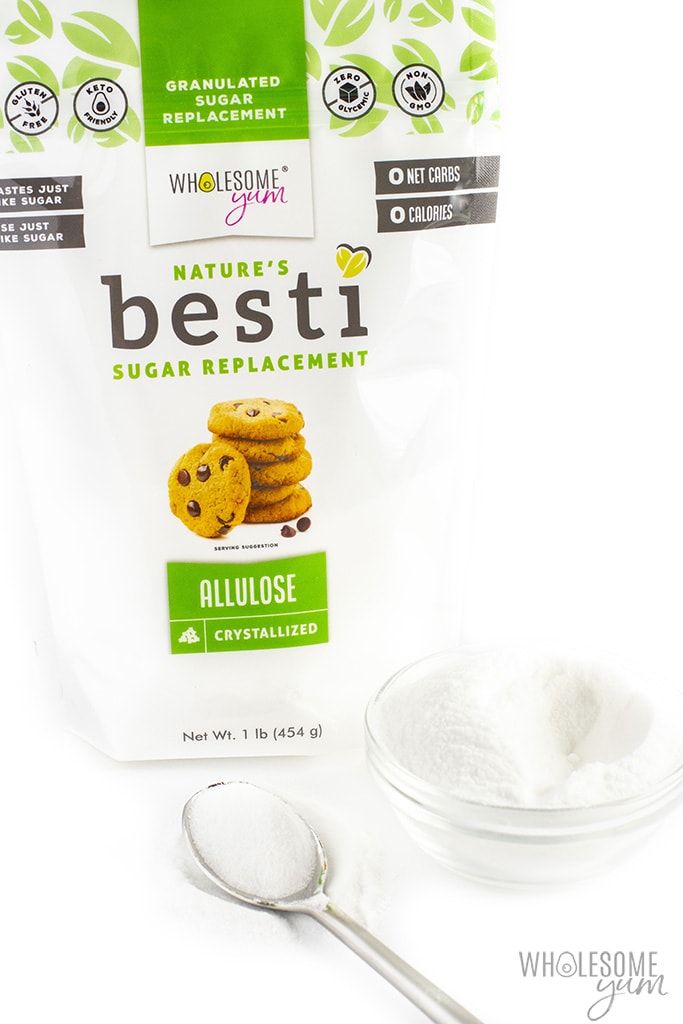
Allulose is a relatively new natural, healthy sugar substitute with incredible benefits for cooking and baking. Even though it’s plant based, it’s neither a sugar alcohol nor an extract — it’s actually a rare type of sugar that we can’t absorb, which puts it in its own category. Despite being the same family as sugar, allulose has a glycemic index of 0 and 0 net carbs, too. Like erythritol, allulose is 70% as sweet as sugar.
Being in the same family as sugar makes allulose totally different from other keto sugar substitutes. (That’s why it ends with “ose”, just like glucose, fructose, or lactose do.) The difference from other sugars is that we can’t metabolize allulose [ * ]. That means it tastes and behaves like sugar without the problems of sugar. In April 2019, the FDA ruled that sugar counts on nutrition labels do not need to include allulose [ * ].
Even though using allulose as a packaged keto sweetener is relatively new, it has been around for a long time, because it’s naturally occurring in fruit, maple syrup, and other plants. Unfortunately, the amounts in fruit are small and difficult to extract. For this reason, allulose for us to consume is made just like erythritol, via a natural fermentation process.
Is Allulose Keto?
Yes, allulose is a natural healthy sweetener. With 0 glycemic index and 0 net carbs, it’s excellent for keto and low carb diets.
Allulose Benefits:
The biggest benefits of allulose are how it behaves when you cook with it — much closer to sugar than other sugar alternatives. Being in the same family, it bakes, tastes, browns, and dissolves just like sugar does. (See the Comparison Of Sugar Substitutes For Baking section below for more details.) In addition, allulose has numerous health benefits:
- Allulose has a glycemic index of zero and does not impact blood sugar levels [ * ].
- Promising studies show that test subjects, after consuming allulose, had lower blood glucose levels [ * , * ].
- Studies on rats show that allulose may help reduce body fat, including belly fat [ * , * ].
- Studies link allulose consumption to a reduction in fat storage in the liver [ * , * ]. This condition that can otherwise lead to insulin resistance and diabetes.
Where To Buy Allulose
I highly recommend Besti Monk Fruit Allulose Blend for an allulose-based sweetener that measures just like sugar. It still has all the benefits and baking properties of allulose. You can also buy plain allulose:
- Wholesome Yum Allulose – Also available on Amazon .
- Wholesome Yum Powdered Allulose – Also available on Amazon .
Liquid Healthy Sweeteners: Syrups With Natural Sugar
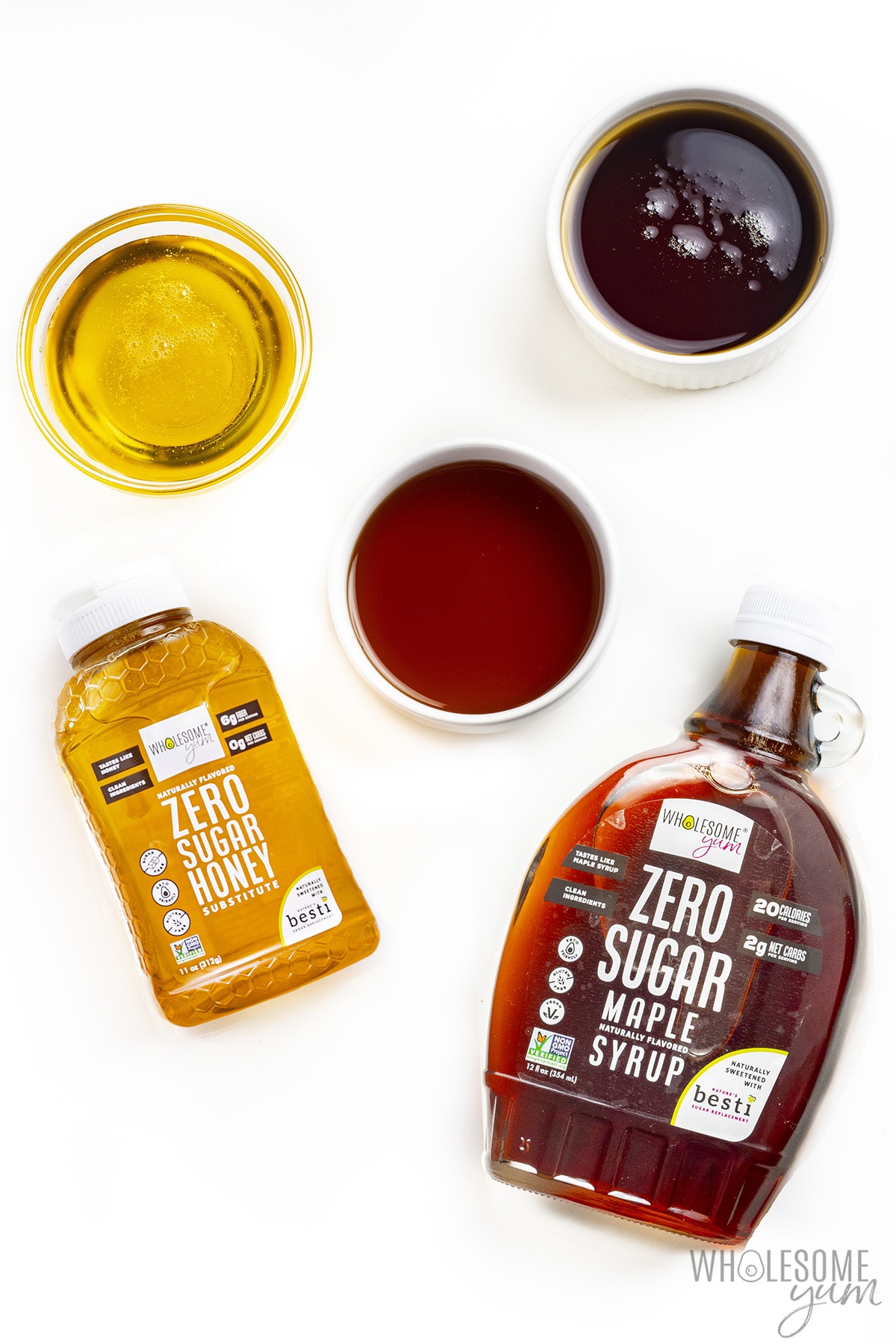
Many people use honey, maple syrup, or agave as healthy sweetener alternatives to sugar, and they are also paleo friendly. This can work if you don’t need a keto sweetener and they fit your lifestyle, and they do have benefits…
Benefits:
- Honey – Honey is very high in antioxidants [ * ]. Its chemical structure also makes it a natural antimicrobial [ * ] and cough suppressant [ * ]. It has even been linked to reduction of cancer cells in lab tests [ * ].
- Maple Syrup – Maple syrup is rich in antioxidants as well, plus minerals such as calcium, potassium, zinc, iron, and manganese.
- Agave – Agave has a lower glycemic index than other liquid healthy sweeteners like maple syrup and honey, but fewer benefits beyond that.
Drawbacks:
Unfortunately, these sweeteners also have their drawbacks compared to some of the other sugar alternatives, particularly if used as sweeteners for diabetics:
- Glycemic Index – Maple syrup has a glycemic index of 54, honey clocks in at 59, and agave comes in at a more moderate 19. This means that despite their benefits, all of them will spike blood sugar and insulin. They are not suitable sweeteners for diabetics or for a low carb lifestyle. Considering that many of the other substitutes on this page have a glycemic index of zero, there are much better options.
- Calories – Even though honey, maple syrup, and agave are healthy sweeteners compared to table sugar, they are still high in calories: 60 for honey, 52 for maple syrup, and 62 for agave — and that’s in just one tablespoon [ * , * , * ].
- Fructose – In particular, agave is higher in fructose than many sweeteners, which is linked to insulin resistance [ * ]. Fructose is almost entirely metabolized in the liver. With too much fructose, liver will start converting it to fat, which some research suggests could lead to fatty liver disease [ * , * ]. Honey also has a moderate amount of fructose (40%), wile maple syrup doesn’t have much.
Where To Buy Keto Honey & Maple Syrup
If you need keto sweeteners that will taste and behave like honey and maple syrup, try Wholesome Yum’s sugar-free versions. They are naturally sweetened with Besti (monk fruit with allulose), naturally flavored from real honey and maple, measure 1:1, and have the same consistency — but without the sugar, calories, and insulin spike. You can check the Wholesome Yum Foods store locator for a store near you, or buy them online:
- Wholesome Yum Zero Sugar Honey – Also available on Amazon .
- Wholesome Yum Zero Sugar Maple Syrup – Also available on Amazon .
Granulated Sugar Alternatives: Date & Coconut Sugar
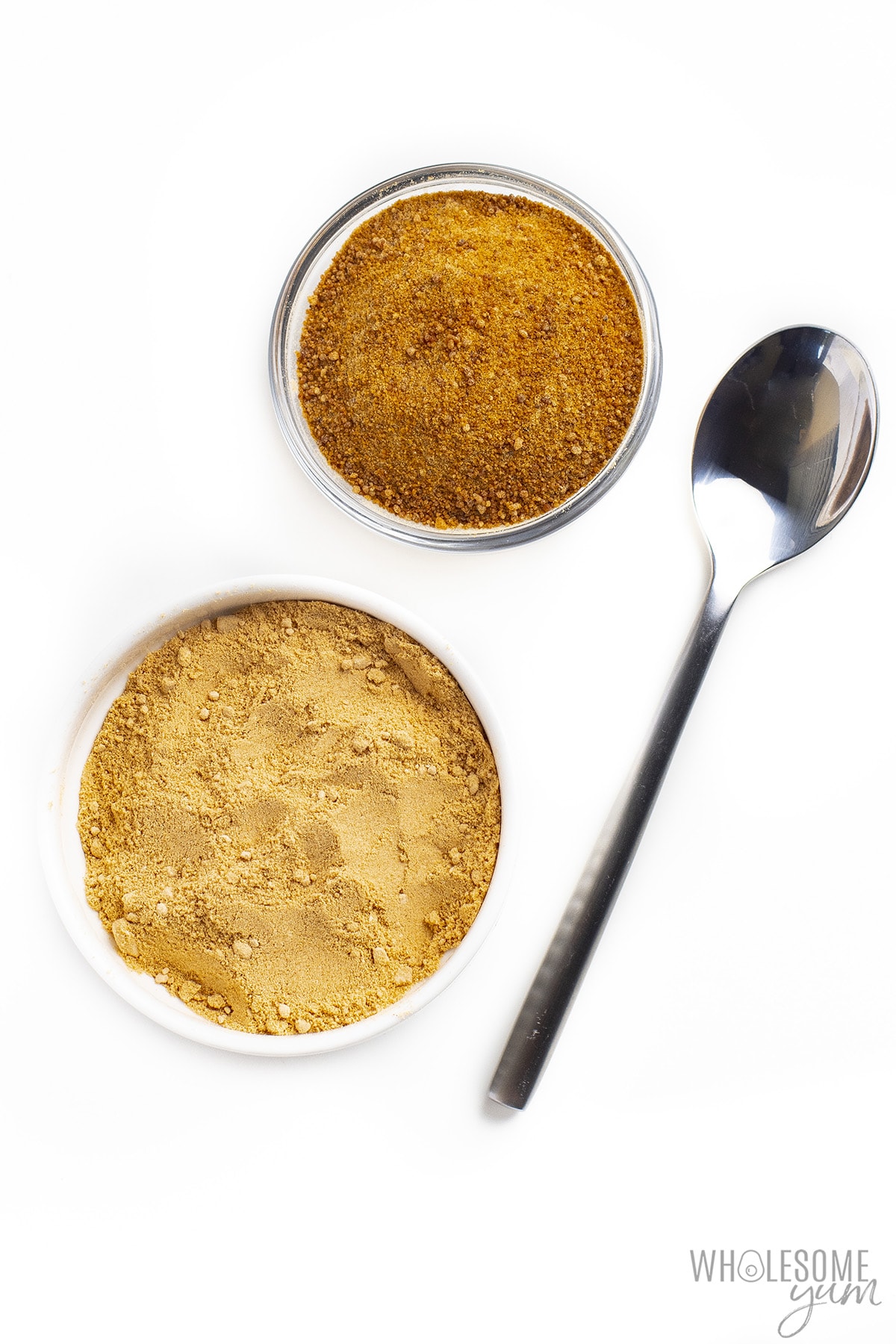
Coconut sugar and date sugar are common paleo sugar substitutes. People not following the diet also use them as a natural healthy sweetener option.
- Coconut Sugar – Coconut sugar is made from coconut palm sap, which is dehydrated to make granulated coconut sugar. It does retain a small amount of nutrients from the sap, and has a small amount of inulin, which can support gut health and slow down blood sugar spikes [ * ]. However, it still has a high glycemic index of 54 and is as high in calories as conventional table sugar.
- Date Sugar – Date sugar is one of the least processed sweeteners. It’s the ground-up equivalent of whole, dried dates, so it retains a lot of the vitamins, fiber, and other nutrients of the dried fruit. It has a glycemic index of 42, which is lower than many nutritive healthy sweeteners, but still fairly high. On the negative side, date sugar does not melt or dissolve, and has a strong date taste that doesn’t work well in all recipes.
Both of these options are more natural and better than white table sugar. However, they do not make suitable keto sweeteners for diabetics.
Artificial Sweeteners & Why To Avoid Them
Sometimes people call monk fruit, stevia, allulose, and erythritol “artificial sweeteners”, but they are not. They are simply natural sugar substitutes. Yes, there is some processing involved to achieve the granulated keto sweeteners you can purchase for home use. But this is no less natural than the processing needed for coconut sugar, maple syrup, or white table sugar.
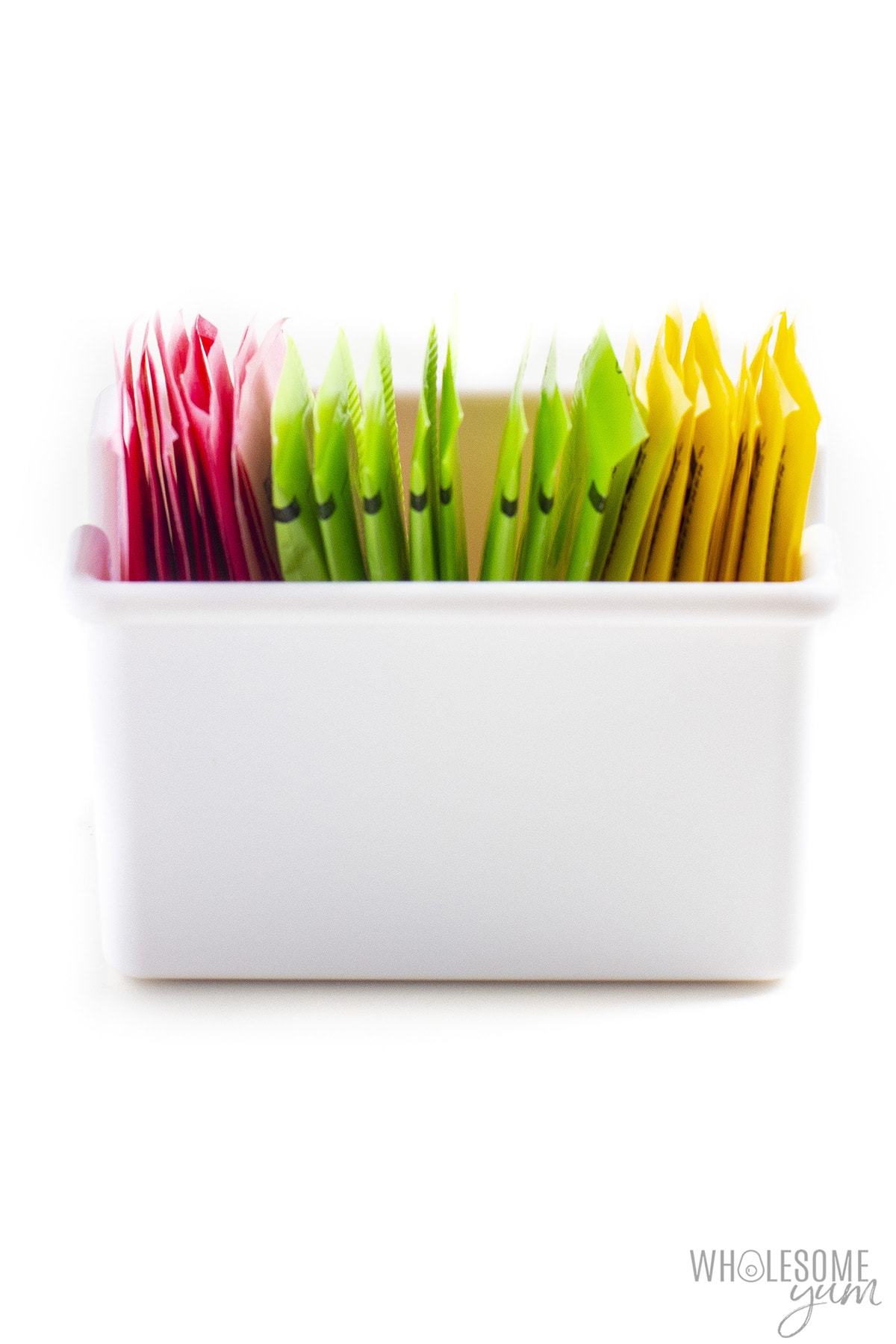
On the other hand, there are several truly artificial sweeteners (not found in nature) and each has potential health concerns:
Asparatame
Asparatame is known under the brand names Equal and Nutrasweet. It’s also the most common sweetener in diet sodas. It has been linked to cancer in rats and kidney strain [ * , * ]. It also contains phenylalanine, which can be dangerous for people with phenylketonuria (a rare disorder that causes sensitivity to this amino acid), and can affect certain medications. Neotame, a newer artificial sugar substitute derived from asparatame, has been linked to disruption of gut flora [ * ].
Finally, asparatame is 200 times sweeter than sugar and loses sweetness when heated. For these reasons, it’s not the best sugar substitute for baking.
Saccharin
Created in 1879, saccharin is the oldest artificial sugar substitute, often recognized by the brand name Sweet’N’Low. For many years, it was touted as the best sweetener for diabetics.
However, a 2019 study suggested that long-term consumption increases the risk of obesity, diabetes, liver and renal impairment, and even brain cancer [ * ]. Saccharin also has a bitter aftertaste.
Sucralose
Rumors have circulated that sucralose causes cancer. But, the biggest study supporting this claim involved feeding rats an amount of artificial sweetener that no human would reasonably consume (equal to hundreds of cans of diet soda a day) [ * ]. Other studies linking sucralose and cancer show that exposing it to higher temperatures, along with glycerol (found in fats), produced cancer-causing compounds [ * ]. This could mean that baking with sucralose isn’t a great idea.
In addition, a more clear issue with sucralose is that it can impact digestion and immunity by altering gut flora. A study in rats showed a reduced amount of “good bacteria” in the gut after consuming sucralose [ * ].
Acesulfame Potassium
Acesulfame potassium, also known as Ace-K, is an artificial sweetener that has been used in foods since 1988. Its chemical structure is similar to saccharin. A 2017 study in mice found that this sugar substitute affects the gut microbiome and can lead to weight gain [ * ].
Conclusion About Artificial Sugar Substitutes:
All of these artificial sugar alternatives do have zero calories and a glycemic index of zero. But, I wouldn’t call them healthy sweeteners or even keto sweeteners (except maybe for dirty keto). In addition to the specific issues above, my biggest concern with them is time. The amount of time we’ve had to observe their effects on humans is much smaller, compared to the time that people have been exposed to natural sweeteners found in plants. With so many natural choices available, it’s not worth the risk.
Best & Worst Sweeteners For Diabetics Or Keto
Whether you have diabetes or are following a keto diet, the best sugar substitutes for you to use will be the same — those with zero glycemic index. Most people following a low carb lifestyle for health reasons would also want natural sweeteners.
Best Keto Sweeteners:
- Natural Granulated Keto Sweeteners – Monk fruit, stevia, or allulose. You can also use these in their powdered or brown forms.
- Liquid Keto Sweeteners – Such as keto maple syrup , keto honey , liquid allulose , liquid monk fruit or stevia, or zero sugar simple syrup (made with liquid allulose and monk fruit). Liquid oligosaccharides (from chichory root) may be okay for keto, but diabetics may want to avoid them.
Avoid These Sweeteners For Diabetics & Keto:
- Refined Sugars – Such as white table sugar or brown sugar. Most people know this part.
- Natural Sugars – Coconut sugar and date sugar.
- Liquid Sweeteners That Contain Sugar – Maple syrup, honey, rice syrup, agave syrup, corn syrup, and blackstrap molasses (except the latter in very small amounts).
- Artificial Sweeteners – These will not spike blood sugar, but they are not recommended for the other reasons described in the Artificial Sweeteners & Why To Avoid Them section above.
Even though some people consider these healthy sweeteners and they may contain nutritive qualities, they are all simple sugars from a chemistry standpoint. While the ratios between glucose and fructose can vary, they will all spike blood sugar.
Side Effects Of Sugar Substitutes & How To Avoid Them
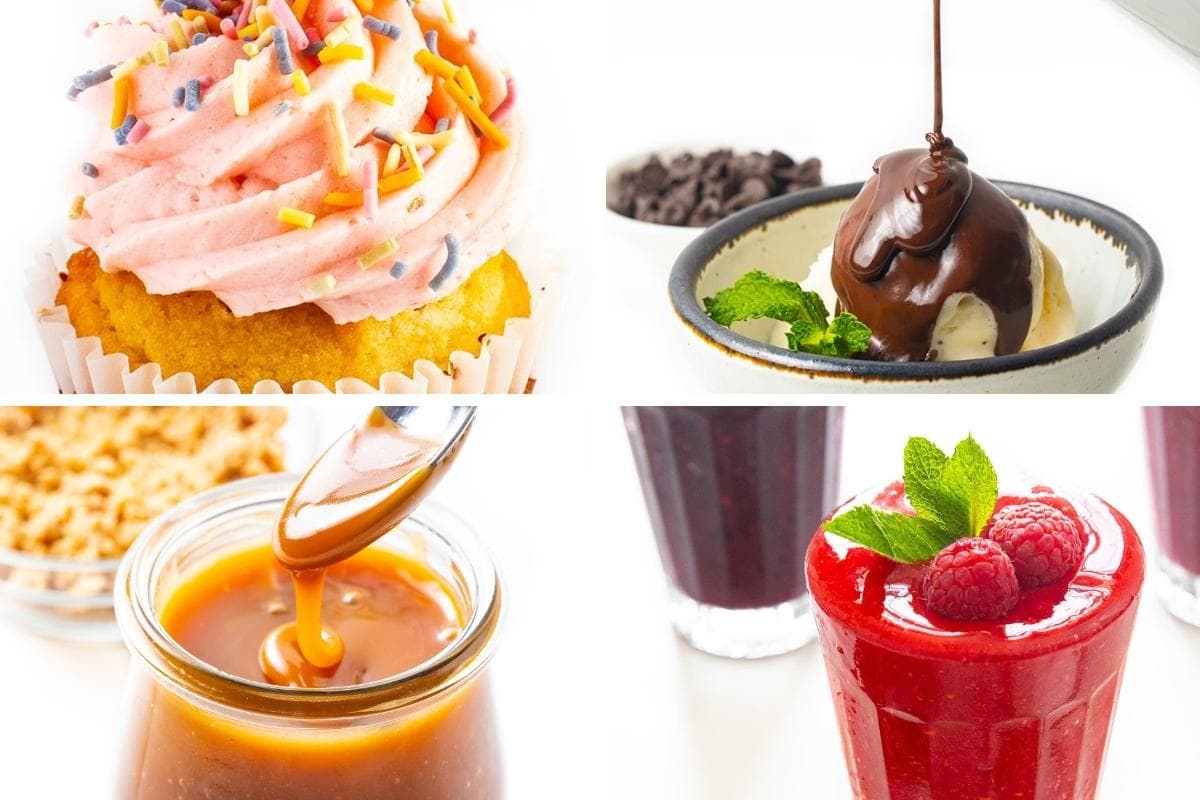
The natural sugar substitutes in this article are pretty mild in side effects, but they are possible:
Side Effects Of Sugar Alcohols:
Because sugar alcohols are not absorbed well, they can cause stomach upset, bloating, or diarrhea. Their impact on blood sugar and potential for side effects varies depending on the type of sugar alcohol.
- Erythritol – Although it’s in the sugar alcohol family, erythritol does not raise blood glucose like some polyols do [ * ]. It is also less likely to cause gastrointestinal distress, because most of it gets absorbed in the small intestine (but is poorly metabolized [ * ]) and is later excreted unchanged into the urine. All other sugar alcohols reach the large intestine instead, which is why they are more likely to cause stomach upset. Still, erythritol can cause stomach issues for some people. Erythritol can also create a cooling aftertaste in cooking and baking.
- Xylitol – Unlike erythritol, xylitol does not get absorbed in the small intestine. Instead, it proceeds to the large intestine, and the reaction between the natural bacteria there and the xylitol is what can cause distress. How much varies from person to person. People with dogs in the house may want to avoid keeping xylitol around, because even a small accidentally ingested amount can be lethal for a dog [ * ].
Side Effects Of Monk Fruit, Stevia, & Chicory Root:
Side effects with monk fruit and stevia are rare. However, since monk fruit and stevia are very concentrated in sweetness, most brands blend it with other sugar substitutes to make them measure like sugar does (check those labels!). And these other food additives can have other side effects in addition to the below.
- Monk Fruit – There are no reported side effects of monk fruit sweetener. Although the Food & Drug Administration only approved it in 2010, Eastern cultures have used it for hundreds of years.
- Stevia – Because the stevia plant is in the ragweed family, people with ragweed allergies can be allergic to stevia as well, leading to headaches. It’s not dangerous, but unpleasant, so if this affects you, try other sugar substitutes instead.
- Chicory Root – Oligosaccharides, including inulin, do not cause stomach upset in most people, when used in reasonable amounts. However, like any fiber, they can cause stomach upset if you consume too much. Like stevia, chicory root is also in the ragweed family, so is best avoided for those with ragweed allergies. A study also showed that people allergic to birch should avoid chicory root [ * ].
Allulose Side Effects:
Many keto sweeteners contain erythritol (which can cause gas and bloating) or bulking agents (which can spike your blood sugar). Compared to other alternative sweeteners, allulose does not cause gas or bloating [ * ], and side effects are minimal.
Tips For Minimizing Side Effects:
- Introduce slowly – Start with consuming just a little bit of sweetener to see how you react. Often times, you may be able to gradually increase the amount once your body gets used to it.
- Use blends – Using a low carb sweetener blend can help reduce side effects because you aren’t getting too much of any one sweetener. If you notice a reaction to a particular type, try another.
- Avoid high-glycemic sugar alcohols – Maltitol, sorbitol, and other polyols that aren’t erythritol or xylitol cause stomach upset in most people. Plus, they spike blood sugar.
- Consider eliminating all sugar alcohols – If you have a sensitive stomach, it’s best to avoid xylitol and possibly erythritol (or any monk fruit or stevia blends containing them).
- Be cautious with fibers – Prebiotic fiber syrups can cause bloating and gas for those sensitive to too much fiber.
- Skip stevia and chicory for ragweed allergies – Stevia and chicory root may cause headaches for people that are allergic to ragweed, birch, and similar plants. Chicory root may cause other allergic reactions as well.
The keto sweetener with the least side effects is allulose (or monk fruit allulose blend ) , because it’s chemically most similar to sugar — without the sugar spike, of course!


Baking Sweetener Considerations
There are many factors that go into choosing sugar substitutes for baking. Their properties vary, and most don’t behave exactly like sugar does.
The number one question I get in baking recipes is people asking if they can use a different sweetener. You can use the sweetener conversion calculator here , but before you do, consider these factors when making substitutions:
- Ratio of wet to dry ingredients: People often ask if they can replace a liquid sweetener with a granulated one, or vice versa. Another common question is wanting to replace a granulated sweetener, like erythritol, with a very concentrated one, like pure stevia. The answer is usually no. The problem with these swaps is that it alters the ratio between wet and dry ingredients. If that ratio changes, the end result won’t have the same texture or consistency. It could be too dense, too wet, too dry, or fall apart. Therefore, it’s best to substitute sweeteners with similar volumes and consistencies.
- Function as a bulking agent: This issue is similar to the above. If you are reducing bulk by using a more concentrated sweetener than a recipe calls for, you will need to replace it with something else (such as more flour). Then, balance out the sweetness accordingly. If you increase bulk by using a less concentrated sweetener, add more wet ingredients to absorb the extra dry sweetener.
- Level of sweetness: This is the easiest one. Different sugar substitutes have different levels of sweetness. So, you can’t just replace one with another in the same quantity. If you do, your end result could be too sweet, not sweet enough, or worse, have an awful aftertaste. This is where the conversion chart below can help. It doesn’t address differences in wet/dry ingredients or bulk, but it does help you convert sweetness levels as a starting point.
- Browning & Caramelization: Allulose-based sweeteners brown more readily and quickly than other types. Often times, the baking temperature or time may be lower for recipes using Besti compared to other sweeteners. Further, erythritol-based sweeteners will hardly caramelize at all, so an allulose-based sweetener is best for this purpose.
- Dissolving: Any sweetener that contains erythritol (whether plain or a blend) will not easily dissolve. This can lead to a gritty texture compared to liquid or allulose-based sweeteners.
- Moisture: Allulose-based sweeteners lock in moisture (read: more moist baked goods, which is a great thing!), sugar alcohols tend to be drying, and other sugar substitutes are mostly neutral in this area. If you make a substitution, this can affect how dry the end result turns out.
Comparison Of Sugar Substitutes For Baking
Because different regular and keto sweeteners vary in consistency, volume, and level of sweetness, they will behave differently in baking.
Erythritol In Baking:
Erythritol is about 70% as sweet as sugar, so the correct conversion would indicate to use a little more compared to sugar (about 1.3 times more). However, many people use it as a 1:1 replacement for sugar without noticing a difference.
In most situations, baking with erythritol is similar to baking with sugar. You can mix it with dry ingredients or cream butter with it. However, there are several main differences when baking with erythritol instead of sugar:
- Erythritol does not dissolve quite as well as sugar. It’s still possible, just a little more difficult. For any uses where a smooth texture is important, use a powdered (or confectioners) version instead for a good end result.
- Erythritol can cause a cooling sensation, similar to mint. This is the only type of aftertaste that it might have, and is more prevalent when using larger quantities.
- Erythritol does not caramelize. Depending on what you are trying to make, you would need to find an alternate way to achieve the same result.
- Erythritol may crystallize. Like it sounds, crystallization means that crystals can form when storing foods made with erythritol (especially sauces, frostings, etc.) The result is a crunchy, gritty texture instead of a smooth one. Using the powdered form can help reduce this phenomenon, but does not fully eliminate it.
Some erythritol brands, like Swerve, add other ingredients to make them measure 1:1 with sugar, but the issues above will still exist.
Monk Fruit In Baking:
Monk fruit extract by itself (either as a powder or liquid drops) is very concentrated. This makes it difficult to use as a sugar substitute in its pure form. It’s hard to get the right amount, an aftertaste is common, and you don’t get the bulking function of regular sugar.
It’s easier to use a monk fruit blend that contains another, less concentrated sweetener or bulking agent, like allulose or erythritol. Most brands labeled “monk fruit” are actually blends for this reason, and can replace sugar 1:1 in recipes.
The way a monk fruit sugar substitute behaves in baking will be similar to the bulking agent it contains. Most brands of monk fruit will behave the same way as erythritol above, whereas Besti Monk Fruit Allulose Blend will have the advantages of allulose below.
Stevia In Baking:
If you use pure stevia powder or drops, their concentration can make it difficult to use them recipes, for the same reasons as monk fruit above. With stevia, the exact conversion amount for concentrated varieties can vary widely by brand.
There are also stevia blends, much like monk fruit, that combine stevia with erythritol to offer a product that measures 1:1 like sugar. These will have the same problems in baking as erythritol above.
Regardless of brand or blend, one thing to note is that stevia in baking does not work very well with foods that are already naturally bitter. An example of this is dark chocolate, which can sometimes amplify any stevia aftertaste. However, in many other applications, it works great.
Allulose In Baking:
Allulose-based sweeteners are my top choice for keto baking — you can use them pretty much the same way you would sugar! It’s particularly great for soft baked goods, such as cookies, muffins, cakes, pancakes, etc.
Plain allulose is about 70% as sweet as sugar, so the correct conversion would indicate to use a little more compared to sugar (about 1.3 times more). However, just like erythritol, many people use it as a 1:1 replacement for sugar without noticing a difference.
However, allulose has these additional benefits over erythritol:
- Allulose creates more moist, soft baked goods. While erythritol is good for a little crunch, allulose locks in moisture beautifully, which is far more often desirable.
- Allulose browns, caramelizes and dissolves like sugar. Other sugar substitutes don’t do this.
- Allulose doesn’t crystallize. Erythritol can crystallize in certain situations, while allulose does not.
Chicory Root Fiber In Baking:
Chicory root fiber can be used cup-for-cup like sugar. However, it can have an aftertaste, so is best when blended with other sweeteners.
Artificial Sweeteners In Baking:
Artificial sweeteners, including sucralose, asparatame, and others, can vary widely in sweetness. Sucralose generally makes a decent 1:1 sugar substitute, whereas asparatame is sweeter and more bitter. However, I don’t recommend any of them, as there are much better natural healthy sweeteners to choose from.
Liquid Sweeteners In Baking:
Liquid sweeteners, including maple syrup (regular or zero sugar maple syrup ), honey (regular or zero sugar honey ), agave, and liquid inulin-based sweeteners require recipes developed for a liquid sweetener. This is because they would drastically alter the batter consistency in a baking recipe that calls for any granulated sugar or sugar alternative.
Coconut Sugar & Date Sugar In Baking:
You can use coconut sugar and date sugar in baking in the same way you’d use regular sugar. However, keep in mind that they will affect the flavor of your baked goods.
Summary Comparison Chart:
The chart below is a good summary of the most common sugar substitutes for baking. Some are keto sweeteners and some are not.
If you are on a mobile device, swipe the table below to the right to see all the info!
| Sugar Substitute | Natural | Glycemic Index | Net Carbs Per Tbsp | Sweetness Compared To Sugar | Key Baking Properties |
|---|---|---|---|---|---|
| Monk Fruit (concentrated) | Yes | 0 | 0g | 150-400X | Too concentrated to use easily in pure form. |
| Stevia (concentrated) | Yes | 0 | 0g | 100-300X | Can be bitter. Too concentrated to use easily in pure form. |
| Allulose (including blends) | Yes | 0 | 0g | 0.7X plain, 1X blends | Locks in moisture in baked goods. Dissolves and caramelizes like sugar. Browns more quickly than erythritol, so may need reduced baking time or temp. Does not crystallize. |
| Erythritol (including blends) | Yes | 0 | 0g | 0.7X plain, 1-2X blends | Can be drying in baked goods, but good for crispy results. Does not dissolve or caramelize well. May crystallize. |
| Xylitol | Yes | 7 | 3g (assumes 1/4 carbs absorbed) | 1X | Can be drying in baked goods, but less than erythritol. Good for crispy results. |
| Maltitol | Yes | 65 | 6g (assumes 1/2 carbs absorbed) | 0.7-0.9X | Typically in pre-packaged foods, not used for baking. |
| Maple Syrup | Yes | 54 | 13g | 3X | Browns, caramelizes, and imparts maple flavor. Sweetens a lot. Might need reduced baking temp. Liquid form requires special recipes. |
| Zero Sugar Maple Syrup (Wholesome Yum) | Yes | 0 | 1g | 3X | Like regular maple syrup, plus locks in moisture in baked goods. |
| Honey | Yes | 59 | 17g | 1.25X | Browns and caramelizes, and imparts mild honey flavor. Locks in moisture in baked goods. Liquid form requires special recipes. |
| Zero Sugar Honey (Wholesome Yum) | Yes | 0 | 0g | 1X | Like regular honey. |
| Agave | Yes | 19 | 15g | 1.5X | Browns and caramelizes. Liquid form requires special recipes. |
| Coconut Sugar | Yes | 54 | 12g | 1X | Browns, dissolves and caramelizes like sugar, but can be more drying in comparison. Burns at a lower temp. |
| Date Sugar | Yes | 42 | 6g | 1.5X | Does not melt or dissolve. Has a strong date flavor. |
| Aspartame, Saccharin, & Acesulfame Potassium | No | 0 | 0g | 200-400X | Typically in packets or food products, not for baking. Asparatame loses sweetness when heated. |
| Table Sugar | Yes | 65 | 12g | 1X | Behaves like what you’d expect from sugar. |
Brown Sugar Substitutes
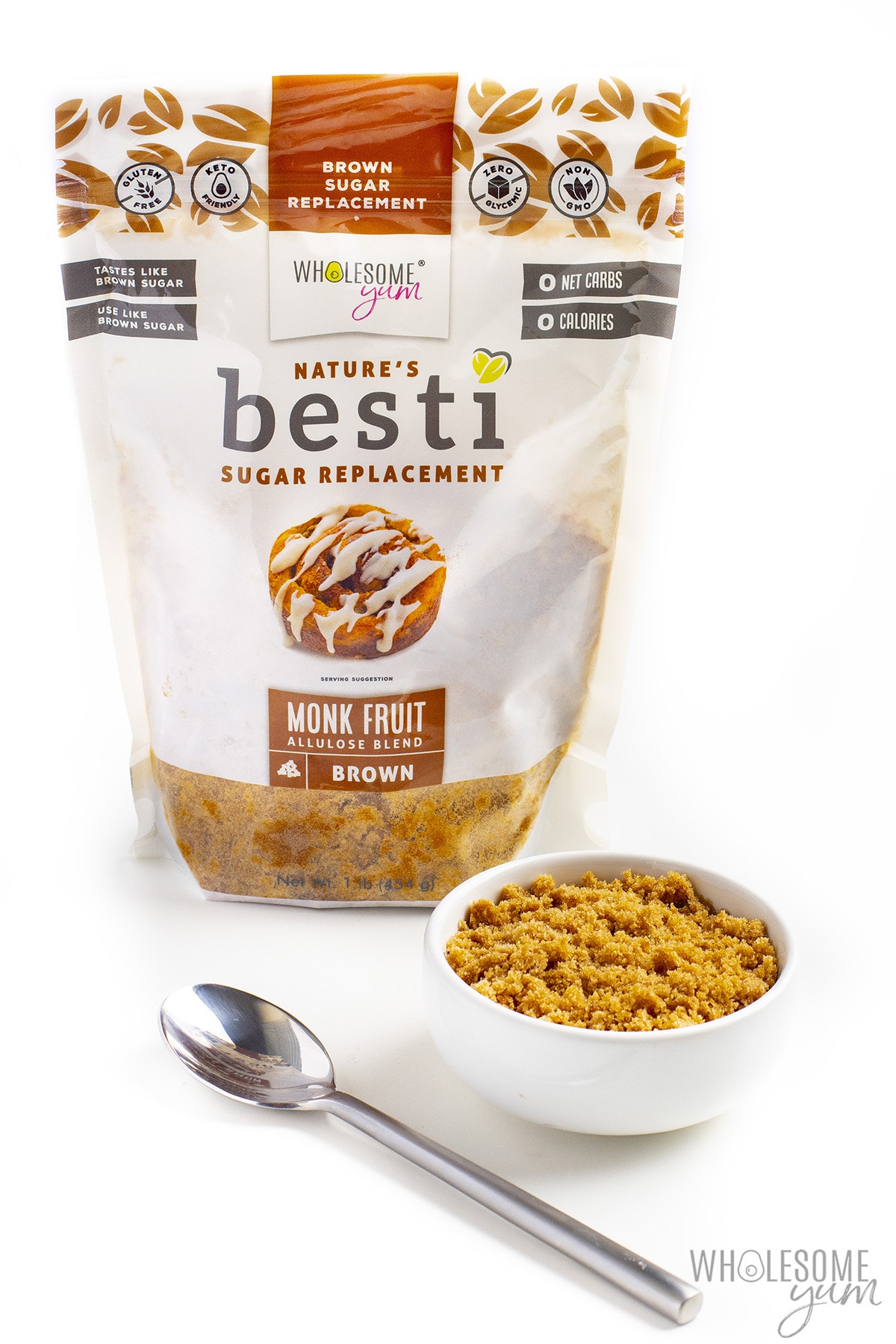
Use brown sugar substitutes when you need to replace brown sugar to achieve the desired flavor and texture. Most of these are erythritol-based, even when they are labeled monk fruit or stevia.
Where To Buy The Best Brown Sugar Substitute
Powdered Sugar Substitutes
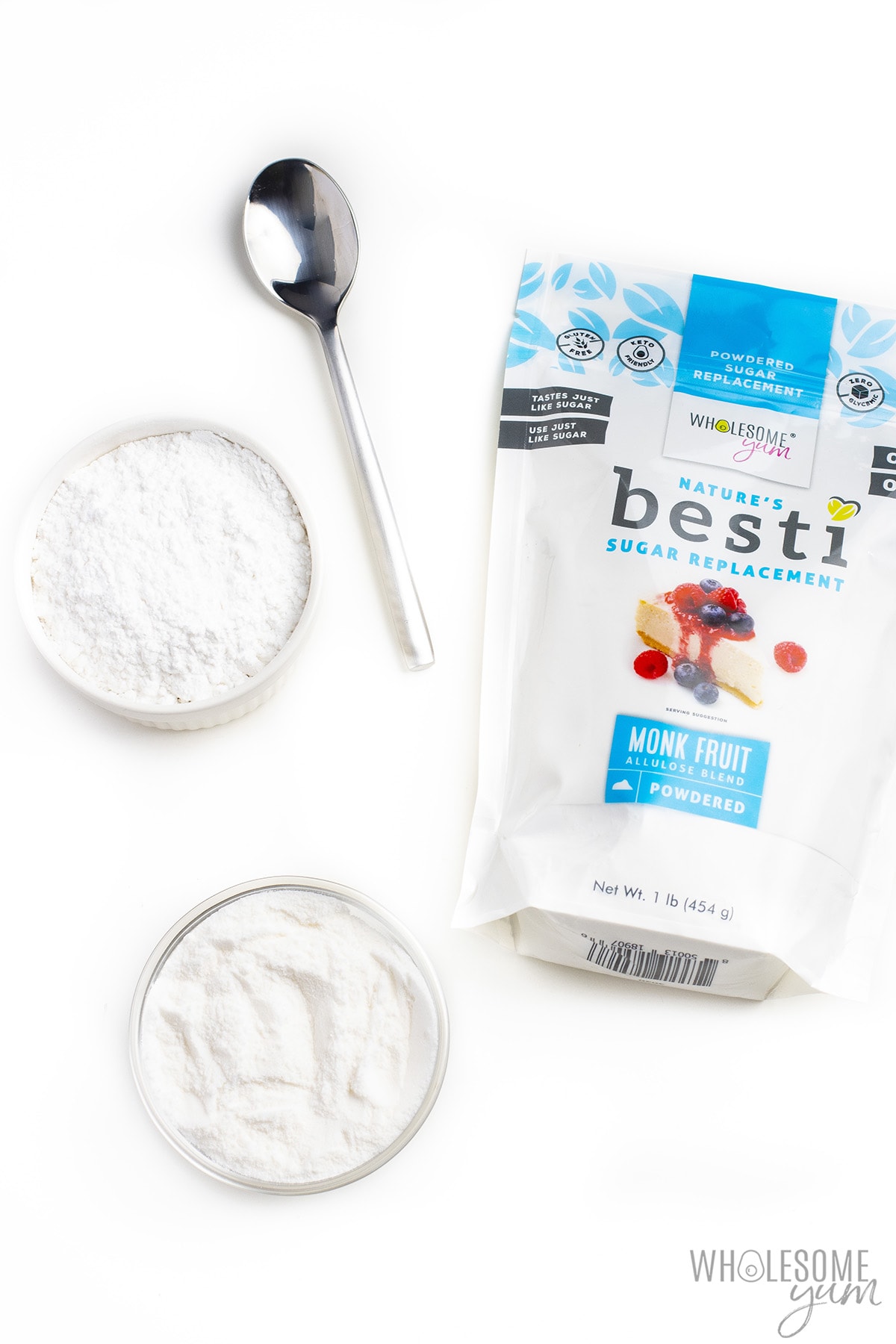
Most needs for powdered sugar alternatives arise when you need a smooth consistency, for things like drinks, sauces, dressings, frosting, glaze, etc.
Unfortunately, one big difference between most keto sweeteners and sugar is their ability to dissolve. While there are many powdered sugar substitutes, most of them use erythritol as a base. Granulated versions will definitely yield a gritty texture, but even powdered ones can have this issue. Besides, erythritol can crystallize, making the problem worse. So while powdered erythritol is an okay choice for these applications, it’s not the best one.
Where To Buy The Best Powdered Sugar Substitute
Conclusion: Using Sugar Alternatives
As you can see, there are many sugar substitutes (for baking and more) to choose from! Hopefully, you are now armed with the information you need for choosing the best keto sweeteners, sweeteners for diabetics, or simply sugar alternatives that fit your lifestyle.
FREE PRINTABLE: SWEETENER CONVERSION CHART
Join 300,000+ others to get a FREE printable conversion chart for keto sweeteners!
Free Printable: Low Carb & Keto Food List
- Want The Keto Cheat Sheet Printable PDF System?
- The Basic Keto Meal Formula
- Understanding Macros
- Keto Food Swaps
- Keto Food List
- Electrolyte Basics
- Keto Diet Types
- Want The Keto Cheat Sheet Printable PDF System?
- Recipe Reviews
Even though I have a great guide to starting a keto diet , people often ask me for a quick keto cheat sheet they can use. That’s why I created this simple keto diet cheat sheet , so that you can have all the info you need handy. We’ll cover the basic keto formula for building meals, foods to eat and to avoid, delicious keto swaps for high-carb foods, electrolyte basics, and 4 ways to follow the keto lifestyle.
You can keep reading to view this info, or download my keto cheat sheet printable pdf to print out or save ad-free on any device (plus the pdf has more details!).
Want The Keto Cheat Sheet Printable PDF System?
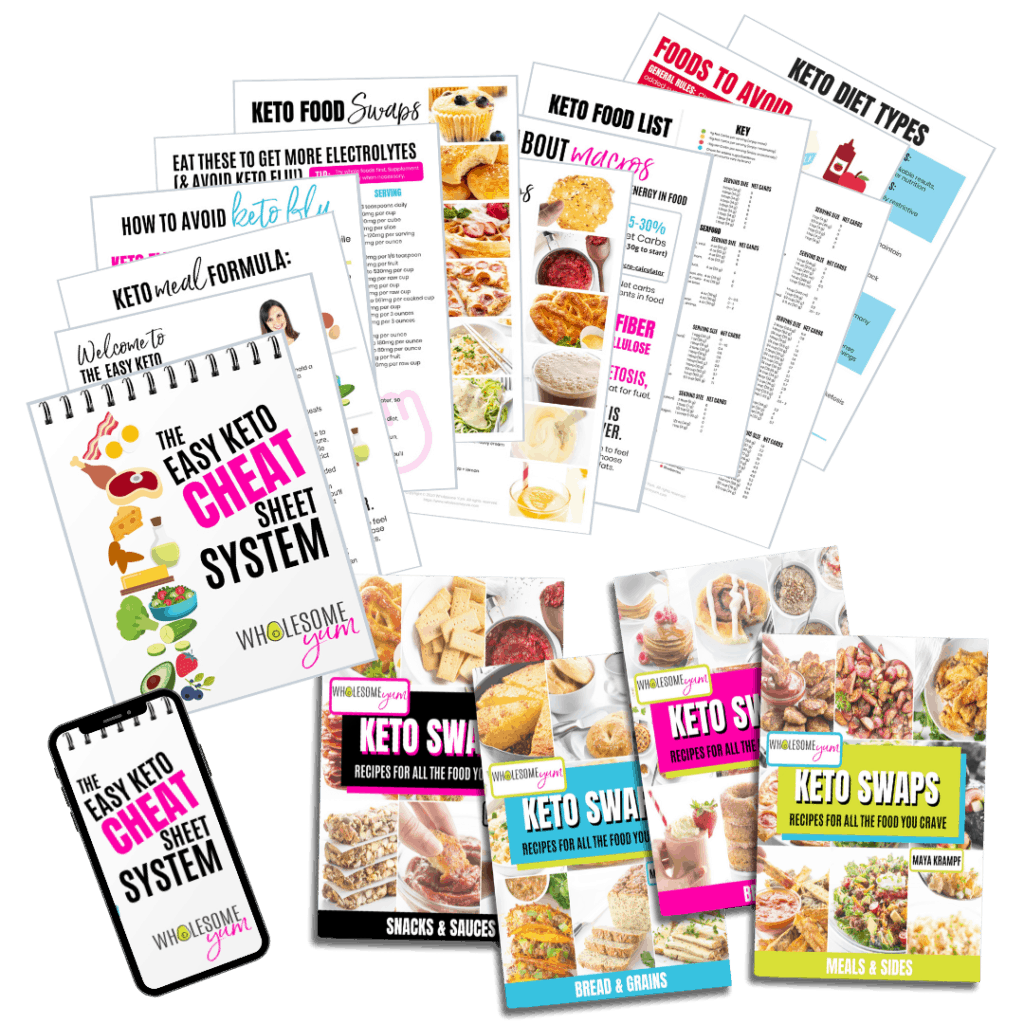
Get all this information and MORE in convenient printer-friendly format – 13 cheat sheet pages you can take with you anywhere or keep in your kitchen, plus 4 recipe cookbooks! Includes:
- Keto food list (230+ foods) – Super detailed & color-coded, with net carb counts, so you’ll know exactly what to eat.
- Foods to avoid on keto – Detailed and specific list so that you know exactly what to watch out for.
- Macros cheat sheet – Explains everything you need to know about macros to succeed on keto.
- Keto food swaps (60+ foods) – Covers virtually every food you love, so you don’t have to miss out!
- Keto meal formula – With specific food ideas, so it’s easy to mix-and-match.
- Keto flu guide – Understand what it is and exactly how to avoid it.
- Electrolyte cheat sheet – With whole food ideas + bonus keto tips.
- Keto Diet Types – Summary of 4 ways to do keto, so you can choose what fits you best.
- FOUR (4!) Keto Swaps Recipe EBooks – Dozens of recipes to replace bread, rice, potatoes, pasta, desserts, and other carbs you’d otherwise miss.
Get The Printable Keto Cheat Sheet System + EBooks (Only $37)
The Basic Keto Meal Formula
Eating keto doesn’t have to be complicated! While there are plenty of delicious easy keto recipes to choose from, you don’t even have to cook from a recipe to get started.
Simply follow the keto cheat sheet formula of protein + veggie + fat for your meals.
Be sure to choose a moderate amount of protein, only low carb vegetables (mostly ones that grow above ground), and generous fat to attain an optimal macro ratio. That’s approximately 60-75% of calories from fat, 20-25% protein, and 5-10% from carbohydrates. The table below will give you ideas for what to choose.
| Pick A Protein | Pick A Veggie | Add Fat |
|---|---|---|
| Beef Chicken Pork Eggs Lamb Turkey Fish Shellfish Protein powder Venison | Cauliflower Broccoli Zucchini Leafy Greens Cucumbers Brussels Sprouts Cabbage Asparagus Radishes Bell Peppers Jicama Celery | Butter Avocado Oil Cheese Bacon Avocado Lard Ghee Mayo Nuts MCT Oil |
Understanding Macros
Macros are macronutrients for short. They include fat, protein, and carbohydrates.
You can calculate your own macros using the macro calculator , but the macro keto cheat sheet below will explain how to look at macros when following a keto lifestyle.
Carbs Are A Limit.
Keeping carbs low is what gets you into ketosis and keeps you there. Ketosis means that you’re using fat as your primary energy source instead of sugar, and requires keeping carbs very low.
A good starting point is 20-25 grams net carbs per day, but you can experiment after a few weeks to see if your body stays in ketosis at higher levels. People who are very active may be able to do more and stay in ketosis, up to around 50 grams per day.
“Carbs are a limit” means that you set a limit for how many carbs to eat per day and don’t exceed it. You don’t have to hit that limit, so if you’re under that’s okay, just don’t go over. Ideally most of your carbs would come from low carb vegetables, and if you’re eating enough veggies, you’ll usually get close to the limit naturally.
A common misconception is that reaching ketosis requires a certain macro ratio, but it’s really only restricting your carb intake that gets you there [ * ]. In the absence of sufficient carbs to use as energy, the body will switch to using fat as fuel. This is called the metabolic state of ketosis.
Protein Is A Goal.
Protein is made up of amino acids, the building blocks of all our cells. It’s a crucial for keeping our muscles strong and for many cellular functions [ * ].
“Protein is a goal” means that you always want to eat enough protein to reach the goal each day, but not exceed it too much. You want enough for your needs, but excess protein can trigger gluconeogenesis, which is protein being converted to sugar [ * ] and can kick you out of ketosis.
Fat Is A Lever.
Fat is the primary macronutrient in a keto lifestyle, because being in ketosis means that fat is your primary fuel source. Fat as a fuel source will come from your food, and if you are losing weight, from your body.
A big advantage of a keto lifestyle is the high fat intake. It keeps you full and satisfied, making it easier to stick to, and using it as the primary fuel source makes it easier on your body to burn body fat, with a lower chance of breaking down your muscle (provided you get enough protein).
Aside from reaching your protein goal and limiting your carbs, the remainder of your calories on a keto diet comes from fat.
Don’t fear fat – it’s your main energy source on keto, and getting enough of it trains your body to use fat for fuel instead of sugar. That means that as long as you are not overdoing your overall calorie intake, you’ll efficiently burn your body fat for fuel as well.
“Fat is a lever” means that you can increase or decrease your fat intake depending on your goals and hunger levels. Increase it (along with exercise) to gain muscle, or decrease it to lose weight.
Keto Food Swaps
One of my favorite challenges is creating recipes, or just discovering, keto food swaps. These are delicious keto replacements for traditionally high-carb or high-sugar foods.
So, I created this keto diet cheat sheet with all the swaps in one place! I also have more keto food swaps in my Easy Keto Cookbook .
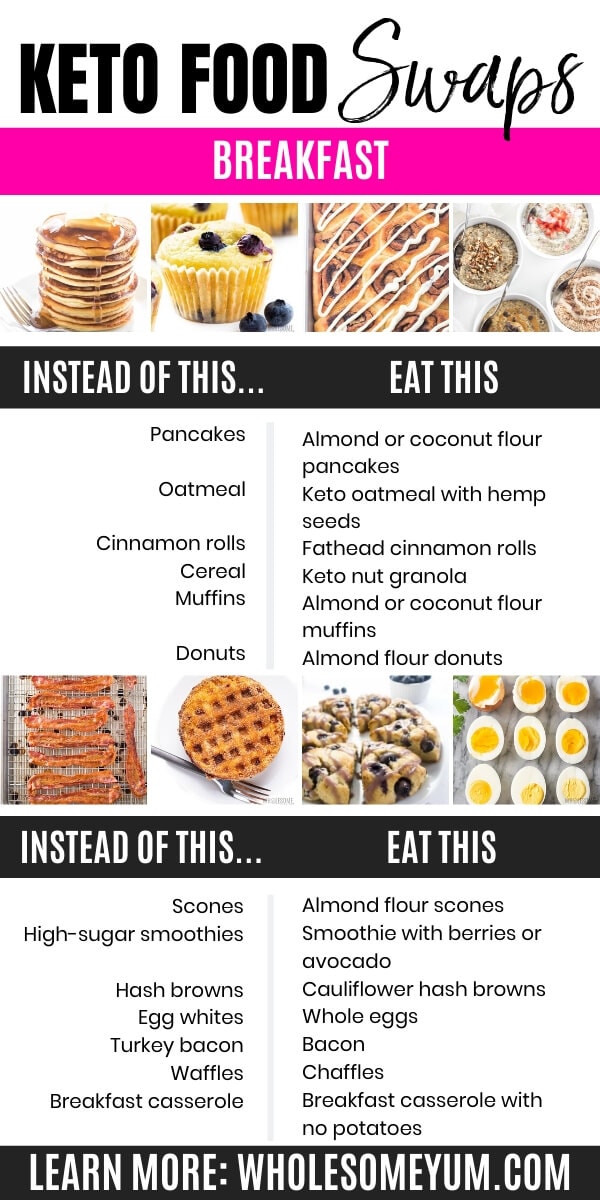
Keto Swaps For Breakfast
| Instead Of This… | Eat This |
|---|---|
| Pancakes | Almond flour pancakes or coconut flour pancakes |
| Oatmeal | Keto oatmeal with hemp seeds |
| Cinnamon rolls | Fathead cinnamon rolls |
| Cereal | Keto nut granola |
| Muffins | Almond flour muffins or coconut flour muffins |
| Donuts | Almond flour donuts |
| Scones | Almond flour scones |
| High-sugar smoothies | Smoothie with berries or avocado |
| Hash browns | Cauliflower hash browns |
| Breakfast casserole | Breakfast casserole with no potatoes |
| Egg whites | Whole eggs |
| Turkey bacon | Bacon |
| Waffles | Chaffles |
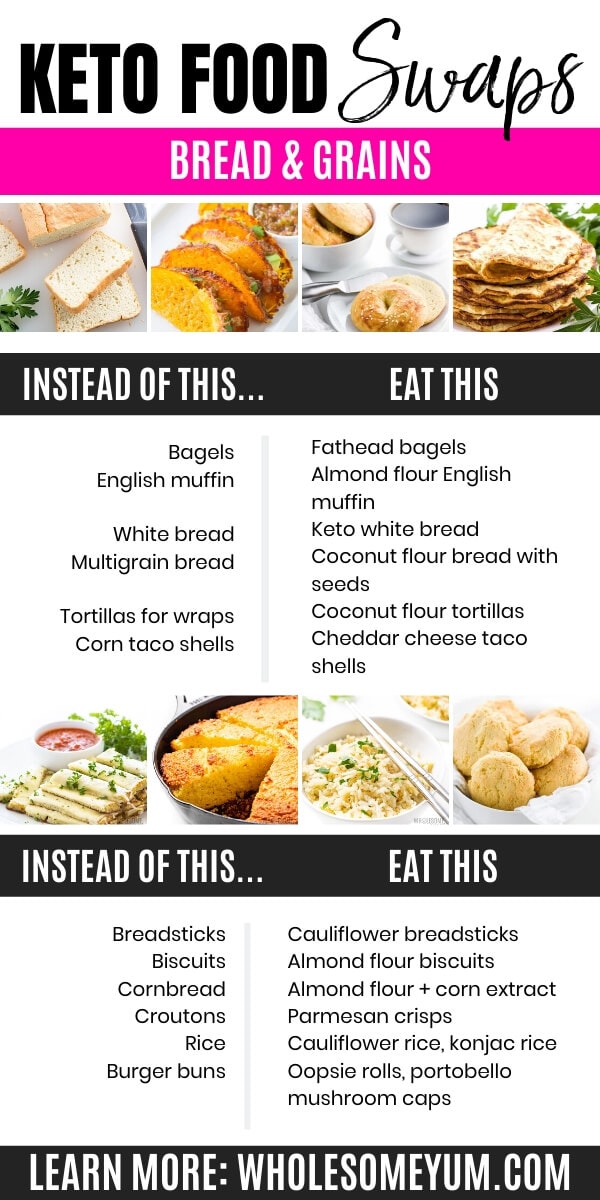
Keto Swaps For Bread
| Instead Of This… | Eat This |
|---|---|
| Bagels | Fathead bagels |
| English muffin | Almond flour English muffin |
| White bread | Keto white bread |
| Multigrain bread | Coconut flour bread with seeds |
| Tortillas for wraps | Coconut flour tortillas |
| Corn taco shells | Cheddar cheese taco shells |
| Burger buns | Oopsie rolls , portobello mushroom caps |
| Breadsticks | Cauliflower breadsticks |
| Biscuits | Almond flour biscuits |
| Cornbread | Almond flour cornbread |
| Croutons | Parmesan crisps |
| Rice | Cauliflower rice , konjac rice |
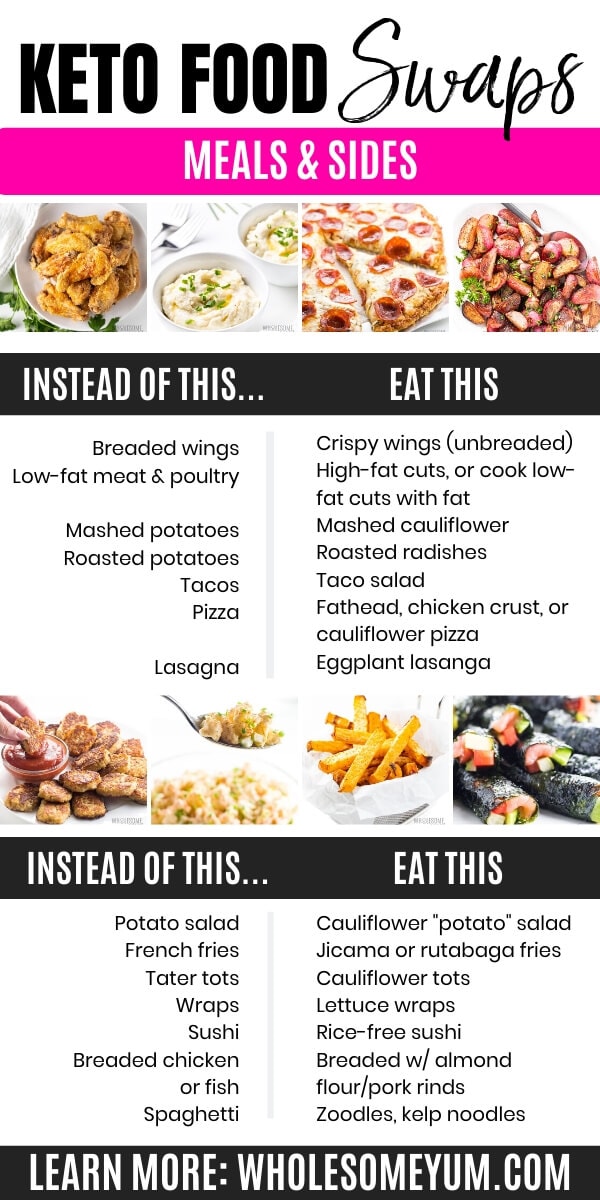
Keto Swaps For Meals & Side Dishes
| Instead Of This… | Eat This |
|---|---|
| Breaded wings | Crispy air fryer wings (unbreaded) |
| Low-fat meat & poultry | High-fat cuts, or cook low-fat cuts with fat |
| Mashed potatoes | Mashed cauliflower |
| Roasted potatoes | Roasted or fried radishes |
| Tacos | Taco salad |
| Pizza | Fathead crust , chicken crust , or cauliflower crust pizza |
| Lasagna | Eggplant lasagna |
| Potato salad | Cauliflower “potato” salad |
| French fries | Jicama , rutabaga , or zucchini fries |
| Tater tots | Cauliflower tots |
| Wraps | Lettuce wraps , almond flour tortillas |
| Sushi | Naruto-style or homemade rice-free sushi |
| Breaded chicken or fish | Breaded cuts with almond flour or pork rinds |
| Spaghetti | Zoodles , spaghetti squash , shirataki noodles, kelp noodles |
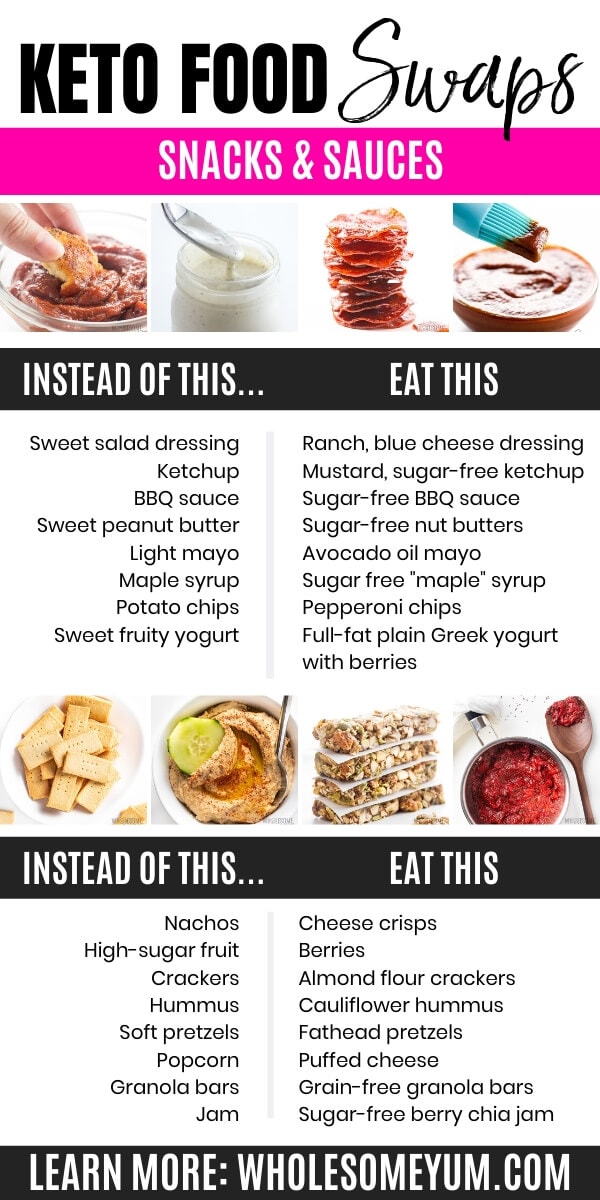
Keto Swaps For Snacks & Sauces
| Instead Of This… | Eat This |
|---|---|
| Nachos | Cheese crisps |
| High-sugar fruit | Berries & other keto fruits |
| Crackers | Almond flour crackers |
| Hummus | Cauliflower hummus |
| Soft pretzels | Fathead pretzels |
| Popcorn | Puffed cheese |
| Granola bars | Grain-free granola bars |
| Jam | Sugar-free berry chia jam |
| Sweet fruity yogurt | Full-fat plain Greek yogurt with berries |
| Sweet salad dressing | Ranch , blue cheese , or plain vinaigrette |
| Ketchup | Mustard and/or sugar-free ketchup |
| BBQ sauce | Sugar-free BBQ sauce |
| Sweetened peanut butter | Natural, sugar-free nut butters |
| Light mayo | Avocado oil mayo |
| Maple syrup | Sugar-free, maple flavored syrup |
| Potato chips | Zucchini chips , pepperoni chips , pork rinds |
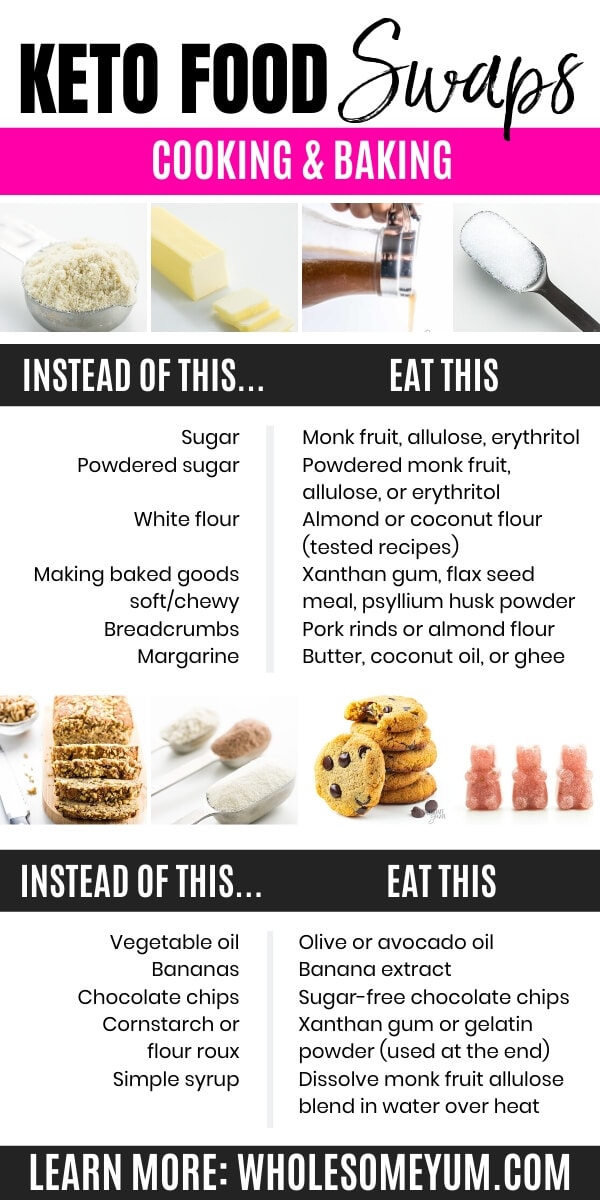
Keto Swaps For Cooking & Baking
| Instead Of This… | Eat This |
|---|---|
| Sugar | Monk fruit or allulose |
| Powdered sugar | Powdered monk fruit or allulose |
| White flour | Almond or Coconut flour (use in tested recipes) |
| Making baked goods soft/chewy | Xanthan gum, flax seed meal, psyllium husk powder |
| Breadcrumbs | Pork rinds or almond flour |
| Margarine | Butter, coconut oil, or ghee |
| Vegetable oil | Olive or avocado oil |
| Bananas | Banana extract |
| Chocolate chips | Sugar-free chocolate chips |
| Cornstarch or flour roux | Xanthan gum or gelatin powder (used at the end) |
| Simple syrup | Dissolve monk fruit allulose blend in water over heat |
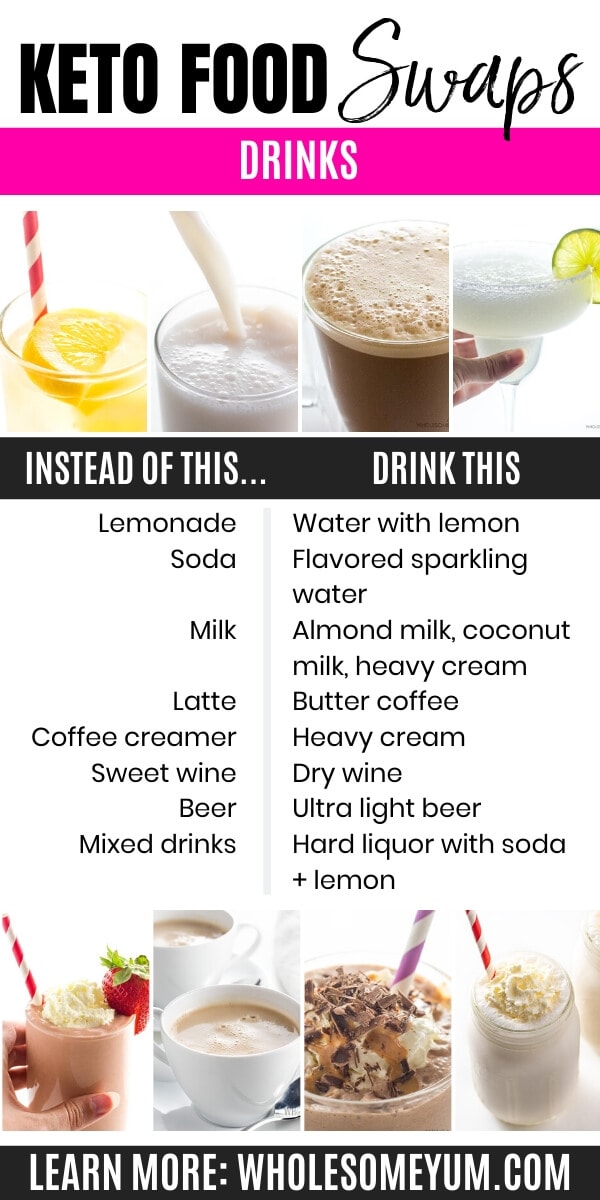
Keto Swaps For Drinks
| Instead Of This… | Eat This |
|---|---|
| Lemonade | Water with lemon |
| Soda | Flavored sparkling water |
| Milk | Almond milk, coconut milk, heavy cream |
| Latte | Butter coffee |
| Coffee creamer | Heavy cream |
| Sweet wine | Dry wine |
| Beer | Ultra light beer |
| Mixed drinks | Hard liquor with soda + lemon |
If you’re looking specifically for keto alcohol options, browse the full keto alcohol guide .
Keto Food List
When looking for a keto cheat sheet printable, the most-requested information is a keto food list.
The great thing is that keto doesn’t have to feel restrictive. It’s incredibly satisfying and there’s such a wide variety of foods you can eat!
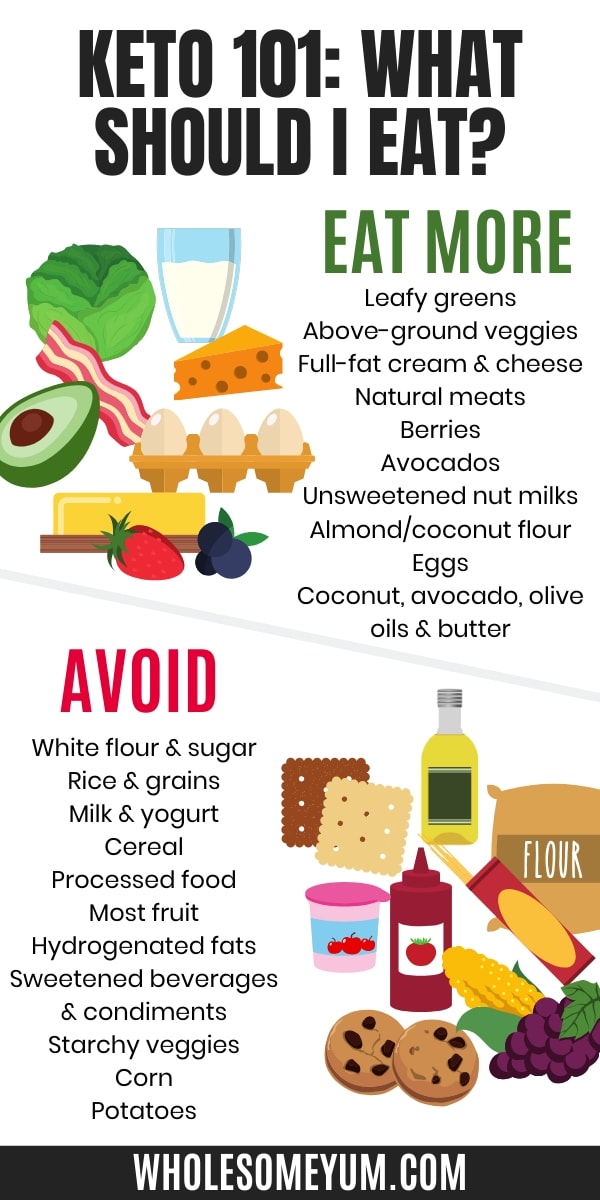
Foods To Eat On Keto
- Leafy greens – Such as spinach, chard, and lettuce.
- Above-ground veggies – Such as peppers, zucchini, and cauliflower.
- Full-fat cream & cheese – Such as heavy cream, sour cream, and full-fat hard cheeses.
- Natural meats – Such as beef, lamb, and pork.
- Berries – Such as raspberries, blackberries, and strawberries.
- Avocados
- Unsweetened nut milks – Such as almond milk and coconut milk.
- Almond flour and coconut flour
- Eggs
- Healthy fats – Such as coconut oil, avocado oil, olive oil and butter.
Foods To Avoid On Keto
- White flour & sugar
- Rice & grains – Such as barley, wheat, and corn.
- Milk & yogurt – Such as fruit on the bottom yogurt, sweetened Greek yogurt, and all milk.
- Cereal
- Processed food – Such as granola bars, candy
- Most fruit – Such as apples, bananas, and grapes
- Hydrogenated fats – Such as vegetable oil, soybean oil, and margarine
- Sweetened beverages & condiments – Such as soda, ketchup, and sweet dressings
- Starchy veggies – Such as peas, carrots, and beets.
- Potatoes – Such as sweet potatoes and white potatoes.
That’s the short keto diet cheat sheet version of all the keto food categories, but I recommend downloading the full Keto Cheat Sheet System. It includes a super detailed printable keto food list with over 100 items, including 2 color-coded pages with net carb counts, along with 6 more pages of keto cheat sheets:
Get The Keto Cheat Sheet System PDF (Only $37)
Electrolyte Basics
Getting enough electrolytes is crucial for anyone, but especially so on a keto diet. The reason is that ketosis has a diuretic effect, which increases excretion of water and electrolytes, especially sodium [ * ]. This is often the cause of the keto flu.
For more details on electrolytes and avoiding keto flu, check out the full keto flu guide here .
The important thing to know about electrolytes is that replenishing them will keep keto flu away and keep your body functioning well. I always recommend an electrolyte drink and whole food sources of anything your body needs before resorting to supplements, so I made a list of what to eat to get each of the 3 major electrolytes – sodium, magnesium and potassium.
Here’s your keto diet cheat sheet for getting electrolytes from food:
| Sodium | Magnesium | Potassium |
|---|---|---|
| Bone broth Boullion cubes Bacon Salted nuts Pickles | Seaweed Seeds Nuts Avocado Leafy greens | Potassium chloride Avocado Bone broth Spinach Broccoli Mushrooms Beef Pork |
Keto Diet Types
People follow a keto lifestyle for different reasons. Some do it just to lose weight, others are after better overall health, increased energy, and reduced inflammation.
Strictly speaking, the defining factor of a keto diet is the metabolic state of ketosis, which is achieved by restricting carbs. However, many people (myself included) also reduce or eliminate processed, inflammatory, or low-nutrient foods.
Below is your keto cheat sheet summary of the different ways that people follow keto. You choose what works best for your goals and lifestyle!
- Strict Keto – Up to 20-30g net carbs daily, count all calories and macros, and eat clean, unprocessed foods.
- Lazy Keto – Up to 20-30g net carbs daily, and track only net carbs OR eat keto foods without tracking.
- Dirty Keto – Up to 20-30g net carbs daily, with “if it fits your macros” approach including processed foods.
- Low Carb – Up to 50-100g net carbs daily, less strict.
For a more detailed listing of these different types of keto with pros and cons, grab the Easy Keto Cheat Sheet Printable PDF below!
Want The Keto Cheat Sheet Printable PDF System?
Get all this information and MORE in convenient printer-friendly format – 13 cheat sheet pages you can take with you anywhere or keep in your kitchen, plus 4 recipe cookbooks! Includes:
- Keto food list (230+ foods) – Super detailed & color-coded, with net carb counts, so you’ll know exactly what to eat.
- Foods to avoid on keto – Detailed and specific list so that you know exactly what to watch out for.
- Macros cheat sheet – Explains everything you need to know about macros to succeed on keto.
- Keto food swaps (60+ swaps) – Covers virtually every food you love, so you don’t have to miss out!
- Keto meal formula – With specific food ideas, so it’s easy to mix-and-match.
- Keto flu guide – Understand what it is and exactly how to avoid it.
- Electrolyte cheat sheet – With whole food ideas + bonus keto tips.
- Keto Diet Types – Summary of 4 ways to do keto, so you can choose what fits you best.
- FOUR (4!) Keto Swaps Recipe EBooks – Dozens of recipes to replace bread, rice, potatoes, pasta, desserts, and other carbs you’d otherwise miss.
Get The Printable Keto Cheat Sheet System (75 pages, Only $37!)
